On this page
- 01Key takeaways
- 02What is the difference between consistency and going viral?
- 03Why does consistency matter more than going viral?
- 04How do consistent and viral accounts compare?
- 05Does going viral ever help a business?
- 06How do platform algorithms treat consistent accounts?
- 07What does chasing viral content cost?
- 08How do you measure consistency?
- 09What does a consistent 12-week plan look like?
- 10When is consistency the wrong priority?
- 11What does this look like in practice?
- 12Which consistency guide do you need next?
- 13Your consistency checklist
- 14Next step
- 15Sources and further reading
- 16Frequently asked questions
Key takeaways
Consistency matters more than going viral on social media because buyers choose suppliers they recognise, and recognition is built by repeated, predictable visibility to the same people. A viral post reaches strangers once. A consistent account reaches the right people every week, which is what turns attention into enquiries for a UK business.
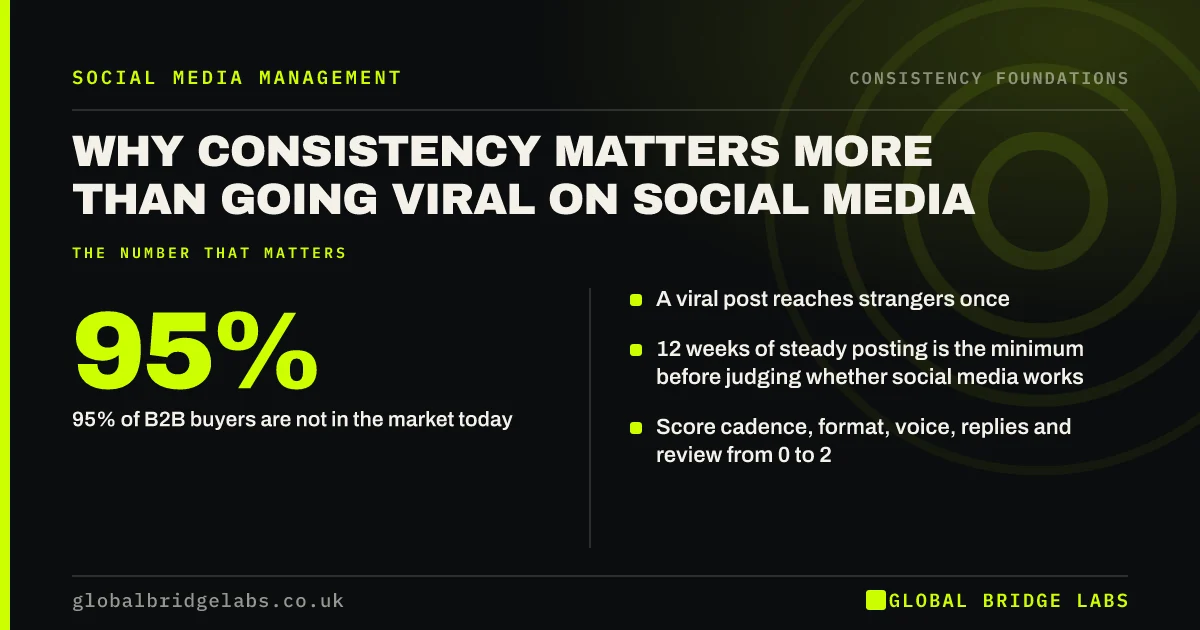
- 95% of B2B buyers are not in the market today. Consistency keeps you remembered for later.
- A viral post reaches strangers once. Consistent posts reach likely buyers every week.
- 12 weeks of steady posting is the minimum before judging whether social media works.
- Score cadence, format, voice, replies and review from 0 to 2. Below 6 is fragile.
- Pick a cadence you can hold in your worst month, not your best one.
Want to know how consistent your social media really is? Send us your profile links on WhatsApp and we will score it.
Chat on WhatsApp →What is the difference between consistency and going viral?
Social media consistency is showing up on a predictable schedule, in a recognisable style, with a steady message, for the same audience over months. Going viral is a single post reaching far beyond your usual audience, usually through shares and algorithmic recommendation, over a few days.
One is a system you control. The other is an outcome you cannot. That difference is the whole argument of this guide, written by Global Bridge Labs (GBL) for UK founders and marketing leads who are tired of being told the next post could change everything.
- Consistency: controllable, repeatable, compounds over time, reaches the same people repeatedly.
- Viral: uncontrollable, one-off, fades within days, reaches mostly people who will never buy.
Why does consistency matter more than going viral?
Consistency matters more because most of your future customers are not ready to buy today. When they become ready, they pick the supplier they remember. Research from the LinkedIn B2B Institute suggests only about 5% of business buyers are in the market at any one time. Repeated visibility is how you are still in mind when the other 95% arrive.
A viral post, by contrast, is mostly seen by people outside your market and forgotten within a week. It can be enjoyable and occasionally useful, but it does not build the memory structures that make someone call you six months later. Marketing effectiveness research from the IPA (The Long and the Short of It, Binet and Field) makes the same point at scale: brand effects build slowly and last, while short bursts fade quickly.
How do consistent and viral accounts compare?
The table below compares the two approaches on what a UK small business actually needs from social media: enquiries, trust and a predictable workload.
- Who sees it: consistent posting reaches followers and lookalikes; a viral post reaches mostly strangers.
- How long it lasts: consistency compounds for years; a viral spike fades within 3 to 7 days.
- Effect on enquiries: consistency produces a steady trickle that grows; viral produces noise, sometimes a brief spike.
- Control: you control cadence, format and message; you control almost nothing about virality.
- Workload: consistency is a fixed weekly routine; chasing viral is unpredictable and expensive.
- Risk: consistency is low risk; viral attention can turn negative in an afternoon.
Does going viral ever help a business?
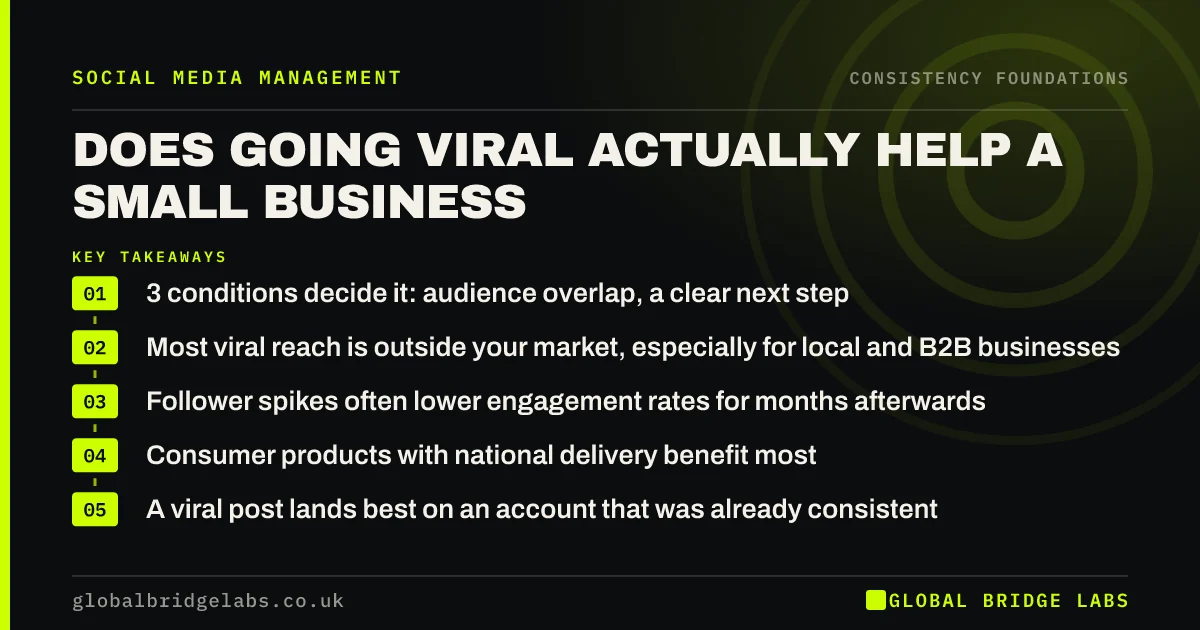
Yes, occasionally, and usually when the business was already consistent before the spike. A viral post helps when the audience it reaches overlaps with your buyers, when your profile gives new visitors a reason to stay, and when you can deliver on the demand it creates. Without those three, the spike is attention you cannot use.
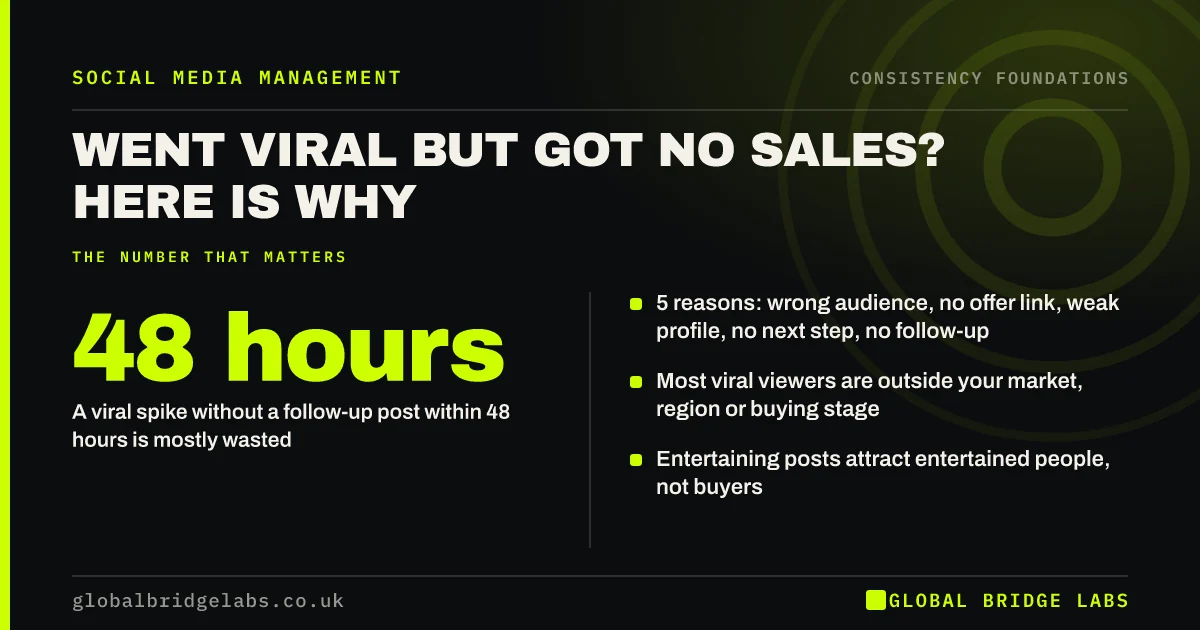
The pattern we see most often is the opposite: a post takes off, followers jump, and within a month engagement rates fall because the new followers were never interested in what the business sells. The account is bigger and weaker at the same time.
How do platform algorithms treat consistent accounts?
Platform algorithms rank each post on how likely a particular person is to engage with it, not on how famous the account is. TikTok states publicly that follower count and previous high-performing videos are not direct factors in its For You recommendations. A past viral hit does not guarantee future reach.
What consistency gives you is more chances. Every post is a fresh test with the people most likely to respond, and a steady stream of posts gives the platform more signals about who your content suits. LinkedIn describes its feed as ranked for relevance to each member; YouTube describes recommendations driven by what viewers watch and say they value. Relevance is earned repeatedly, not once.
What does chasing viral content cost?
Chasing viral content usually costs three to five times the hours of a steady routine, because trend-led posts need fast turnaround, more editing and more attempts. At the April 2026 National Living Wage of £12.71, a UK employee costs about £16.27 per worked hour once National Insurance and pension are added, so ten extra hours a week is roughly £8,500 a year in staff time alone.
The larger cost is what the chase displaces: the proof posts, the answers to buyer questions and the replies to comments that actually generate enquiries. Most UK SMEs using an agency pay £950–£2,500 a month for strategy, production and community management. That budget buys far more when it funds a system than when it funds lottery tickets.
Want to see what a consistent plan would cost against your current hours? Message us on WhatsApp for a costed plan.
Chat on WhatsApp →How do you measure consistency?
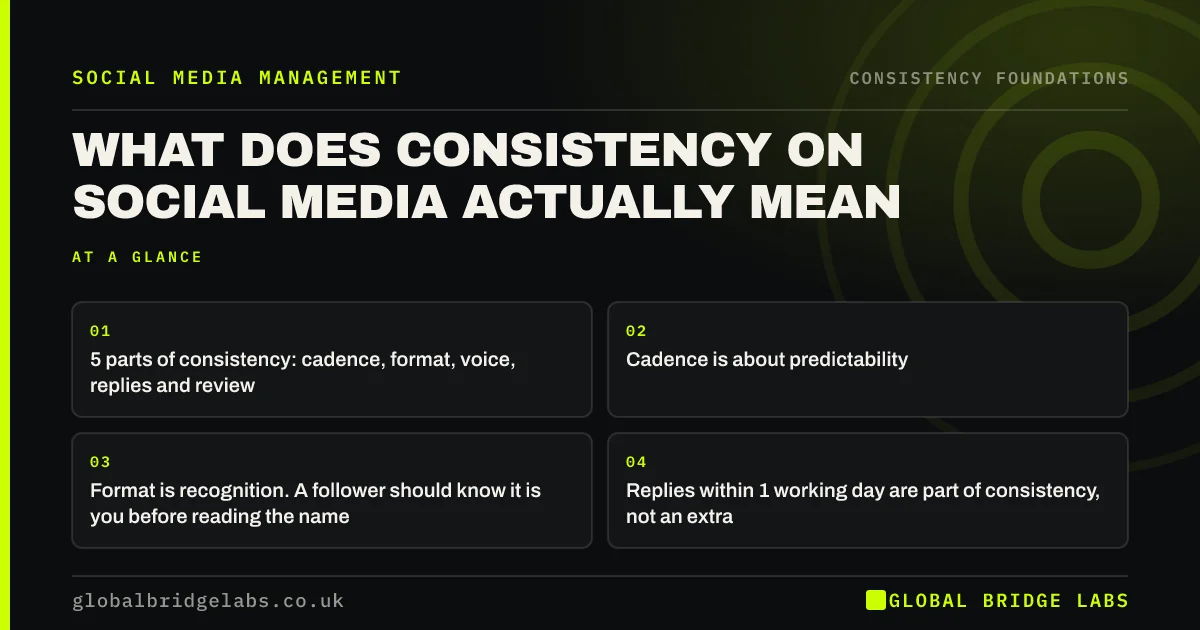
Measure consistency with the GBL Consistency Scorecard: five dimensions, each scored 0, 1 or 2, for a total out of 10. Cadence (did you post on plan in each of the last four weeks?), Format (would a follower recognise your post without the logo?), Voice (does every post sound like the same business?), Replies (are comments answered within one working day?) and Review (did you review the numbers last month and change something?).
A score of 8 to 10 is a healthy system. 6 to 7 is fragile and will break in the next busy month. 5 or below means the account is being run on good intentions. Most accounts we audit for the first time score between 4 and 6, and the weakest dimension is almost always Review.
What does a consistent 12-week plan look like?
A consistent plan is small enough to survive your worst month. For most UK small businesses that means one primary channel, two or three posts a week, and a fixed hour each week for replies. The plan below runs for 12 weeks, which is the minimum period before judging results.
- Week 1: choose one primary channel and a cadence you can hold in your busiest month.
- Week 1: write three recurring post formats, for example a proof post, a question answered and a behind-the-scenes post.
- Week 2: batch four weeks of posts in one half-day session and build a bank of five evergreen spares.
- Weeks 2 to 12: publish on the same days each week and reply to every comment within one working day.
- Every 4 weeks: score yourself on the GBL Consistency Scorecard and fix the weakest dimension.
- Week 12: compare enquiries, profile visits and branded searches with the 12 weeks before you started.
When is consistency the wrong priority?
Consistency is not a virtue on its own. Posting the wrong thing reliably is still posting the wrong thing, so if your content does not speak to buyers, fix the message before you fix the schedule. And if the business has no capacity to answer enquiries, a louder social presence makes the problem worse.
There are also moments when a burst is right: a launch, an event, a seasonal peak. The point is that bursts sit on top of a steady base rather than replacing it. A business with no base gets a spike and then silence, which looks worse to a prospect than steady modest activity.
What does this look like in practice?
A UK home improvement firm with 11 staff came to us after a video of one of its installations passed a million views. Followers rose sharply, enquiries did not, and within six weeks posting had stopped because nobody could match the viral hit. The account was bigger and quieter than before.
We replaced the chase with a three-post weekly routine: one finished job with the price range and timescale, one answered customer question, one team post. Nothing went viral. Over the following quarter, profile visits from the firm's own county rose steadily and the office began logging enquiries that mentioned seeing the posts. Across GBL social media clients, the average reach lift in the first 90 days is +184%, built on routines like this rather than on single hits.
Which consistency guide do you need next?
This guide is the hub of a 60-article series from Global Bridge Labs (GBL) on consistent social media. Start with the question that matches where your business is today.
- Not sure what consistency means in practice: start with the five parts of consistency.
- Wondering why results are slow: read how long social media takes and which early signals to watch.
- Short of time: start with minimum viable social media and a content bank.
- Just had a post take off: follow the 72-hour plan.
- Deciding who should run it: compare outsourcing for consistency and build the business case.
- Selling B2B or locally: read the guides for long sales cycles and local markets.
- What does consistency on social media actually mean?
- How long does social media take to work?
- Leading indicators that social media is working
- Minimum viable social media for busy business owners
- Build a social media content bank for quiet weeks
- A post went viral: what to do in the next 72 hours
- Should you outsource social media to stay consistent?
- The business case for consistent social media
- B2B social media when the sales cycle is long
- Why local businesses gain little from viral reach
- Going viral myths that waste small business time
- How consistent posting builds trust with buyers
Your consistency checklist
- Write down your cadence per channel and check it survives your busiest month.
- Create three recurring formats so you never start from a blank page.
- Keep a bank of five evergreen posts for weeks that go wrong.
- Block one fixed hour a week for replies and comments.
- Score yourself on the GBL Consistency Scorecard every four weeks.
- Judge results after 12 weeks, not after one post.
- Track enquiries and branded searches, not only likes and views.
Next step
Stop measuring your social media against the one post that took off. Measure it against whether the right people saw you this week, last week and the week before. That is what buyers remember, and it is the part you control.
Message us on WhatsApp and we will score your account on the GBL Consistency Scorecard and send back the three fixes that matter most.
Chat on WhatsApp →Sources and further reading
- The 95-5 rule: most B2B buyers are out of market · LinkedIn B2B Institute
- The Long and the Short of It: balancing short and long-term marketing strategies · IPA
- How TikTok recommends videos #ForYou · TikTok Newsroom
- LinkedIn relevance: optimising the member experience · LinkedIn Help
- How YouTube works: recommendations · YouTube
- National Minimum Wage and National Living Wage rates · GOV.UK
Frequently asked questions
Is it better to be consistent or go viral on social media?
For almost every business, consistency is better. It reaches likely buyers repeatedly, builds recognition and produces a predictable flow of enquiries. Going viral reaches mostly strangers once, fades within days and cannot be planned. A viral moment is most useful when it lands on an account that was already consistent.
How long does it take for consistent posting to work?
Allow 12 weeks of steady posting before judging results. Early signals such as profile visits and saves usually move within 3 to 4 weeks, while enquiries and branded searches take longer. Changing strategy every few weeks resets the clock and is the most common reason small businesses decide social media does not work.
Can a small business go viral on purpose?
Not reliably. You can raise the odds with strong hooks, timely topics and native formats, but platforms decide distribution post by post and outcomes are highly unpredictable. Planning a business around a viral hit is like planning cash flow around a lottery win. Plan around consistency and treat virality as a bonus.
How often should I post to be consistent?
Consistency is about predictability, not volume. Two or three posts a week on one primary channel, held for a year, beats daily posting that stops after a month. Choose the highest cadence you can maintain in your busiest month, then keep to the same days so followers and platforms learn your rhythm.
Does going viral increase sales?
Sometimes, but less often than people expect. Viral reach is mostly outside your market, so sales only follow when the audience overlaps with your buyers, your profile converts visitors and you can meet demand. Many businesses see follower growth without enquiries, followed by falling engagement once the spike fades.
Written by

Global Bridge Labs (GBL) is a UK–Sri Lanka partner for social media, websites and BPO. Everything here comes from client delivery, not theory.