On this page
- 01Key takeaways
- 02What is viral content and what is consistent content?
- 03How do viral and consistent content compare?
- 04Which one generates more enquiries?
- 05How should you combine the two?
- 06When should you favour viral-style content?
- 07What does this look like in practice?
- 08Next step
- 09Sources and further reading
- 10Frequently asked questions
Key takeaways
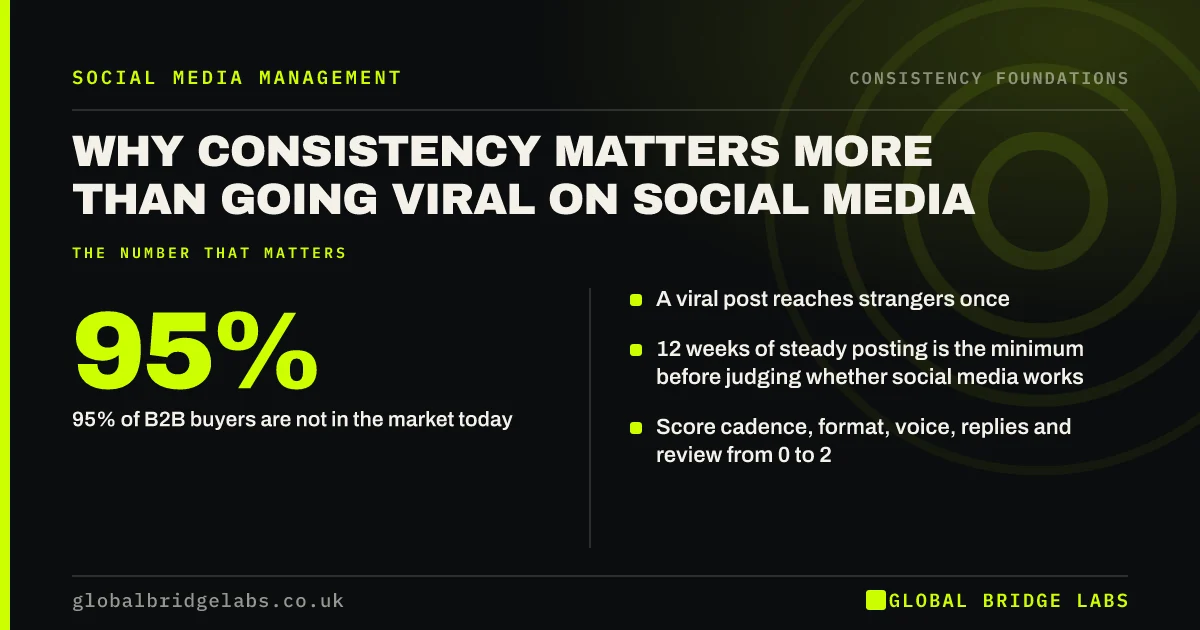
Viral content delivers a short burst of reach, mostly to strangers. Consistent content delivers repeated reach to likely buyers, recognition and a steady flow of enquiries. For most UK businesses consistent content is the foundation, and viral-style experiments are an occasional extra on top of it.
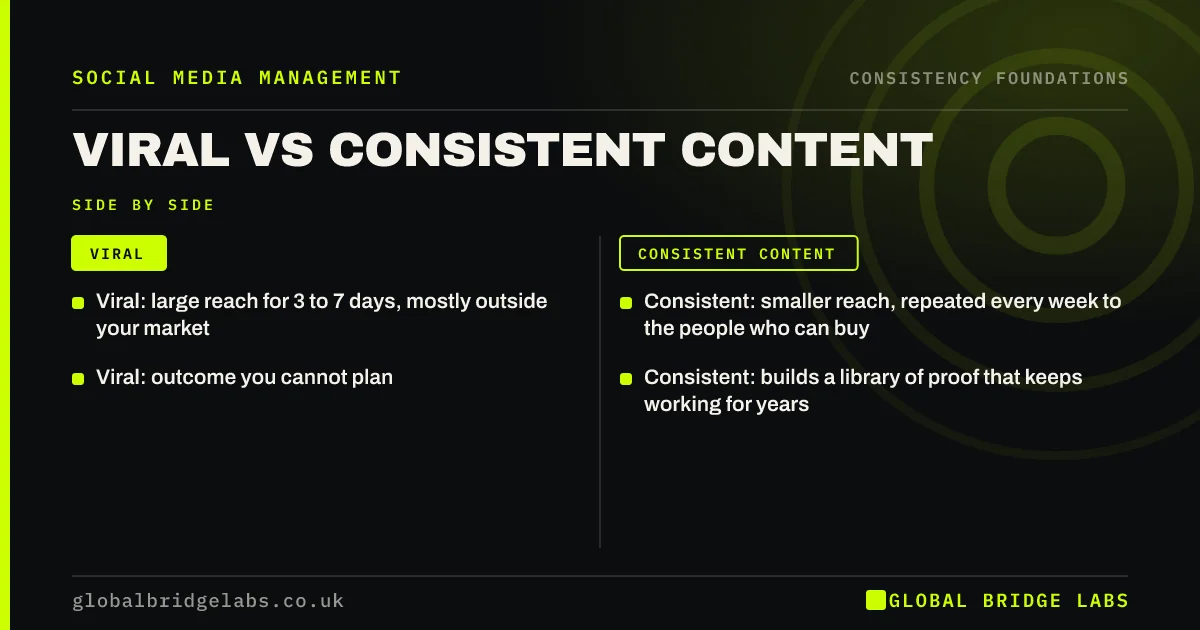
- Viral: large reach for 3 to 7 days, mostly outside your market.
- Consistent: smaller reach, repeated every week to the people who can buy.
- Viral: outcome you cannot plan. Consistent: routine you can budget and staff.
- Consistent: builds a library of proof that keeps working for years.
- Viral: high variance, including negative attention. Consistent: low risk.
Want to know the right mix of steady and experimental content for your business? Message us on WhatsApp.
Chat on WhatsApp →What is viral content and what is consistent content?
Viral content is a post designed or lucky enough to spread far beyond your usual audience through shares and recommendations. Consistent content is a planned series of posts published on a predictable schedule, in a recognisable format, aimed at the same buyers.
They are not opposites in quality. A good consistent post can go viral, and a viral post can be poorly made. The difference is intent: one aims for maximum reach once, the other for reliable reach repeatedly.
How do viral and consistent content compare?
- Audience: viral reaches broad strangers; consistent reaches followers and similar buyers.
- Duration: viral peaks within days; consistent keeps working as the library grows.
- Enquiries: viral is unpredictable and often low; consistent is steadier and rises over time.
- Cost: viral attempts take 3 to 5 times longer per post; consistent formats get cheaper.
- Control: viral depends on the algorithm and luck; consistent depends on your routine.
- Risk: viral can attract criticism or the wrong audience; consistent carries little risk.
- Brand: viral may become associated with one post; consistent builds a broad reputation.
Which one generates more enquiries?
For most small and medium UK businesses, consistent content generates more enquiries over a year. Enquiries come from people in your market who are ready to buy, and consistency keeps you visible to them across the months when they become ready. A viral post may produce a short spike, but it usually fades back to the baseline within weeks.
The exception is a consumer product that can be bought instantly online. There, a viral post can produce real sales in hours, provided stock and fulfilment keep up.
How should you combine the two?
Treat consistent content as the base and viral-style experiments as a small, deliberate addition. A practical split is four posts in five aimed at buyers in recognisable series, and one in five testing a wider-reach idea such as a strong opinion, a trend format or a surprising story.
- Keep the base schedule fixed, whatever happens with experiments.
- Run experiments inside your brand voice, not in someone else's style.
- Judge experiments on profile visits and enquiries, not only views.
- If an experiment works, turn it into a series rather than chasing the next hit.
Want us to design a four-in-five plan for your channels? Message us on WhatsApp.
Chat on WhatsApp →When should you favour viral-style content?
When you sell nationally online, when you are launching something and need a burst of awareness, or when a steady base is already in place and you want to test new audiences. Even then, the viral attempt works best when it points clearly to your offer and when the profile behind it is active and credible.
What does this look like in practice?
A UK skincare brand ran two months of trend-led videos aiming for reach. Two did very well, most did not, and sales moved only around the two hits. In the next two months it switched to a steady series: a customer routine on Mondays, an ingredient explainer on Wednesdays and a behind-the-scenes post on Fridays, with one experimental post a week.
Total views were lower. Repeat purchases, saves and direct messages asking about products were higher, and weekly sales were steadier. The brand kept the experiments, but they became the extra rather than the plan.
Next step
Audit your last 20 posts and label each as consistent or viral-style. If more than one in five are reach experiments, rebalance towards buyer-focused series and judge the change after 12 weeks.
Send us your last 20 posts on WhatsApp and we will tell you whether your mix is working.
Chat on WhatsApp →Sources and further reading
- How TikTok recommends videos #ForYou · TikTok Newsroom
- The Long and the Short of It: balancing short and long-term marketing strategies · IPA
- The 95-5 rule: most B2B buyers are out of market · LinkedIn B2B Institute
Frequently asked questions
Is viral content better than consistent content?
Not for most businesses. Viral content produces short bursts of reach, mostly to people outside your market. Consistent content keeps you visible to likely buyers every week and builds recognition and enquiries over time. Viral-style posts are best used as occasional experiments on top of a consistent base.
Can consistent content go viral?
Yes. Well-made posts in a regular series sometimes spread widely, especially when they tap into a common problem or strong opinion. When that happens, the consistent account behind the post is ready to hold onto the new attention, which is why viral moments work best for accounts that are already steady.
What percentage of posts should aim to go viral?
A sensible rule for most UK businesses is no more than about one post in five. The rest should serve buyers through recognisable series such as proof, advice and behind-the-scenes posts. Consumer brands selling nationally online can reasonably experiment a little more.
Does viral content build a brand?
Only sometimes, and often narrowly. A viral post can make a business known for one moment rather than for what it does. Brands are built by repeated, consistent exposure to the right people, which is why steady posting usually contributes more to brand recognition than a single hit.
Written by

Global Bridge Labs (GBL) is a UK–Sri Lanka partner for social media, websites and BPO. Everything here comes from client delivery, not theory.