On this page
- 01Short answer
- 02Why does consistency matter more than volume?
- 03What is the right frequency per channel?
- 04Can you post too often?
- 05How do you calculate your real capacity?
- 06Should frequency change over time?
- 07What does this look like in practice?
- 08What happens if you cannot hit your cadence?
- 09Next step
- 10Sources and further reading
- 11Frequently asked questions
Short answer
Three posts a week per channel is the right target for most UK small businesses. It is frequent enough for platforms to distribute you consistently and light enough to hold through a busy quarter. The correct frequency is the highest one you can maintain in your worst month, not your best.
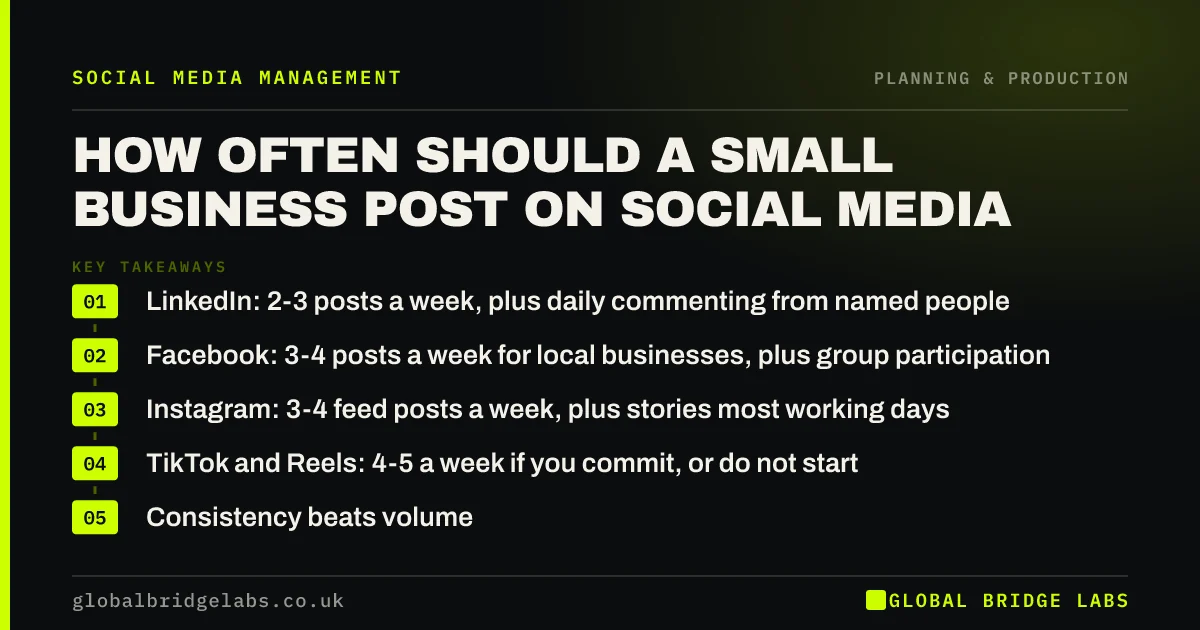
- LinkedIn: 2-3 posts a week, plus daily commenting from named people.
- Facebook: 3-4 posts a week for local businesses, plus group participation.
- Instagram: 3-4 feed posts a week, plus stories most working days.
- TikTok and Reels: 4-5 a week if you commit, or do not start.
- Consistency beats volume. Two a week for a year beats seven a week for six weeks.
Want a cadence set against your real capacity? Message us on WhatsApp.
Chat on WhatsApp →Why does consistency matter more than volume?
Two reasons, one algorithmic and one human. Platforms distribute accounts that publish predictably more reliably than accounts that spike and disappear, because prediction is what recommendation systems are built to do.
The human reason matters more. A prospective customer who checks your profile and sees a gap since last spring draws a conclusion about the business, not about your marketing. In competitive UK trades and hospitality markets, that alone loses enquiries.
What is the right frequency per channel?
Frequency should follow the production cost of the format and the pace of the feed, not a universal number.
- Text-led channels tolerate lower frequency because each post carries more.
- Visual feeds need more volume because individual posts are consumed in under two seconds.
- Short-video platforms reward volume most aggressively, which is why they are the most expensive commitment.
- Stories and status formats are not posts. They are presence, and daily is fine.
Can you post too often?
Yes, in two ways. Publishing several times a day on a feed-based channel splits your own reach, because platforms rarely show one account twice to the same person in a short window. And volume without a corresponding rise in quality trains an audience to scroll past you.
The practical ceiling for a small business is roughly one feed post a day per channel. Above that, you are competing with yourself.
How do you calculate your real capacity?
Multiply the posts you want by the honest hours each takes, then compare that with the hours you have protected in a calendar, not the hours you hope to find.
A realistic set of averages for a small team: a text post is 20-30 minutes including research, a photo carousel is 45-60 minutes, a short video is 60-90 minutes including filming and captions, and community replies take 20-30 minutes a day. At three posts a week across two channels, that is roughly 6-8 hours a week in total.
If the arithmetic does not work, the honest options are lower cadence, fewer channels, or outsourced production. Pretending is not one of them.
Send us your available hours on WhatsApp and we will tell you what cadence is realistic.
Chat on WhatsApp →Should frequency change over time?
Start lower than you think and raise it only after eight weeks of holding the baseline. Rising frequency is easy to sustain psychologically; falling frequency reads as decline to both the algorithm and your audience.
Increase frequency when a specific pillar is consistently producing conversations, and increase it in that pillar rather than across the board.
What does this look like in practice?
A pattern in hospitality: daily Instagram posting that burns out the one person doing it, with engagement concentrated on two posts a week and the rest disappearing.
Cutting to four a week and moving the reclaimed time into stories and replies usually raises total reach, because the posts that remain are the formats that were working and nothing is competing with itself for the same audience on the same day.
What happens if you cannot hit your cadence?
Lower the number and hold the new one, rather than repeatedly missing the old one. A cadence you meet half the time is worse than a lower one you always meet, because the gaps are what both your audience and the platform register.
When capacity drops, cut channels before cutting cadence. Two posts a week on one channel beats one post a week on two, because the remaining channel keeps enough rhythm to be distributed while the other carries a pinned signpost until you return to it.
Recovery is straightforward. Resume at the sustainable number without apologising or double-posting to catch up, since publishing several times in one day splits your own reach and does not recover the missed weeks.
- Cut channels before cutting cadence.
- Publish from your evergreen bank rather than leaving a visible gap.
- Never double-post to catch up.
- Reset the number honestly and hold it for eight weeks before judging anything.
Next step
The right cadence is a resourcing decision dressed as a marketing one. It takes half an hour to get right and it determines everything downstream.
Message us on WhatsApp and we will set a posting cadence you can hold for twelve months.
Chat on WhatsApp →Sources and further reading
- Online Nation: how the UK uses online services · Ofcom
- LinkedIn Pages best practices · LinkedIn
Frequently asked questions
How many times a week should a small business post?
Three times a week per channel, on two channels, is the target that works for most UK small businesses. It is enough for consistent distribution and light enough to survive a busy quarter without gaps that undo the previous months of work.
Is posting once a week enough?
It is enough to avoid looking dormant but rarely enough to build momentum on feed-based channels. If once a week is your genuine ceiling, put the effort into one strong proof post and daily community replies rather than spreading it thinner.
Does posting more often increase reach?
Up to about one feed post a day per channel, yes. Beyond that you compete with yourself, because platforms rarely show the same account twice to one person in a short window. Quality and consistency scale better than raw volume.
Should I post on weekends?
Test it rather than assume. B2C and hospitality often see strong weekend engagement; B2B usually does not. The bigger issue is that weekend posts generate comments and messages nobody answers until Monday, which costs more than the extra reach is worth.
Written by

Global Bridge Labs (GBL) is a UK–Sri Lanka partner for social media, websites and BPO. Everything here comes from client delivery, not theory.