On this page
- 01Key takeaways
- 02What is minimum viable social media?
- 03What does it include?
- 04Why is one post a week enough?
- 05How do you fit it into one hour a week?
- 06When is minimum viable not enough?
- 07What does this look like in practice?
- 08What does minimum viable social media cost?
- 09Your minimum viable checklist
- 10Next step
- 11Sources and further reading
- 12Frequently asked questions
Key takeaways
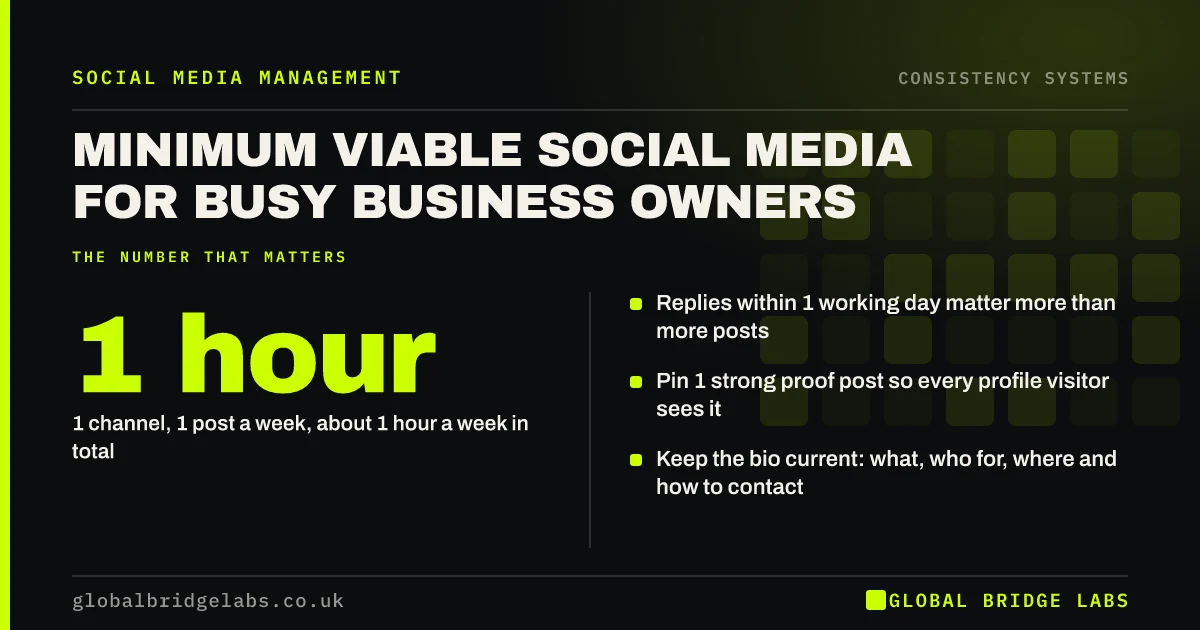
Minimum viable social media is the smallest consistent presence that stops prospects doubting you and keeps you visible to existing followers. For most busy owners it is one channel, one post a week, replies within a working day and a pinned proof post, which takes about one hour a week.
- 1 channel, 1 post a week, about 1 hour a week in total.
- Replies within 1 working day matter more than more posts.
- Pin 1 strong proof post so every profile visitor sees it.
- Keep the bio current: what, who for, where and how to contact.
- Consistent and small beats ambitious and abandoned.
Want a one-hour-a-week plan for your business? Message us on WhatsApp.
Chat on WhatsApp →What is minimum viable social media?
Minimum viable social media is a deliberately small, sustainable social media routine designed to protect trust and maintain visibility with the least possible time. It accepts that the business cannot run a full content programme and focuses on the few actions that matter most.
What does it include?
- An up-to-date profile: bio, contact details, service area and opening hours.
- One pinned post showing your best work or a strong customer review.
- One post a week, ideally a finished job or answered question.
- Replies to comments and messages within one working day.
- A quarterly check that links, details and pinned posts are current.
Why is one post a week enough?
Because the main job of minimum viable social media is not reach but reassurance. A prospect checking your profile needs to see recent activity and real work. One genuine post a week proves you are active; a gap of months raises doubts. For businesses whose enquiries come mainly from referrals or search, that reassurance is what social media mainly does.
How do you fit it into one hour a week?
- 10 minutes: take one photo or short video of a job, product or team member.
- 15 minutes: write a specific caption with the what, where and result.
- 20 minutes: check and reply to comments and messages across the week.
- 15 minutes: once a month, batch four posts ahead if you can.
Want caption templates that make this faster? Message us on WhatsApp.
Chat on WhatsApp →When is minimum viable not enough?
When social media is expected to generate new demand rather than support existing demand. If you need enquiries from people who have never heard of you, you need more frequency, more formats and probably paid support. Minimum viable is a floor to stand on, not a growth plan.
What does this look like in practice?
A UK plumbing firm owner had no time for social media and his Facebook page had been silent for a year. We set up minimum viable: a fresh bio, a pinned review and one finished-job post each Friday, written from photos his engineers sent over WhatsApp. It took him under an hour a week. Several customers mentioned they had checked the page and felt reassured by the recent jobs.
What does minimum viable social media cost?
About one hour a week of owner or staff time. At around £16.27 per worked hour for a UK employee on the April 2026 National Living Wage, that is under £900 a year in staff time. Outsourced, a basic publishing service in the UK typically starts around £500 a month, which is more than most businesses need for this level.
The cost of not doing it is harder to see: prospects who check an abandoned profile and quietly choose someone else.
Your minimum viable checklist
- Bio says what you do, who for, where and how to contact you.
- Contact details, links and opening hours are correct.
- One strong proof post is pinned.
- One genuine post goes out each week on the same day.
- Comments and messages are answered within one working day.
- Google Business Profile details match your social profile.
Next step
Update your bio, pin your best proof post and set a weekly reminder for one post and a replies check. Hold it for three months before deciding whether to do more.
Message us on WhatsApp and we will set up your minimum viable presence with you.
Chat on WhatsApp →Sources and further reading
- Google Business Profile Help · Google
- Meta Business Help Centre · Meta
- Tips to improve your local ranking on Google · Google Business Profile Help
Frequently asked questions
What is the minimum a business should do on social media?
Keep one profile up to date, pin a strong proof post, publish one genuine post a week and reply to comments and messages within one working day. That is enough to reassure prospects and stay visible to existing followers.
Is posting once a week enough for a business?
For a minimum viable presence, yes. It shows the business is active and gives prospects evidence of real work. It will not generate much new reach, so businesses that need social media for new demand should post more often.
Can a business skip social media entirely?
Some can, especially if they rely on referrals and have a strong Google Business Profile. But many buyers check social profiles, and an abandoned profile can do more harm than having none. If you have a profile, keep it minimally active or close it properly.
How much time does a small business need for social media?
About an hour a week for a minimum viable presence, three to five hours for a consistent growth routine on one channel, and more for video-led or multi-channel plans. Batching and templates reduce the time.
Which platform is best for minimum viable social media?
The one your customers are most likely to check. For many UK local businesses that is Facebook, alongside a Google Business Profile. For B2B firms it is usually LinkedIn. For visual consumer businesses it may be Instagram. Choose one and keep it active.
Written by

Global Bridge Labs (GBL) is a UK–Sri Lanka partner for social media, websites and BPO. Everything here comes from client delivery, not theory.