On this page
- 01Key takeaways
- 02Does the algorithm reward consistent posting?
- 03What do the platforms actually say?
- 04How does consistency help with ranking signals?
- 05Does posting more often help more?
- 06Does posting at the same time every week matter?
- 07When does consistency not help reach?
- 08What does this look like in practice?
- 09What does a steady account build that a gappy one lacks?
- 10Your algorithm-friendly consistency checklist
- 11Next step
- 12Sources and further reading
- 13Frequently asked questions
Key takeaways
Posting consistently helps with algorithms indirectly rather than directly. Platforms rank each post on how likely each viewer is to engage with it, not on a posting streak. But consistency gives the platform more recent signals about who likes your content, keeps followers in the habit of engaging, and gives you more chances to be shown to the right people.
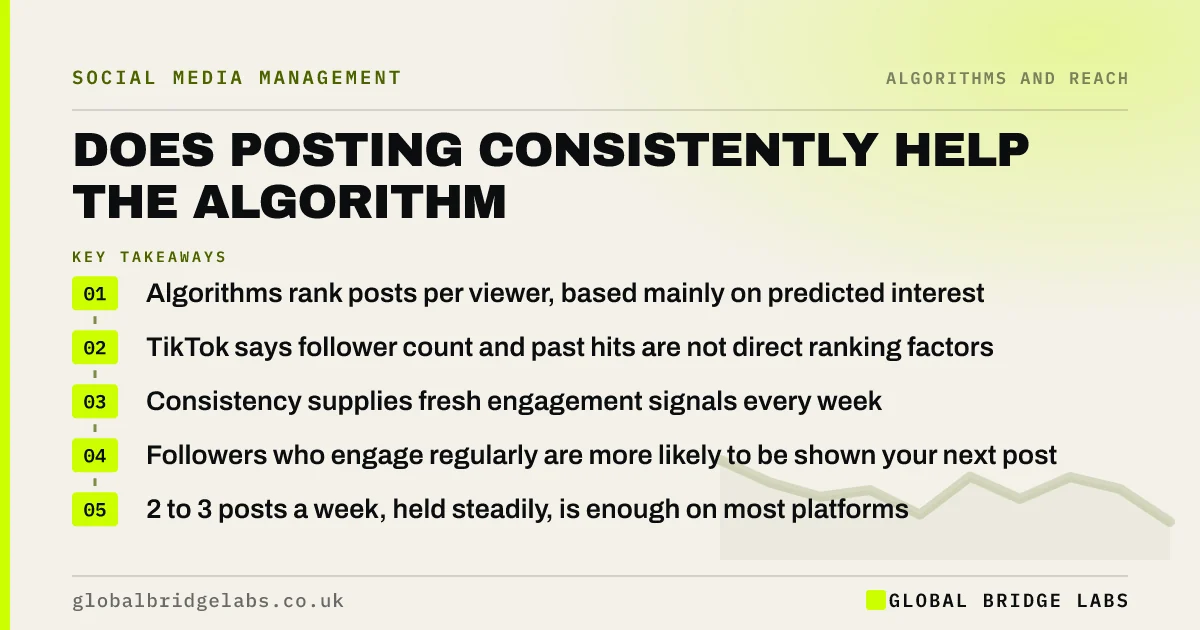
- Algorithms rank posts per viewer, based mainly on predicted interest.
- TikTok says follower count and past hits are not direct ranking factors.
- Consistency supplies fresh engagement signals every week.
- Followers who engage regularly are more likely to be shown your next post.
- 2 to 3 posts a week, held steadily, is enough on most platforms.
Want to know what your platforms are rewarding right now? Send us your analytics screenshots on WhatsApp.
Chat on WhatsApp →Does the algorithm reward consistent posting?
Not as a rule in itself. No major platform publishes a bonus for posting on a schedule. What platforms describe is ranking each post for each viewer based on predicted interest, using signals such as past interactions with the account, the content of the post and how early viewers respond.
Consistency matters because those signals are built through regular activity. An account that posts weekly generates a steady flow of interactions that tell the platform who its audience is. An account that posts sporadically gives the platform far less to go on.
What do the platforms actually say?
- TikTok: recommendations are based on user interactions, video information and settings; follower count and previous high-performing videos are not direct factors.
- LinkedIn: the feed is ranked for relevance to each member, drawing on connections, interests and engagement.
- YouTube: recommendations reflect what viewers watch, how long they watch and what they say they value in surveys.
- Meta (Facebook and Instagram): feeds are ranked using predictions about what each person is likely to engage with.
How does consistency help with ranking signals?
Consistency helps in three ways. First, regular posts give regular followers regular opportunities to interact, and platforms use past interactions to decide who sees future posts. Second, a steady stream of posts means more data about which topics and formats your audience responds to. Third, followers who expect your posts are more likely to engage early, and early engagement is a common ranking input.
The reverse is also true. After a long gap, the interaction history between your account and your followers is older, and your first posts back often reach fewer people until that history rebuilds.
Does posting more often help more?
Only up to the point where quality and engagement hold. Posting more often than your audience wants can lower average engagement per post, which does not help. For most UK small businesses, two or three good posts a week on a primary channel is the practical sweet spot.
Short-form video platforms reward higher volume more than LinkedIn or Facebook do, but only if you can sustain it. Four or five videos a week for a month followed by silence is worse than two a week indefinitely.
Want a cadence matched to your platforms and your hours? Message us on WhatsApp.
Chat on WhatsApp →Does posting at the same time every week matter?
The exact time matters less than people think; predictability matters more. Posting on the same days helps your followers form a habit and helps your team keep the routine. Posting when your audience is active helps early engagement, which is a useful ranking signal.
When does consistency not help reach?
When the content is not relevant to the audience. Posting weekly content that nobody engages with teaches the platform that your posts are not interesting, and reach falls. Consistency multiplies whatever you post; it cannot rescue content that does not suit the people you want to reach.
What does this look like in practice?
A UK training provider posted in bursts around course launches and was frustrated that each launch post reached fewer people. We moved it to three posts a week between launches: tips from trainers, learner stories and practical explainers. Launch posts that followed reached noticeably more followers, because the audience had been interacting with the account throughout the quarter.
What does a steady account build that a gappy one lacks?
A steady account builds a recent, continuous record of who engages with it. Each week of posting adds fresh interactions from followers, which platforms use to decide who sees the next post. A sporadic account has long gaps in that record, so each return starts with weaker information about its audience.
- Recent interactions: followers who engaged last week are more likely to be shown this week's post.
- Topic signals: repeated posts on the same themes help platforms match you to interested people.
- Habit: followers who expect your posts look for them and engage earlier.
- Your own data: steady posting gives you enough posts each month to compare formats fairly.
Your algorithm-friendly consistency checklist
- Post on the same days each week at a cadence you can hold.
- Keep each post aimed at one clear buyer.
- Reply to comments within one working day to keep conversations going.
- Use the native format each platform currently favours.
- Avoid engagement bait, bought followers and deleting underperforming posts.
- Review monthly which posts earned saves, shares and replies from buyers.
Next step
Stop trying to game the algorithm with streaks. Post consistently, aim each post at people likely to engage, and review monthly which posts earned interactions from your buyers.
Message us on WhatsApp and we will review what your last 30 posts taught the algorithm about your audience.
Chat on WhatsApp →Sources and further reading
- How TikTok recommends videos #ForYou · TikTok Newsroom
- LinkedIn relevance: optimising the member experience · LinkedIn Help
- How YouTube works: recommendations · YouTube
- Meta Business Help Centre · Meta
Frequently asked questions
Does the algorithm punish you for not posting?
Platforms do not publish a penalty for gaps, but after a long break your interaction history with followers is older and your first posts back often reach fewer people. Reach usually recovers as engagement rebuilds. Steady posting avoids the dip.
Is it better to post every day for the algorithm?
Not usually. Daily posting only helps if quality and engagement hold. For most small businesses two or three strong posts a week on a primary channel performs better than daily posts that are rushed or that the team cannot sustain.
Do algorithms favour accounts with more followers?
Less than people assume. TikTok says follower count is not a direct ranking factor, and other platforms rank posts on predicted relevance for each viewer. More followers can mean more initial viewers, but relevance and engagement matter more than size.
How long does it take for the algorithm to learn my audience?
Platforms learn from every post, but most businesses see clearer patterns after 8 to 12 weeks of consistent posting. That is enough data for the platform, and for you, to see which topics and formats your audience responds to.
Does posting at the same time every day help the algorithm?
Posting at a consistent time helps your team keep the routine and can help followers form a habit, but platforms do not publish a bonus for exact timing. Posting when your audience is active helps early engagement, which is a useful ranking signal. Predictable days matter more than exact minutes.
Written by

Global Bridge Labs (GBL) is a UK–Sri Lanka partner for social media, websites and BPO. Everything here comes from client delivery, not theory.