On this page
- 01Key takeaways
- 02Why does the business case matter?
- 03What should the business case include?
- 04How do you cost it?
- 05What outcomes should you promise?
- 06How do you frame the long-term value?
- 07What risks should you include?
- 08What does this look like in practice?
- 09What does a one-page summary look like?
- 10Which objections should you prepare for?
- 11Next step
- 12Sources and further reading
- 13Frequently asked questions
Key takeaways
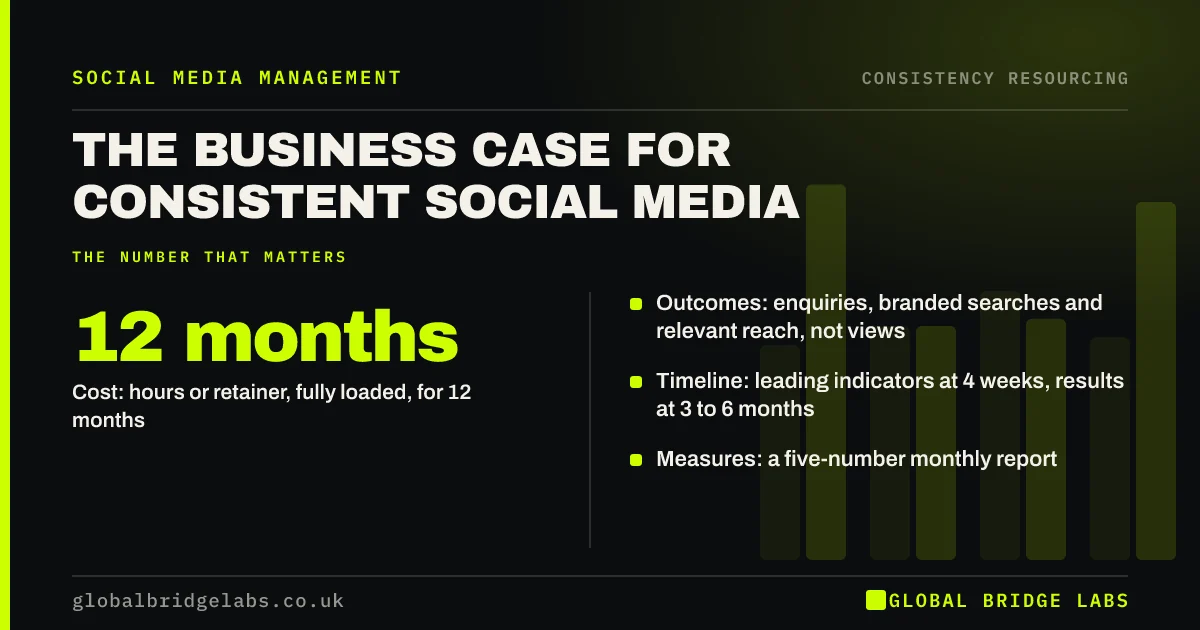
A business case for consistent social media should set out the cost, the expected outcomes, the timeline and how success will be measured. It is stronger when it promises consistency rather than virality: a fixed cadence, leading indicators within weeks and enquiry measures within 3 to 6 months.
- Cost: hours or retainer, fully loaded, for 12 months.
- Outcomes: enquiries, branded searches and relevant reach, not views.
- Timeline: leading indicators at 4 weeks, results at 3 to 6 months.
- Measures: a five-number monthly report.
- Review point: a formal decision at 12 weeks and 6 months.
Need to present a business case for social media? Message us on WhatsApp and we will help you build it.
Chat on WhatsApp →Why does the business case matter?
Because social media without a business case gets cut in the first bad quarter. A clear case sets realistic expectations, protects the budget long enough for consistency to pay off and gives the board a way to judge it fairly.
What should the business case include?
- The goal: which business outcome social media supports.
- The audience and channels.
- The plan: cadence, formats and who does the work.
- The cost for 12 months.
- Expected outcomes and timeline.
- Measures and review points.
- Risks and what happens if results do not appear.
How do you cost it?
For in-house delivery, multiply weekly hours by the fully loaded hourly cost. A UK employee on the April 2026 National Living Wage costs about £16.27 per worked hour; a mid-level marketer on £32,000–£42,000 costs considerably more once National Insurance and pension are added. For outsourced delivery, most UK SMEs pay £950–£2,500 a month. Add tools and any ad spend.
Want the cost section built from your numbers? Message us on WhatsApp.
Chat on WhatsApp →What outcomes should you promise?
Promise activity you control and outcomes you can measure, not virality. Commit to the cadence and reply standard. Forecast leading indicators, such as relevant profile visits and saves, rising within four weeks, and enquiries and branded searches rising over three to six months. Across GBL social media clients, the average reach lift in the first 90 days is +184% and qualified leads per month rise by an average of +62%; use figures like these as context, not guarantees.
How do you frame the long-term value?
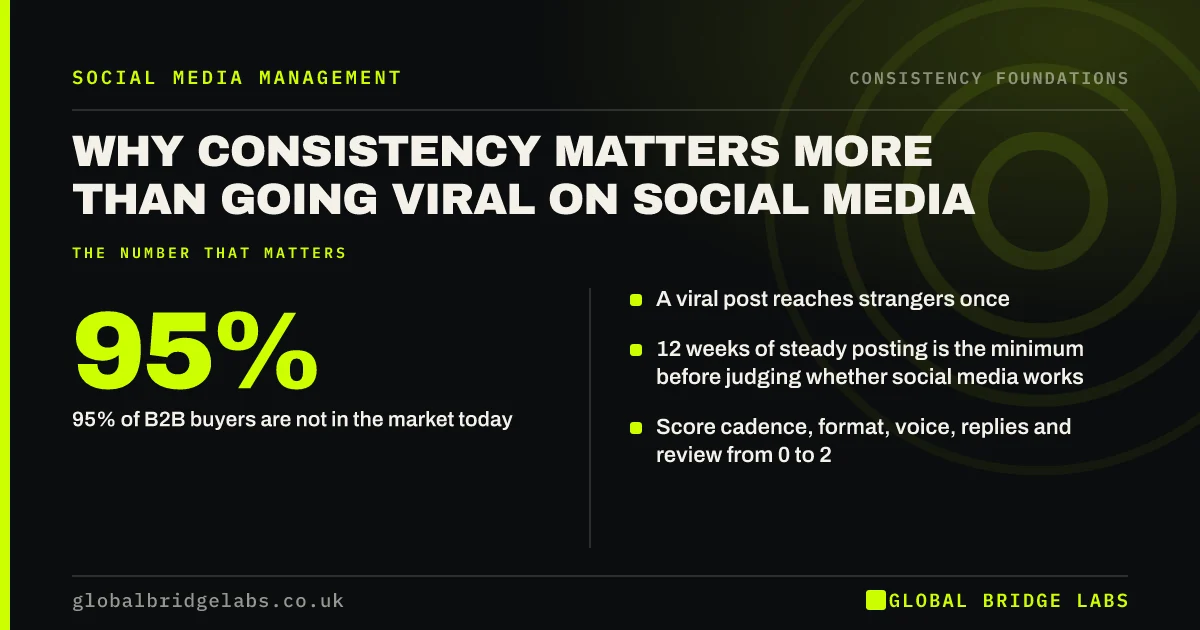
Use the evidence on long-term marketing. The IPA's The Long and the Short of It found that brand-building effects grow over time while short-term activation fades. For B2B, the LinkedIn B2B Institute's 95-5 rule shows that most buyers are not in-market today; consistent visibility is how you are remembered when they are.
What risks should you include?
- Inconsistency if the owner of the work is overloaded.
- Attribution gaps from dark social, reducing measured results.
- Content aimed at the wrong audience.
- Platform changes affecting reach.
What does this look like in practice?
A marketing manager at a UK manufacturing SME had two social media proposals rejected. Her third was built on this structure: two posts a week on LinkedIn, a cost of 12 months of retainer, leading indicators reported monthly and a formal review at 12 weeks and six months. The board approved it, and at the six-month review the firm could show enquiries attributed to LinkedIn and a rise in branded searches.
What does a one-page summary look like?
- Goal: steady enquiries from operations managers in the region.
- Plan: LinkedIn, two posts a week, three series, replies within one working day.
- Cost: 12-month retainer plus £150 a month always-on ads.
- Measures: enquiries, relevant followers, saves and shares, branded search, consistency score.
- Review points: 12 weeks (leading indicators) and 6 months (enquiries).
- Risk: attribution gaps; mitigated by asking every enquirer.
Which objections should you prepare for?
- Our buyers are not on social media: show audience research and competitor activity.
- We tried it before: show why it was inconsistent and how this plan differs.
- We cannot measure it: show the five-number report and enquiry log.
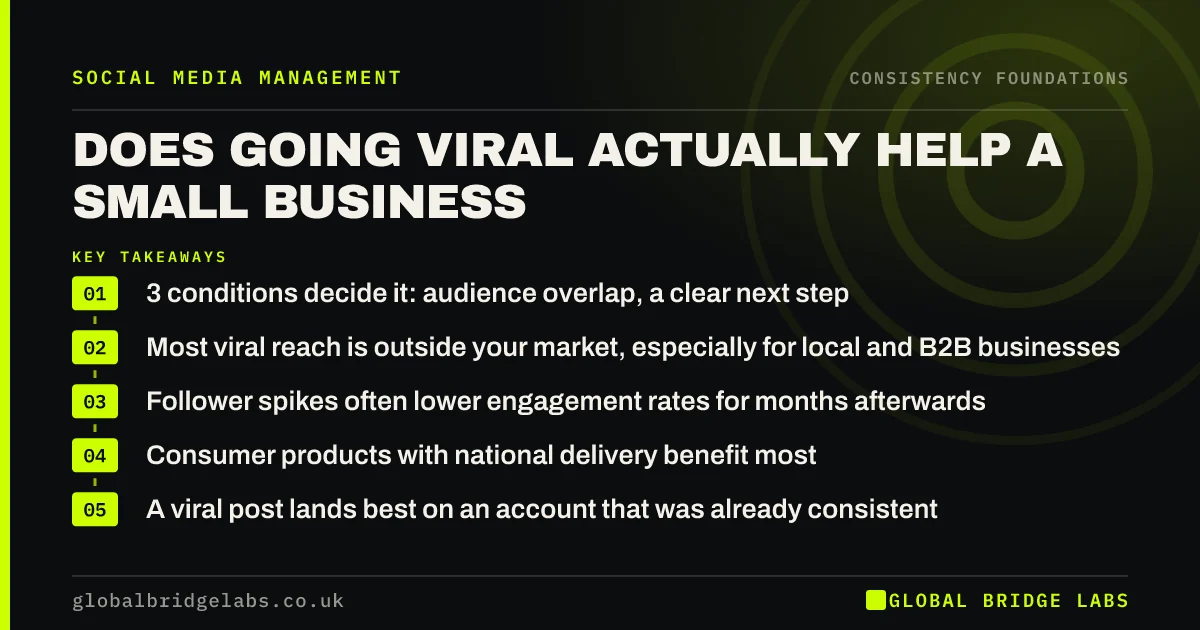
- Why not go viral instead: explain that virality is not controllable and rarely reaches buyers.
Next step
Draft your business case using the seven sections above. Keep it to two pages and make the review points explicit.
Message us on WhatsApp and we will review your draft business case.
Chat on WhatsApp →Sources and further reading
Frequently asked questions
How do I justify spending on social media?
Set out the goal, audience, plan, 12-month cost, expected outcomes, timeline, measures and review points. Promise consistency and measurable outcomes rather than virality, and agree to a formal review at 12 weeks and six months.
What ROI should I expect from social media?
It varies widely by sector and model. Expect leading indicators within weeks and enquiry results within 3 to 6 months of consistent activity. Measure ROI over at least six months, and account for dark social, which hides some results.
How do I present social media results to a board?
Use a short monthly report with five numbers: enquiries from social media, relevant profile visits, saves and shares, branded searches and a consistency score, compared with a 12-week average. Lead with business outcomes, not views.
Why do social media budgets get cut?
Usually because expectations were unrealistic, results were reported in vanity metrics or activity was inconsistent. A clear business case with realistic timelines and business measures makes budgets more resilient.
What if the board wants results in a month?
Agree on leading indicators for the first month, such as relevant profile visits, saves and replies, and set enquiry expectations for three to six months. Explain that consistent activity compounds and that judging at one month usually ends the programme just before it starts to work.
Written by

Global Bridge Labs (GBL) is a UK–Sri Lanka partner for social media, websites and BPO. Everything here comes from client delivery, not theory.