On this page
- 01Key takeaways
- 02What does compounding mean for social media?
- 03Which five things compound over time?
- 04Why do results look flat for the first few months?
- 05What breaks the compounding effect?
- 06How do you make sure your content keeps paying back?
- 07What does this look like in practice?
- 08Next step
- 09Sources and further reading
- 10Frequently asked questions
Key takeaways
Consistent social media compounds because each month of posting makes the next month cheaper and more effective: templates are reused, the audience grows more relevant, recognition builds, and a library of proof accumulates. A viral post does not compound. It starts from zero and ends where it started.
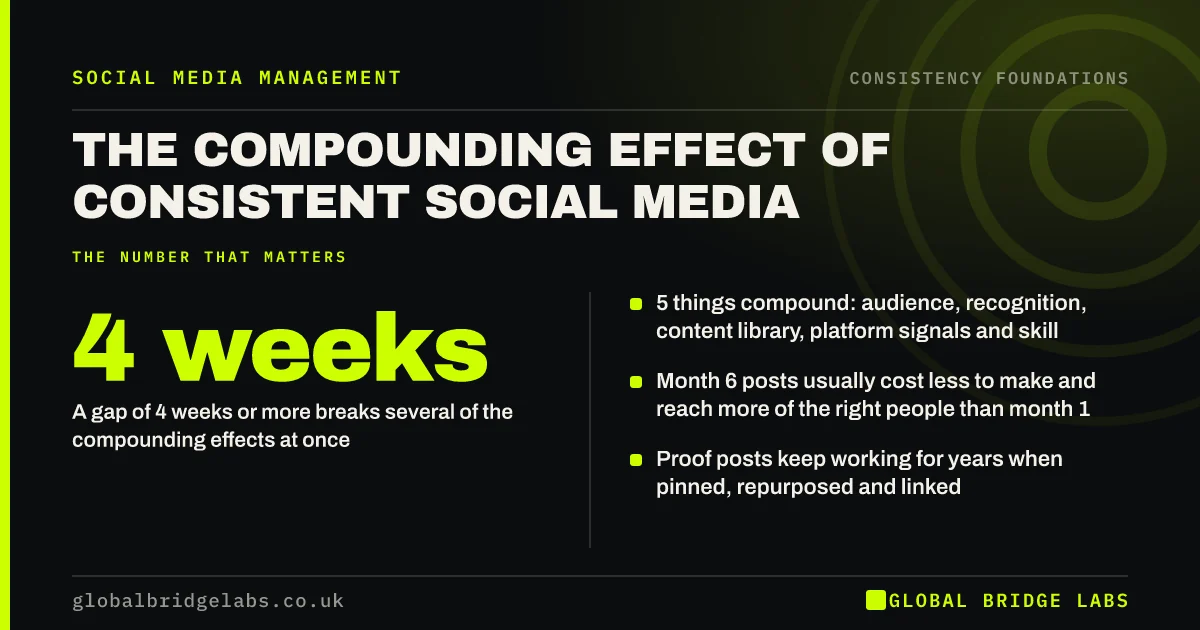
- 5 things compound: audience, recognition, content library, platform signals and skill.
- Month 6 posts usually cost less to make and reach more of the right people than month 1.
- A gap of 4 weeks or more breaks several of the compounding effects at once.
- Proof posts keep working for years when pinned, repurposed and linked.
- Measure compounding quarterly, not weekly.
Want to know whether your social media is compounding or resetting? Send us your profile on WhatsApp.
Chat on WhatsApp →What does compounding mean for social media?
Compounding in social media means that the returns from each month of consistent activity build on previous months rather than starting again. A consistent account in its second year does not just repeat the first year's results. It gets more from the same effort because recognition, audience fit and content assets have accumulated.
The idea is familiar from money: small, regular contributions outperform occasional large ones because growth builds on growth. The same logic is why a steady posting routine usually beats a series of bursts.
Which five things compound over time?
- Audience: each relevant follower makes the next post more likely to reach similar people.
- Recognition: repeated formats and voice mean followers identify you faster each time.
- Content library: every proof post and answered question becomes reusable material.
- Platform signals: steady engagement helps platforms learn who your posts suit.
- Skill and speed: the team gets faster and better at making the formats that work.
Why do results look flat for the first few months?
Early months look flat because compounding is slow at the start. The audience is small, recognition is low and the content library is empty. Most of the value in months one to three is being built rather than collected, which is why so many businesses give up just before results appear.
The IPA's analysis of marketing effectiveness (The Long and the Short of It) found that brand-building effects take longer to show but last far longer than short-term activation. Social media behaves similarly: early activity lays foundations that later posts stand on.
What breaks the compounding effect?
Long gaps break it most. After four weeks of silence, followers have moved on, platforms have fewer recent signals about your audience, and the team has lost its rhythm. Restarting feels like starting again because, in several respects, it is.
Frequent strategy changes break it too. Changing format, voice or channel every few weeks means nothing is repeated long enough to become recognisable or cheaper to produce.
Planning a pause or a change of direction? Message us on WhatsApp first and we will help you keep what you have built.
Chat on WhatsApp →How do you make sure your content keeps paying back?
- Pin your three strongest proof posts and refresh them every quarter.
- Turn every answered customer question into a reusable post and a website FAQ.
- Repurpose one strong post into two other formats rather than making three new ones.
- Keep a simple library of posts by theme so nothing good is made only once.
- Review quarterly which series produce enquiries and drop the ones that do not.
What does this look like in practice?
A UK logistics company started posting twice a week on LinkedIn: one delivery story and one practical explainer for warehouse managers. For the first two months, reactions were modest and nothing notable happened. By month five, prospects were mentioning specific posts in sales calls, and the sales team was sending old explainers to leads as follow-up material.
By the end of the first year, the library held over 80 posts that the sales team used regularly. The cost per post had fallen because the formats were settled. None of that came from a single post; it came from the accumulation.
Next step
Commit to one cadence for six months without changing the format more than once. Review quarterly, not weekly, and measure whether each quarter produced more enquiries for the same effort than the last.
Message us on WhatsApp and we will set up a six-month plan built to compound.
Chat on WhatsApp →Sources and further reading
Frequently asked questions
Does social media have a compounding effect?
Yes, when it is consistent. Audience fit, recognition, a reusable content library, platform signals and team skill all build over time, so each month of steady posting becomes more effective. Bursts and long gaps reset much of that progress, which is why sporadic accounts rarely see compounding results.
How long before social media results compound?
Expect early signals within 3 to 4 weeks and clearer compounding after 3 to 6 months of consistent posting. The first quarter mostly builds foundations. Results usually become visible in enquiries and branded searches during the second and third quarter, provided the cadence and formats stay steady.
Why are my social media results not growing?
Common causes are gaps in posting, frequent changes of format or channel, content aimed at general audiences rather than buyers, and no review of what works. Each of these stops results from building on previous months. Fix consistency first, then refine content.
Is it better to post a lot at once or steadily?
Steadily. Posting in bursts followed by gaps breaks the compounding effect and makes the profile look irregular to prospects. The same number of posts spread evenly across months builds more recognition and gives platforms steadier signals about who your content suits.
Written by

Global Bridge Labs (GBL) is a UK–Sri Lanka partner for social media, websites and BPO. Everything here comes from client delivery, not theory.