On this page
- 01Key takeaways
- 02Why do going viral myths persist?
- 03Myth 1: more followers means more reach
- 04Myth 2: one viral post will transform the business
- 05Myth 3: you must jump on every trend
- 06Myth 4: there is a formula for going viral
- 07Myth 5: posting more often makes you go viral
- 08Myth 6: views are the measure of success
- 09Myth 7: viral is free marketing
- 10What does this look like in practice?
- 11Next step
- 12Sources and further reading
- 13Frequently asked questions
Key takeaways
Most advice about going viral rests on myths: that follower count drives reach, that one hit changes everything, that trends always work, and that virality can be engineered. Platform documentation and marketing research contradict each of them. The time spent chasing them is better spent on consistent posting to buyers.
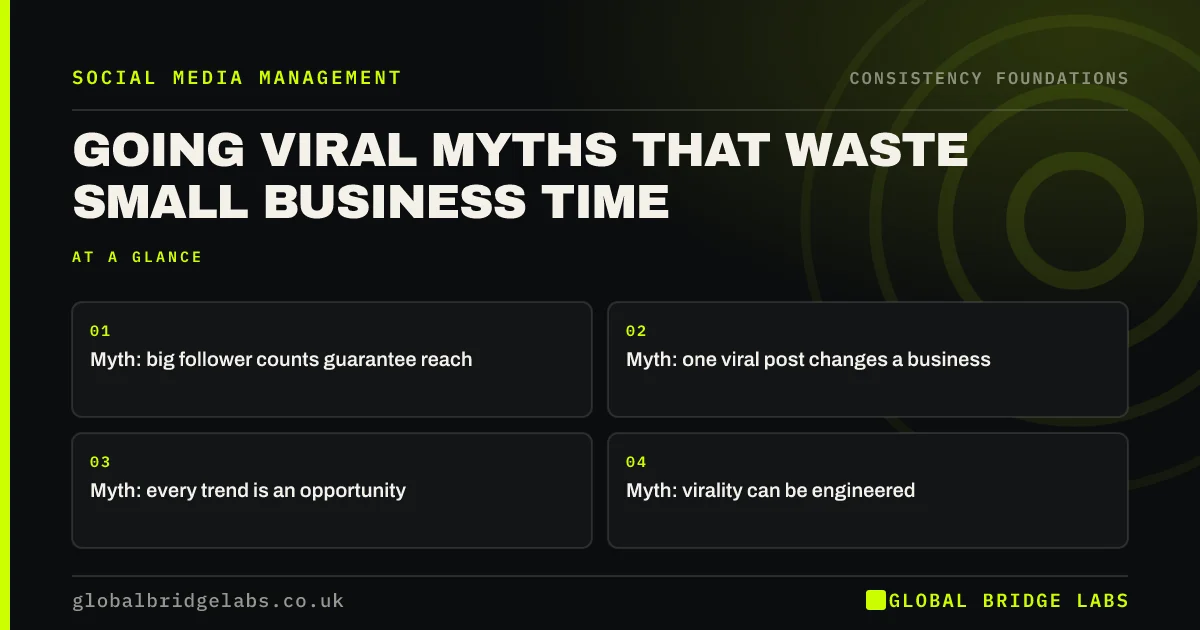
- Myth: big follower counts guarantee reach. TikTok says follower count is not a direct factor.
- Myth: one viral post changes a business. Spikes usually fade within a week.
- Myth: every trend is an opportunity. Most trends are irrelevant to buyers.
- Myth: virality can be engineered. Outcomes are unpredictable post by post.
- Myth: views equal success. Enquiries and branded searches matter more.
Want a plan based on what actually works for your sector? Message us on WhatsApp.
Chat on WhatsApp →Why do going viral myths persist?
Going viral myths persist because the successes are visible and the failures are not. Everyone hears about the post that took off; nobody hears about the hundreds of similar posts that reached a few hundred people. Courses and consultants selling viral formulas have a strong incentive to repeat the success stories.
For a UK small business, the cost of believing the myths is time: hours spent chasing formats that suit entertainers rather than suppliers.
Myth 1: more followers means more reach
Follower count helps a little, but platforms rank posts mainly on predicted interest for each viewer. TikTok states publicly that neither follower count nor a history of high-performing videos is a direct factor in its For You recommendations. LinkedIn ranks its feed for relevance to each member. A small account with a relevant audience can outperform a large account with an irrelevant one.
Myth 2: one viral post will transform the business
Most viral spikes fade within three to seven days, and many produce followers who never buy. The businesses whose lives changed after a viral moment usually had stock, a clear offer and a steady account already in place. The post was the spark, not the fuel.
Myth 3: you must jump on every trend
Trends are useful only when they fit your audience and your voice. A trending audio clip that your buyers do not recognise, or a meme that does not suit your brand, costs time and can make a professional business look out of touch. Most trends are best ignored.
Myth 4: there is a formula for going viral
There are good practices, such as a strong opening, a clear point, native formats and captions, but no reliable formula. Platforms change ranking systems frequently, and viewers are unpredictable. A formula that worked for one account last year may not work for yours now.
Myth 5: posting more often makes you go viral
Posting more increases the number of attempts, but it also tends to lower quality and burn out the people making the posts. Two good posts a week, held for a year, beat seven rushed posts a week held for a month.
Myth 6: views are the measure of success
Views measure attention, not business value. For a business, better measures are enquiries, profile visits from your target area, saves and shares by relevant people, and branded searches for your name. A post with a tenth of the views can be worth far more if it reaches the right people.
Want to know which of your numbers actually matter? Send us your latest report on WhatsApp.
Chat on WhatsApp →Myth 7: viral is free marketing
Viral attempts cost staff time, often three to five times the time of routine posts, and success brings its own costs: moderating comments, answering messages and sometimes handling demand the business cannot meet. It is not free, and it is not reliably cheap.
What does this look like in practice?
A UK property maintenance company followed advice from an online course to post daily trend videos. After three months, one video had done well and the rest averaged a few hundred views, mainly from outside its region. The owner was spending around eight hours a week on it.
Switching to two posts a week showing completed jobs and answering landlord questions cut the time to about two hours. Enquiries from landlords in the firm's area increased, because the content was now aimed at them.
Next step
Check your current social media plan against the seven myths. Drop anything that relies on them and put the time into consistent, buyer-focused posts and replies.
Message us on WhatsApp and we will review your plan for the myths that are costing you time.
Chat on WhatsApp →Sources and further reading
- How TikTok recommends videos #ForYou · TikTok Newsroom
- LinkedIn relevance: optimising the member experience · LinkedIn Help
- How YouTube works: recommendations · YouTube
Frequently asked questions
Is it true that you need lots of followers to go viral?
No. Platforms rank posts mainly on predicted interest for each viewer. TikTok says follower count is not a direct factor in its For You recommendations. Small accounts can reach large audiences, and large accounts can reach few people if their posts are not relevant.
Can you make a post go viral on purpose?
Not reliably. Strong openings, clear points and native formats improve the odds, but outcomes depend on algorithms and audience reactions that nobody controls. Treat virality as an occasional bonus rather than a plan, and build the plan on consistent posting to buyers.
Do hashtags make posts go viral?
Hashtags can help categorise content but rarely make a post go viral on their own. Platforms rely far more on how viewers respond. Use a few relevant hashtags and put your effort into content that your buyers find useful.
What should small businesses focus on instead of going viral?
A steady cadence on one or two channels, recognisable formats, content that answers buyers' questions and shows real work, replies to every genuine comment, and a monthly review of enquiries and branded searches. These build results you can plan around.
Written by

Global Bridge Labs (GBL) is a UK–Sri Lanka partner for social media, websites and BPO. Everything here comes from client delivery, not theory.