On this page
- 01Key takeaways
- 02What is the mere exposure effect?
- 03How does it apply to social media?
- 04Why does familiarity make people buy?
- 05How do you use repetition without boring people?
- 06When does repeated exposure stop working?
- 07What does this look like in practice?
- 08Next step
- 09Sources and further reading
- 10Frequently asked questions
Key takeaways
The mere exposure effect is the tendency to prefer things simply because we have seen them before. For social media, it means a business that appears in the same buyer's feed every week becomes more familiar, and familiar suppliers feel safer to choose. Consistency creates repeated exposure; a viral post creates one.
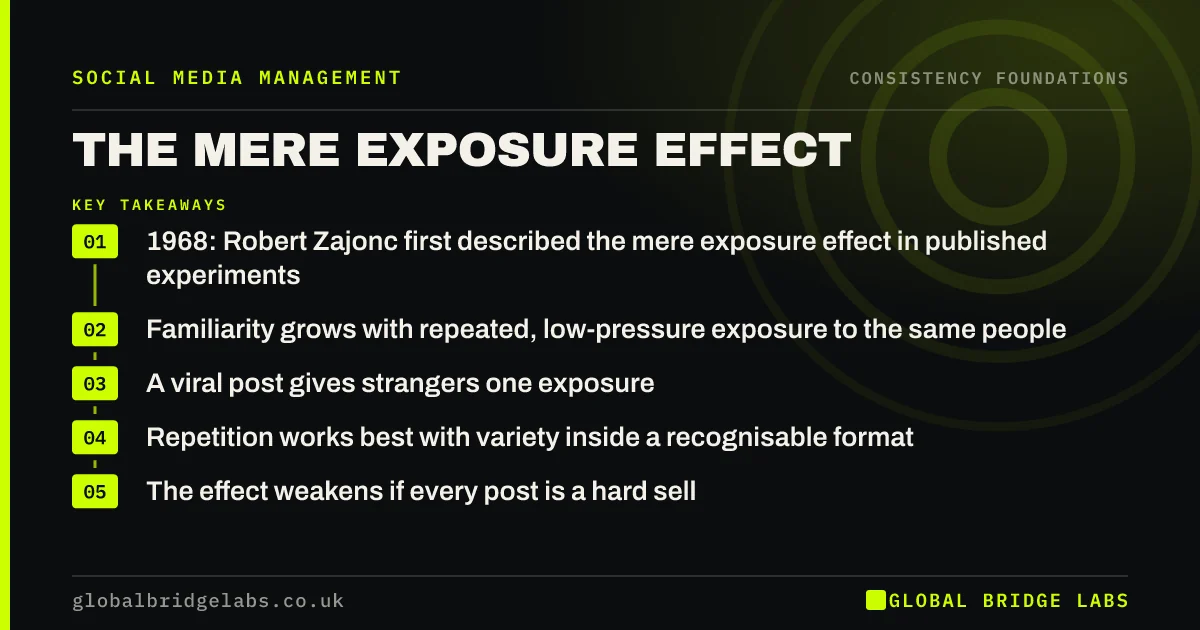
- 1968: Robert Zajonc first described the mere exposure effect in published experiments.
- Familiarity grows with repeated, low-pressure exposure to the same people.
- A viral post gives strangers one exposure. Consistency gives buyers dozens.
- Repetition works best with variety inside a recognisable format.
- The effect weakens if every post is a hard sell.
Want to know how often your buyers actually see you? Message us on WhatsApp and we will estimate it from your analytics.
Chat on WhatsApp →What is the mere exposure effect?
The mere exposure effect is a psychological tendency for people to develop a preference for things they are repeatedly exposed to, even without noticing the exposure. It was described by psychologist Robert Zajonc in 1968 and has been replicated many times since across words, faces, images and brands.
In buying terms, it explains why people often choose the supplier whose name feels familiar over one they have never encountered, even when they cannot remember where they saw it.
How does it apply to social media?
Social media is one of the few channels where a small business can appear in front of the same people repeatedly at almost no cost per appearance. Each post seen by a follower is a small exposure. Over months, those add up to familiarity that no single post can create.
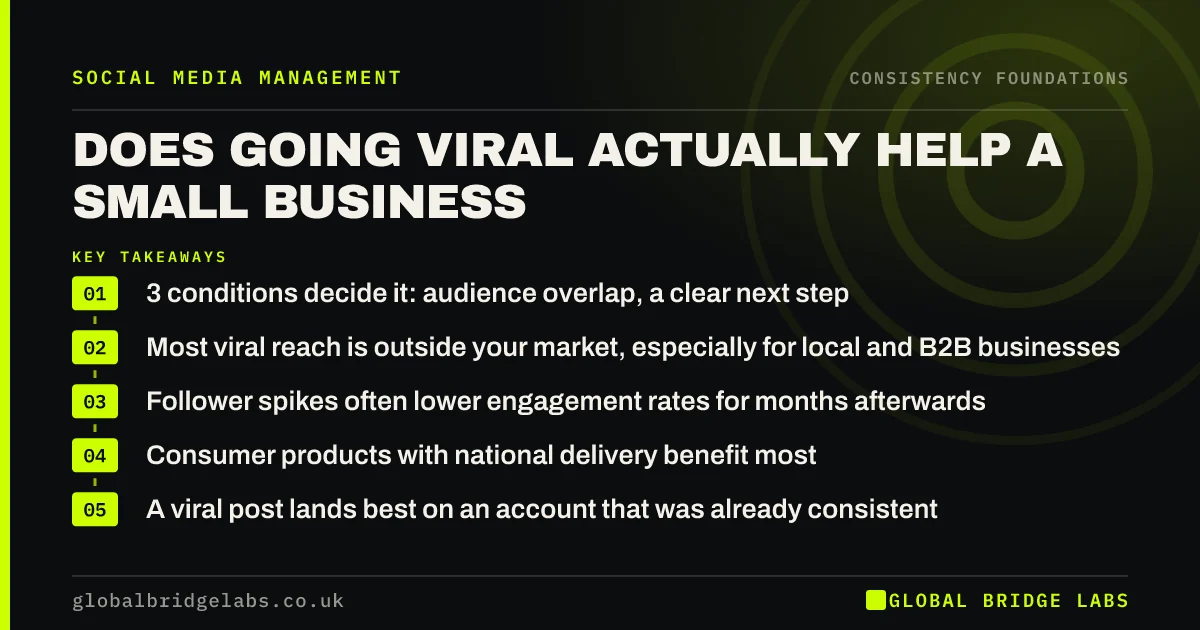
That is the core reason consistency beats virality for most businesses. A viral post reaches many people once. A consistent account reaches fewer people, but the right ones, many times.
Why does familiarity make people buy?
Familiarity reduces perceived risk. When a buyer needs a supplier, especially for something expensive or hard to reverse, a known name feels safer than an unknown one. Marketing scientists at the Ehrenberg-Bass Institute call this mental availability: the likelihood that a brand comes to mind at the moment of need.
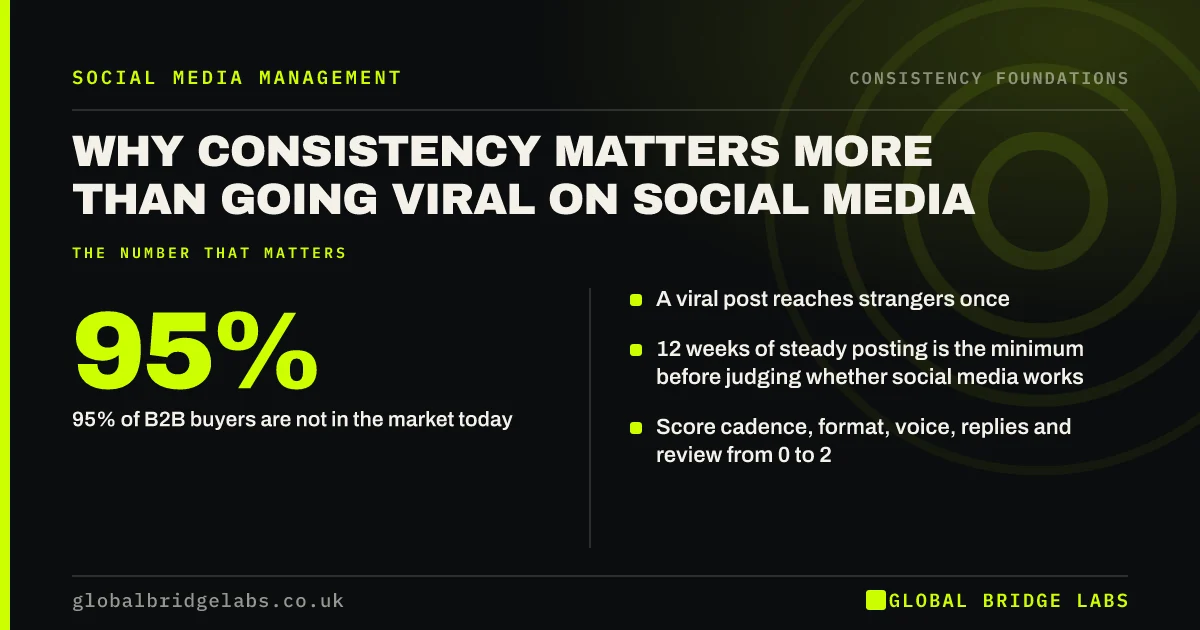
For B2B buyers the timing effect is strong. The LinkedIn B2B Institute estimates that around 95% of business buyers are out of the market at any one time. Repeated exposure is what keeps you in mind until they are ready.
How do you use repetition without boring people?
Repeat the frame, vary the content. A recognisable format, visual style and voice deliver the exposure; fresh examples, questions and stories inside that format keep it worth reading.
- Keep the same series names, layouts and colours so posts are recognised instantly.
- Change the example, customer, question or job in every post.
- Mix proof, advice and people posts so the feed does not feel like an advert.
- Show the same faces regularly. People recognise people faster than logos.
- Limit direct selling to about one post in five.
Want a recognisable format designed for your posts? Message us on WhatsApp.
Chat on WhatsApp →When does repeated exposure stop working?
Repeated exposure stops helping when the content becomes irritating, identical or relentlessly promotional. Research on the mere exposure effect shows the preference boost levels off with heavy repetition, and advertising fatigue is well documented in paid campaigns that show the same creative too often.
It also does nothing if the underlying offer is weak or the experience is poor. Familiarity makes people more willing to consider you; it does not make a bad experience acceptable.
What does this look like in practice?
A UK dental practice posted three times a week on Facebook and Instagram with a fixed format: a patient question answered by the same dentist on Mondays, a team post on Wednesdays and a practice update on Fridays. None of the posts reached large numbers. The same local families saw them week after week.
Within six months, new patients regularly mentioned recognising the dentist from the videos, and the front desk reported fewer nervous first-visit calls. Familiarity had done part of the reassurance work before patients arrived.
Next step
Decide who you want to become familiar to, then design a format they will see weekly. Measure success in how often the right people see you, not how many strangers see you once.
Message us on WhatsApp and we will design a repeatable format built around the mere exposure effect.
Chat on WhatsApp →Sources and further reading
Frequently asked questions
What is the mere exposure effect in marketing?
It is the tendency for people to prefer brands and products they have seen repeatedly, even without remembering the exposures. In marketing it explains why consistent visibility builds preference over time, and why familiar suppliers are often chosen over unknown ones with similar offers.
How many times does someone need to see a brand?
There is no fixed number, and the old rule of seven is a heuristic rather than a research finding. What matters is regular exposure over time to the same people. Steady weekly visibility across months builds familiarity far more reliably than a few intense bursts.
Does the mere exposure effect work on social media?
Yes. Every time a follower sees your post, even briefly, it counts as an exposure. Consistent posting to a relevant audience builds familiarity over months, which is one reason steady accounts outperform accounts that rely on occasional viral posts.
Can too much repetition put people off?
Yes. Heavy repetition of identical content or constant selling can cause fatigue. The fix is to repeat the recognisable frame, such as the format, voice and faces, while varying the content inside it, and to keep direct selling to a small share of posts.
Written by

Global Bridge Labs (GBL) is a UK–Sri Lanka partner for social media, websites and BPO. Everything here comes from client delivery, not theory.