On this page
- 01Key takeaways
- 02Does going viral help a small business?
- 03Which businesses benefit most from going viral?
- 04What are the downsides of going viral?
- 05How do you tell whether a viral post helped?
- 06Should you try to go viral at all?
- 07What does this look like in practice?
- 08Next step
- 09Sources and further reading
- 10Frequently asked questions
Key takeaways
Going viral helps a small business only when three conditions hold: the people reached overlap with your buyers, your profile gives new visitors a clear next step, and you can handle the demand. When any of the three is missing, a viral post brings attention the business cannot use, and sometimes costs it money.
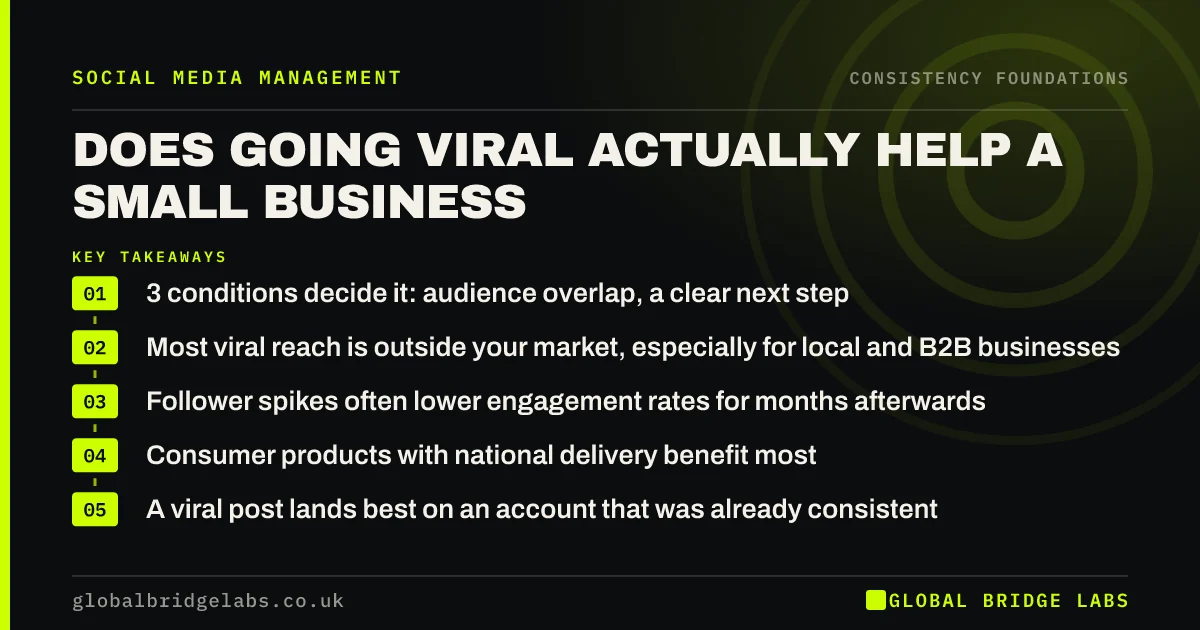
- 3 conditions decide it: audience overlap, a clear next step, and capacity to deliver.
- Most viral reach is outside your market, especially for local and B2B businesses.
- Follower spikes often lower engagement rates for months afterwards.
- Consumer products with national delivery benefit most. Local services benefit least.
- A viral post lands best on an account that was already consistent.
Had a post take off, or hoping for one? Message us on WhatsApp and we will tell you what it is worth to your business.
Chat on WhatsApp →Does going viral help a small business?
Sometimes, and less often than it appears. Going viral helps when the reach lands on people who could buy, when your profile turns their curiosity into an enquiry or a sale, and when you can deliver. For most small UK businesses at least one of these fails, so the typical outcome is a brief rise in followers with little lasting commercial effect.
The stories that circulate are survivorship: the bakery that sold out, the tradesperson booked for a year. They are real, and they are rare, and the businesses in them were usually posting steadily for a long time before the post that took off.
Which businesses benefit most from going viral?
Businesses with a national or online market and a product that is easy to buy benefit most. An e-commerce brand with stock, a clear product page and UK-wide delivery can convert viral attention into orders within hours. A plumber in Leeds cannot serve viewers in Glasgow, however many there are.
- Strong fit: e-commerce with stock and fast checkout, consumer brands, ticketed events, apps.
- Partial fit: hospitality in tourist areas, courses and training, recruitment campaigns.
- Weak fit: local trades, clinics, B2B services with long sales cycles, regulated professions.
What are the downsides of going viral?
The main downside is a follower base that does not match your market. People who followed for one entertaining video rarely engage with ordinary posts, so engagement rates fall and platforms show your later posts to fewer people. The account is bigger and weaker.
Other costs are practical: a flood of messages that nobody has time to answer, comments from people outside your market that distract from real questions, and in some cases negative attention that needs managing. And there is the psychological cost of every later post feeling like a failure by comparison.
How do you tell whether a viral post helped?
Look at four numbers over the 30 days after the spike and compare them with the 30 days before: enquiries or orders, branded searches for your business name in Google Search Console, profile visits from your target region, and engagement rate on your next ten ordinary posts.
If enquiries and branded searches rose, the post helped. If only followers rose and engagement rate fell, it did not. Most businesses only look at the follower number, which is the one least connected to revenue.
Send us your before and after numbers on WhatsApp and we will tell you what the spike actually did.
Chat on WhatsApp →Should you try to go viral at all?
Try to be interesting, not viral. Posts with a strong opening, a clear point and a native format are good posts whether or not they spread widely. Designing everything around shareability tends to pull content away from buyers and towards general entertainment, which is a different business.
A reasonable rule: no more than one post in five should be an experiment aimed at broader reach. The rest should serve the people who could buy from you, because they are the ones who pay the bills.
What does this look like in practice?
A small UK homeware brand had a product video take off on TikTok. Because it had stock, a working product page and a consistent Instagram account with a year of posts behind it, visitors who checked the brand found an active business and bought. Orders rose for about two weeks and then settled at a higher base than before.
In the same month, a UK recruitment consultancy had a LinkedIn post about interview mistakes reach hundreds of thousands of people. It produced thousands of reactions, a few hundred connection requests from job seekers and no client enquiries. Same event, completely different value, because the audience overlap was different.
Next step
Before chasing reach, check the three conditions. If your audience is local or niche, invest in consistency with the right people instead. If you sell nationally online, make sure your profile, product pages and stock are ready so that a spike, if it comes, is not wasted.
Message us on WhatsApp and we will check whether your business is set up to benefit from a viral moment.
Chat on WhatsApp →Sources and further reading
- How TikTok recommends videos #ForYou · TikTok Newsroom
- Performance report (Search results) · Search Console Help
- The 95-5 rule: most B2B buyers are out of market · LinkedIn B2B Institute
Frequently asked questions
Is going viral good for a small business?
It can be, but only when the viral audience includes likely buyers, the profile turns visitors into enquiries and the business can meet demand. For local services and B2B firms, most viral reach falls outside the market, so the effect is often more followers without more revenue.
Can going viral hurt your business?
Yes. It can fill your follower base with people who will never buy, lowering engagement rates on later posts. It can bring more messages than you can answer, negative comments, or demand you cannot meet. It can also set an expectation that every later post feels like a failure against.
How many views count as going viral?
There is no fixed number. For a small business, a post reaching ten or more times its usual audience is effectively viral. What matters commercially is not the view count but how many of those viewers were in your market and what they did next.
What should I do if my post goes viral?
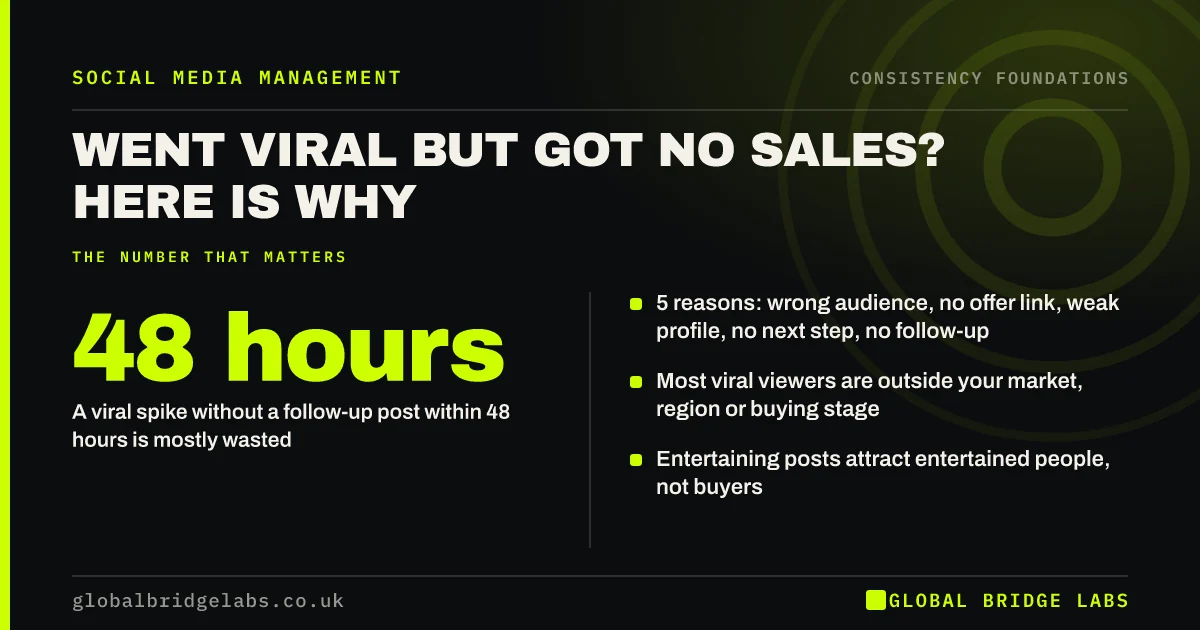
Pin a clear next step to your profile, reply to genuine questions quickly, post a follow-up within 48 hours that explains what you do, and keep your normal posting schedule. Then compare enquiries and branded searches over the next 30 days with the 30 days before.
Written by

Global Bridge Labs (GBL) is a UK–Sri Lanka partner for social media, websites and BPO. Everything here comes from client delivery, not theory.