On this page
- 01Key takeaways
- 02What is the GBL Consistency Scorecard?
- 03How is each dimension scored?
- 04What do the scores mean?
- 05How do you fix each dimension?
- 06What do typical first scores look like?
- 07When is the scorecard not enough?
- 08What does this look like in practice?
- 09What does a worked example look like?
- 10How does the scorecard work across several channels?
- 11Next step
- 12Sources and further reading
- 13Frequently asked questions
Key takeaways
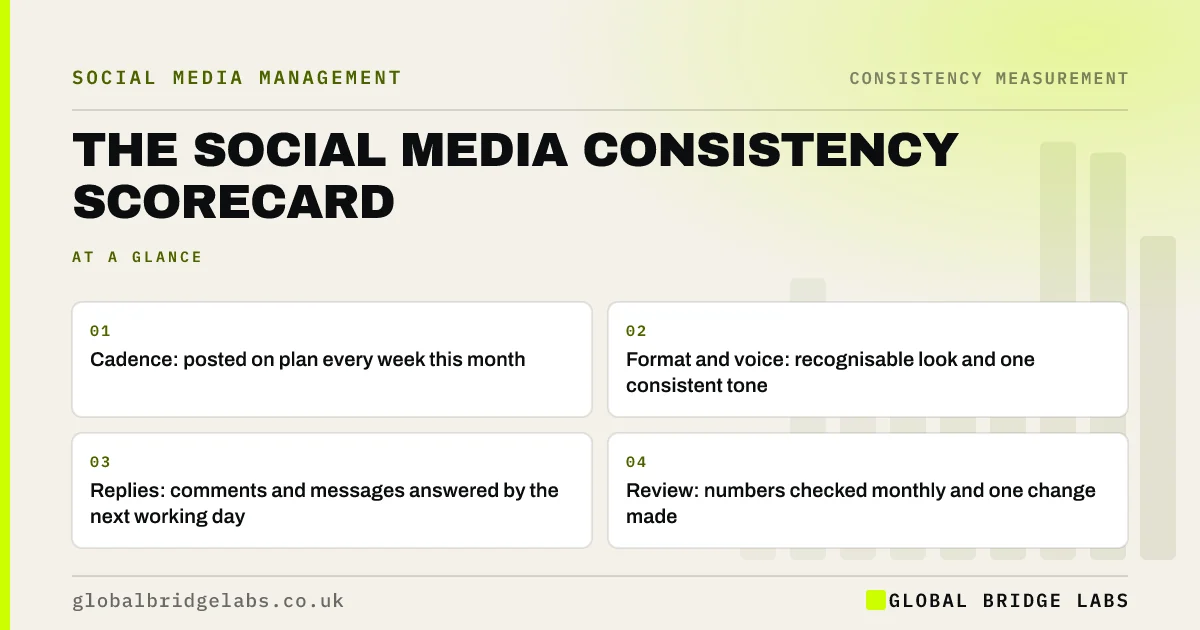
The GBL Consistency Scorecard measures how consistent a business's social media is across five dimensions: cadence, format, voice, replies and review. Each is scored 0, 1 or 2, giving a total out of 10. A score of 8 or more is a healthy system; 5 or below means the account is running on good intentions.
- Cadence: posted on plan every week this month.
- Format and voice: recognisable look and one consistent tone.
- Replies: comments and messages answered by the next working day.
- Review: numbers checked monthly and one change made.
Want us to score your account? Send us your profile links on WhatsApp.
Chat on WhatsApp →What is the GBL Consistency Scorecard?
The GBL Consistency Scorecard is a five-part assessment Global Bridge Labs (GBL) uses to measure how reliably a business runs its social media. It measures the system rather than the results, because results fluctuate while a consistent system produces them over time.
It takes about 15 minutes per channel and should be repeated every four weeks.
How is each dimension scored?
- Cadence: 2 if you posted on plan in all of the last 4 weeks; 1 if 2 or 3 weeks; 0 if fewer.
- Format: 2 if a follower would recognise your last 9 posts as yours without the name; 1 if most; 0 if not.
- Voice: 2 if all recent captions sound like one business; 1 if mostly; 0 if the tone swings.
- Replies: 2 if all comments and messages were answered within 1 working day; 1 if within 3 days; 0 if slower or missed.
- Review: 2 if you reviewed numbers last month and changed something; 1 if reviewed only; 0 if neither.
Want the scorecard as a one-page sheet? Message us on WhatsApp and we will send it.
Chat on WhatsApp →What do the scores mean?
- 8 to 10: healthy system. Focus on improving content quality and results.
- 6 to 7: fragile. It will likely break in the next busy month. Fix the lowest dimension.
- 4 to 5: running on good intentions. Rebuild cadence and replies first.
- 0 to 3: effectively inactive. Consider minimum viable social media before anything else.
How do you fix each dimension?
- Cadence: lower the target to what you can hold, batch monthly, keep a content bank.
- Format: build one template per recurring series.
- Voice: write a one-page voice guide and check captions against it.
- Replies: name one person and a fixed daily time to check.
- Review: book a 30-minute monthly review in the diary.
What do typical first scores look like?
Across accounts we audit for the first time, most UK small businesses score between 4 and 6. Cadence is usually the strongest dimension because it is the one people think about. Review is almost always the weakest, followed by replies. That is useful, because review and replies are the quickest to fix.
When is the scorecard not enough?
A high consistency score shows the system is working, not that the content is right. An account can score 10 while posting content aimed at the wrong audience. Use the scorecard alongside business measures such as enquiries, profile visits from your area and branded searches.
What does this look like in practice?
A UK recruitment agency scored 5 on its first assessment: cadence 2, format 1, voice 1, replies 1, review 0. It added a monthly review, a template set and a named person for replies. Four weeks later it scored 8, and within three months it was receiving candidate and client enquiries that referenced specific posts.
What does a worked example look like?
A UK independent café scored itself on Instagram. Cadence 1: it posted on plan in three of the last four weeks. Format 2: posts used two consistent templates. Voice 1: the owner and a barista wrote in noticeably different styles. Replies 1: most messages were answered within two days. Review 0: nobody had looked at the numbers in months. Total: 5 out of 10, fragile.
The fixes, in order: a monthly review in the diary, a named person checking messages at 11:00 and 16:00, and a short voice note shared with the barista. Four weeks later the café scored 8.
How does the scorecard work across several channels?
Score each channel separately, then look at the pattern. A business that scores 8 on its main channel and 3 on a secondary one should usually either fix or close the weaker channel. Multi-location businesses can score each location the same way and compare them monthly.
Next step
Score your main channel now. Fix the lowest dimension this month and score again in four weeks.
Message us on WhatsApp and we will score your account and send back the three fixes that matter most.
Chat on WhatsApp →Sources and further reading
- Meta Business Help Centre · Meta
- LinkedIn Pages best practices · LinkedIn
- Engagement rate and bounce rate · Google Analytics Help
Frequently asked questions
How do you measure social media consistency?
Score five dimensions from 0 to 2: cadence, format, voice, replies and review. The total out of 10 shows how robust your system is. Repeat every four weeks and fix the lowest dimension each time.
What is a good social media consistency score?
On the GBL Consistency Scorecard, 8 to 10 is healthy, 6 to 7 is fragile and 5 or below needs rebuilding. Most small businesses start between 4 and 6, usually with review and replies as the weakest dimensions.
How often should I assess my social media consistency?
Every four weeks. That is frequent enough to catch drift before it becomes a gap, and long enough for changes to take effect. It takes about 15 minutes per channel.
Does a high consistency score mean my social media is working?
Not on its own. It means the system is reliable. Check it alongside enquiries, profile visits from your target area and branded searches to confirm the content is reaching and persuading the right people.
Can I use the consistency scorecard for an agency or freelancer?
Yes. It is a useful way to check whether an outsourced partner is delivering a consistent system. Ask them to report the five scores monthly alongside business results, and discuss any dimension scoring below 2.
Written by

Global Bridge Labs (GBL) is a UK–Sri Lanka partner for social media, websites and BPO. Everything here comes from client delivery, not theory.