On this page
- 01Key takeaways
- 02Why do most businesses struggle to stay consistent?
- 03What does the 90-day plan look like?
- 04How do you choose a cadence you can hold?
- 05Why do recurring formats matter so much?
- 06How does batching help?
- 07What is a content bank and why keep one?
- 08When is this plan too much?
- 09What does this look like in practice?
- 10What gets in the way, and how do you plan for it?
- 11Your 90-day consistency checklist
- 12Next step
- 13Sources and further reading
- 14Frequently asked questions
Key takeaways
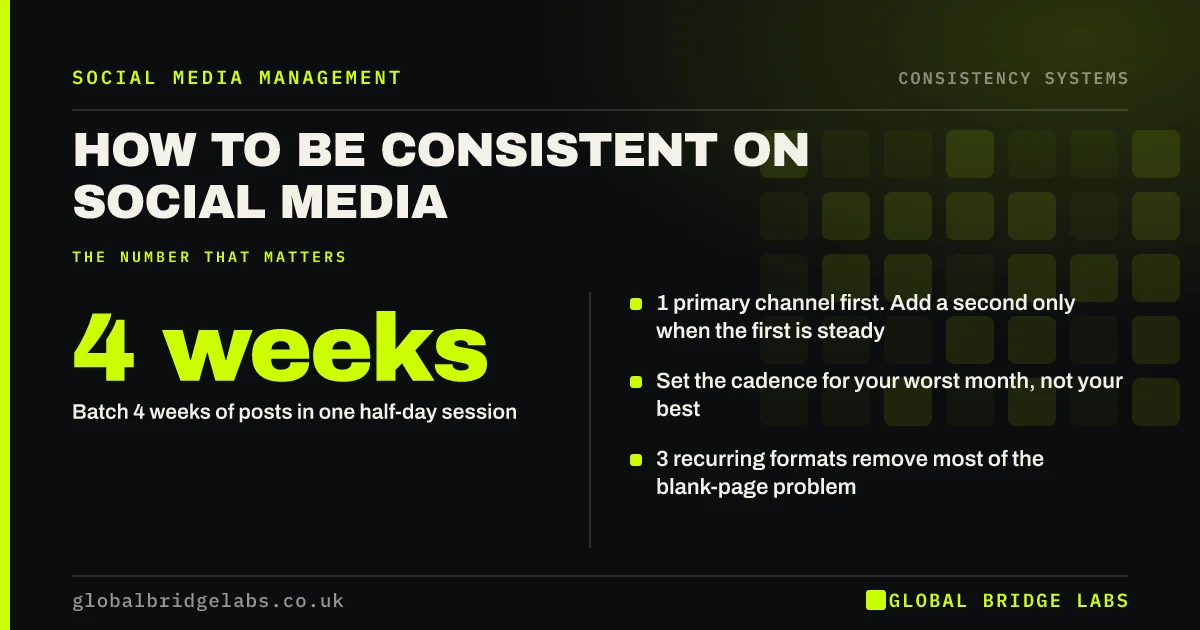
To be consistent on social media, choose one primary channel, set a cadence you can hold in your busiest month, create three recurring formats, batch a month of posts in one session, keep a bank of spare posts and review monthly. Consistency is a system, not willpower. The 90-day plan below builds it step by step.
- 1 primary channel first. Add a second only when the first is steady.
- Set the cadence for your worst month, not your best.
- 3 recurring formats remove most of the blank-page problem.
- Batch 4 weeks of posts in one half-day session.
- Keep 5 evergreen spare posts for weeks that go wrong.
Want this 90-day plan tailored to your business? Message us on WhatsApp.
Chat on WhatsApp →Why do most businesses struggle to stay consistent?
Most businesses struggle because they rely on motivation rather than a system. Posts are made one at a time when someone has a spare moment, so the first busy week breaks the routine. Plans are also usually set in a quiet month, at a cadence nobody can hold in a busy one.
The fix is to design for the worst week: fewer channels, fewer posts, repeatable formats and a reserve for emergencies.
What does the 90-day plan look like?
- Days 1 to 7: choose one primary channel and write down a cadence for your busiest month.
- Days 1 to 7: define three recurring formats, such as proof, answer and people.
- Days 8 to 14: batch four weeks of posts and five spare evergreen posts.
- Days 15 to 90: publish on the same days each week and reply within one working day.
- Day 30, 60, 90: run a 30-minute review and fix one thing.
- Day 90: compare enquiries, profile visits and branded searches with the previous 90 days.
How do you choose a cadence you can hold?
Estimate the time a good post takes, including the caption and replies, then look at how many hours you really have in your busiest month. Divide and round down. For most small businesses that gives two or three posts a week on one channel.
Why do recurring formats matter so much?
Recurring formats turn content creation into filling in a template. Instead of asking what to post, you ask which job, question or person to feature this week. They also build recognition, because followers learn to expect and identify each series.
Want three recurring formats designed for your business? Message us on WhatsApp.
Chat on WhatsApp →How does batching help?
Batching means making several weeks of posts in one focused session. It is faster, because you set up once, and it protects consistency, because busy weeks no longer stop publishing. A half-day session each month is enough for most small businesses.
What is a content bank and why keep one?
A content bank is a reserve of ready-to-publish evergreen posts for weeks when something goes wrong. Five is enough. When illness, a big job or a holiday hits, you publish from the bank and the schedule stays intact.
When is this plan too much?
If you cannot spare even two hours a week, the plan is too big. Drop to one post a week, or consider minimum viable social media: a maintained profile, a monthly proof post and prompt replies. That is still consistent, and consistency at a small scale beats ambition that collapses.
What does this look like in practice?
A UK accountancy firm had started and stopped social media three times. On the 90-day plan it posted twice a week on LinkedIn: a client question answered on Tuesdays and a team post on Thursdays, batched on the first Monday of each month. It used two bank posts during the January self-assessment rush and never missed a week. By day 90, prospects were mentioning the Tuesday posts on discovery calls.
What gets in the way, and how do you plan for it?
- Busy weeks: covered by monthly batching and a five-post content bank.
- Holidays and illness: covered by scheduling and a named backup.
- Approval delays: covered by approving a month of posts at once.
- Running out of ideas: covered by recurring series and a question log.
- Losing motivation: covered by reviewing leading indicators monthly, so progress is visible.
Your 90-day consistency checklist
- One primary channel chosen and written down.
- Cadence set for your busiest month.
- Three recurring series with templates.
- Four weeks batched and five bank posts ready.
- A named owner and backup for replies.
- Monthly review dates in the diary for days 30, 60 and 90.
Next step
Block the first batching session in your diary this week. Everything else in the plan follows from that one session.
Message us on WhatsApp and we will run your first batching session with you.
Chat on WhatsApp →Sources and further reading
- Meta Business Help Centre · Meta
- LinkedIn Pages best practices · LinkedIn
- Engagement rate and bounce rate · Google Analytics Help
Frequently asked questions
How do I stay consistent on social media?
Build a system: one primary channel, a cadence you can hold in your busiest month, three recurring formats, monthly batching, a bank of spare posts and a short monthly review. Systems survive busy weeks; motivation does not.
How many times a week should a business post to be consistent?
Two or three times a week on one primary channel suits most small businesses. Consistency is about holding a cadence reliably, so choose a number you can maintain in your busiest month rather than your quietest.
What is the easiest way to be consistent on social media?
Batch a month of posts in one session using recurring formats, schedule them, and keep five evergreen spare posts for emergencies. This removes the daily decision about what to post, which is where most consistency breaks down.
How long does it take to build a consistent social media habit?
Most teams find the routine feels natural after about 8 to 12 weeks. The first month takes the most effort because formats and templates are new. After that, batching and templates make each month faster.
What if I miss a week of posting?
Carry on with the next scheduled post rather than doubling up to catch up. One missed week has little effect. If misses are becoming regular, lower the cadence, build a content bank or batch further ahead so the plan fits the time you really have.
Written by

Global Bridge Labs (GBL) is a UK–Sri Lanka partner for social media, websites and BPO. Everything here comes from client delivery, not theory.