On this page
- 01Key takeaways
- 02What is social media consistency?
- 03Why is posting often not the same as being consistent?
- 04What are the five parts of consistency?
- 05Which part do UK buyers notice first?
- 06How do you check your own consistency in 15 minutes?
- 07When is inconsistency acceptable?
- 08What does this look like in practice?
- 09Next step
- 10Sources and further reading
- 11Frequently asked questions
Key takeaways
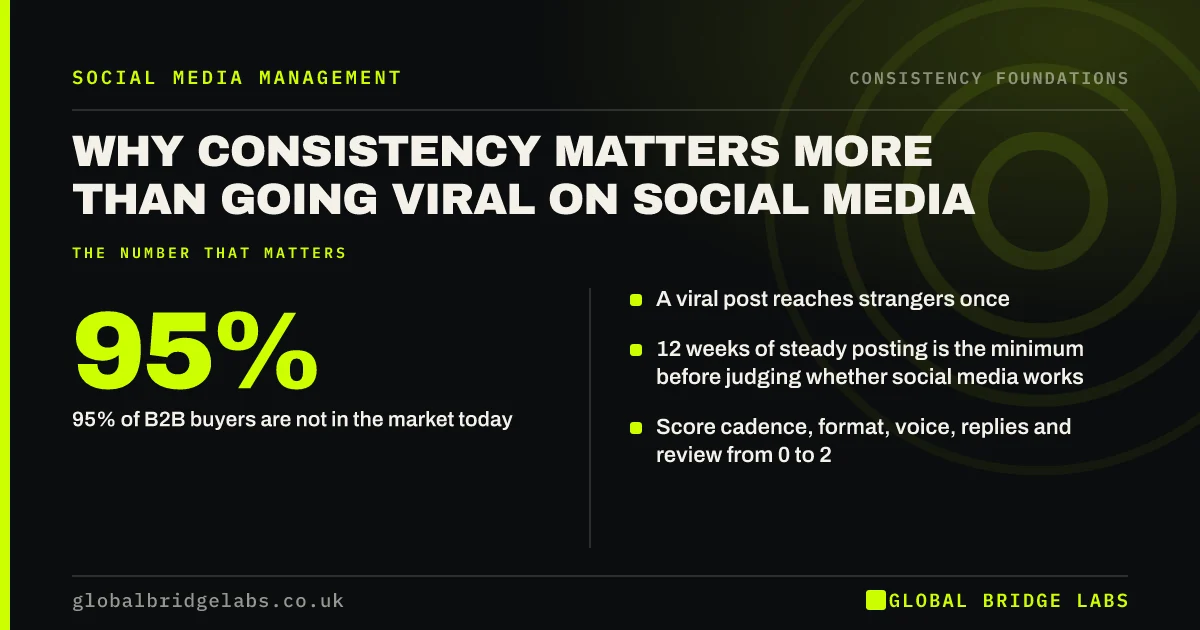
Social media consistency means a follower can predict when you will post, recognise your posts without seeing the logo, and trust that you will reply. It has five parts: cadence, format, voice, replies and review. Posting often is only one of them, and it is rarely the one that fails first.
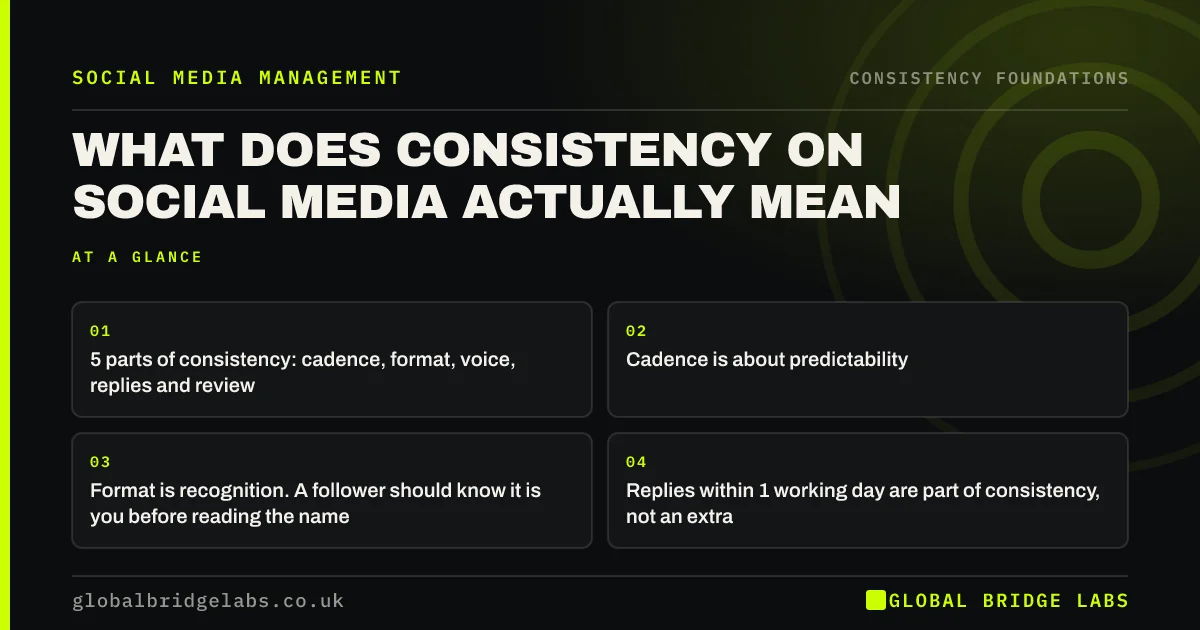
- 5 parts of consistency: cadence, format, voice, replies and review.
- Cadence is about predictability. Same days each week beats more posts.
- Format is recognition. A follower should know it is you before reading the name.
- Replies within 1 working day are part of consistency, not an extra.
- Review monthly. Consistency without review repeats mistakes reliably.
Want to know which part of consistency your account is missing? Send us your profile on WhatsApp.
Chat on WhatsApp →What is social media consistency?
Social media consistency is the practice of publishing on a predictable schedule, in a recognisable format and voice, and responding reliably, so the same audience builds familiarity with a business over time. It is a property of the whole system, not of any single post.
Global Bridge Labs (GBL) splits it into five parts because each one fails for a different reason and needs a different fix. A business can post three times a week and still be inconsistent, because every post looks different, the tone swings between corporate and jokey, and comments sit unanswered for a week.
Why is posting often not the same as being consistent?
Posting often is a volume measure; consistency is a predictability measure. Seven posts one week and none for the next three averages out to nearly two a week, but a follower experiences it as a burst and then an absence. Two posts every week, on the same days, is less work and reads as more reliable.
The distinction matters because most small businesses respond to a quiet spell by posting more, not more steadily. That creates the spike and silence pattern that makes a profile look abandoned to anyone who checks it between bursts.
What are the five parts of consistency?
These are the five dimensions of the GBL Consistency Scorecard. Each is scored 0 to 2, and the total out of 10 tells you how robust the system is.
- Cadence: you posted on plan in each of the last four weeks, on broadly the same days.
- Format: your posts share recognisable layouts, colours, series names or video openings.
- Voice: every post sounds like the same business talking to the same kind of buyer.
- Replies: comments and messages are answered within one working day.
- Review: once a month someone looks at the numbers and changes one thing.
Which part do UK buyers notice first?
Buyers notice cadence first, usually by accident. A prospect who checks your profile before calling sees the date of the last post before anything else. A gap of several months prompts the question whether the business is still trading, which is a trust problem, not a marketing one.
Replies come second. A question left unanswered in public is seen by everyone who visits afterwards, and it tells them how you treat customers. Format and voice work more quietly: they build recognition over months, which is why they matter so much and are noticed so rarely.
How do you check your own consistency in 15 minutes?
- Open your main profile and count posts per week for the last eight weeks. Note any gaps.
- Put your last nine posts side by side. Could a stranger tell they came from one business?
- Read the captions aloud. Does the tone change depending on who wrote them?
- Check the last 20 comments and messages. How many waited more than one working day?
- Ask when anyone last looked at the numbers and changed something as a result.
Send us the results on WhatsApp and we will tell you which gap to close first.
Chat on WhatsApp →When is inconsistency acceptable?
Planned pauses are fine when they are announced. A restaurant closing for two weeks in January, or a consultancy pausing over Christmas, loses nothing by saying so and returning on a stated date. What damages trust is unexplained silence.
Changing format deliberately is also fine, as long as you change it once and stick with the new version. The problem is drift: a slightly different look every month, until nothing is recognisable.
What does this look like in practice?
A UK accountancy practice we worked with was posting four times a week and felt it was doing everything right. Scored against the five parts, it came out at 5 of 10: cadence was strong, but three partners wrote in three different styles, posts used five different templates, and LinkedIn comments often went a week without a reply.
The fix was not more posts. It was one template set, a one-page voice guide and a named person checking comments at 9:00 each working day. Output fell to three posts a week and the account felt more consistent, because it was.
Next step
Run the 15-minute check above on your main channel this week. Most businesses find that cadence is not their weakest part, and that fixing replies or format is quicker and more visible than posting more.
Message us on WhatsApp and we will run the five-part consistency check on your account for you.
Chat on WhatsApp →Sources and further reading
- LinkedIn relevance: optimising the member experience · LinkedIn Help
- LinkedIn Pages best practices · LinkedIn
- Meta Business Help Centre · Meta
Frequently asked questions
What does consistency mean on social media?
It means followers can predict when you will post, recognise your posts on sight and rely on you to reply. In practice that is five things: a steady cadence, a recognisable format, one voice, replies within a working day, and a monthly review. Posting often is only one part of it.
Is posting every day necessary to be consistent?
No. Consistency is about predictability, not volume. Two posts a week on the same days, held for a year, is more consistent than daily posting that stops after a month. Choose a cadence you can hold during your busiest month and keep to it.
Why is consistency important on social media?
Because buyers choose suppliers they recognise and trust. Repeated, predictable visibility builds familiarity, and familiarity makes it more likely you are remembered when someone is ready to buy. It also stops prospects wondering whether a business is still trading when they check a profile.
How do I stay consistent on social media with a small team?
Choose one primary channel, set a cadence you can hold in your worst month, create three recurring post formats and batch posts monthly. Keep a bank of evergreen spares for bad weeks and name one person responsible for replies. Small, predictable systems outlast ambitious plans.
Written by

Global Bridge Labs (GBL) is a UK–Sri Lanka partner for social media, websites and BPO. Everything here comes from client delivery, not theory.