On this page
- 01Key takeaways
- 02Why does chasing viral content cost so much?
- 03How long does a viral attempt take to make?
- 04What does it cost in money?
- 05What is the hidden cost of chasing viral?
- 06When is spending on viral attempts justified?
- 07What does this look like in practice?
- 08Next step
- 09Sources and further reading
- 10Frequently asked questions
Key takeaways
Chasing viral content typically costs a small business three to five times the hours of a steady posting routine, and those hours are taken from the proof posts and replies that actually produce enquiries. At UK employment costs, ten extra hours a week is roughly £8,500 a year in staff time before any agency or tool costs.
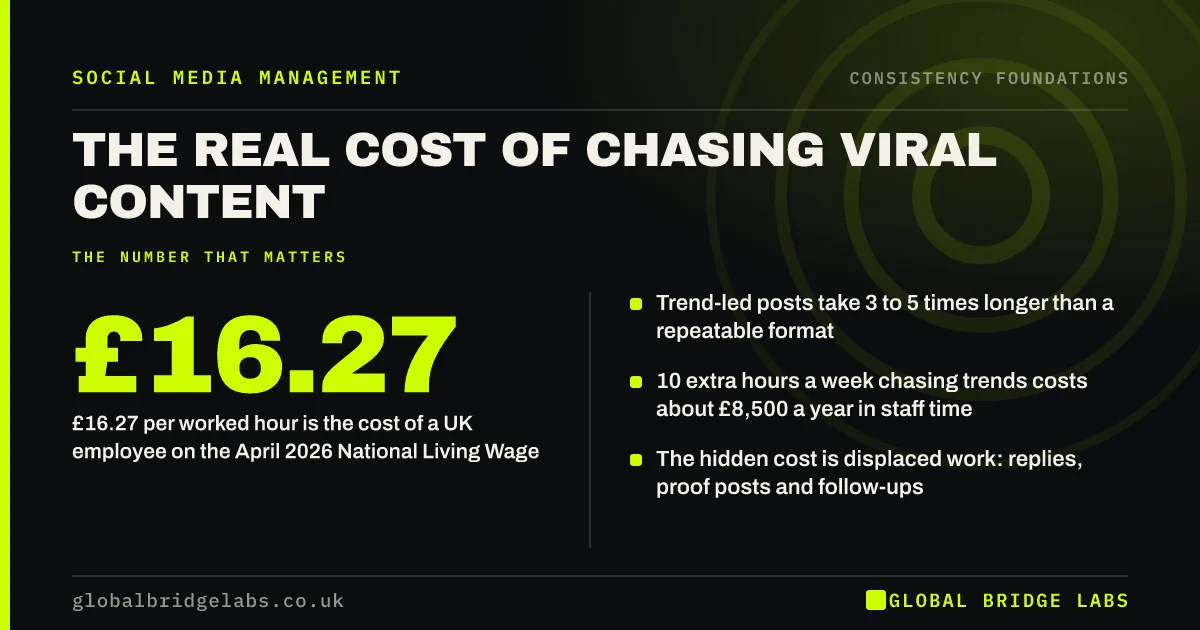
- £16.27 per worked hour is the cost of a UK employee on the April 2026 National Living Wage.
- Trend-led posts take 3 to 5 times longer than a repeatable format.
- 10 extra hours a week chasing trends costs about £8,500 a year in staff time.
- The hidden cost is displaced work: replies, proof posts and follow-ups.
- Consistent formats get cheaper every month. Viral attempts do not.
Want to know what your social media hours actually cost? Message us on WhatsApp for a costed comparison.
Chat on WhatsApp →Why does chasing viral content cost so much?
Chasing viral content is expensive because it depends on speed, novelty and volume. Trends move in days, so posts must be made quickly and often outside normal working time. Each attempt is new, so nothing is reused. And because outcomes are unpredictable, the usual response to a miss is to try more times.
A repeatable format works the other way. The template, the shot list and the caption structure are built once and reused for months, so each post gets cheaper to make.
How long does a viral attempt take to make?
In the UK accounts we produce content for, a routine post in an established series takes 30 to 60 minutes including the caption. A trend-led short video takes two to four hours once scripting, filming, retakes, editing and audio are included, and it often needs to be done the same day.
- Routine proof post from a template: 30 to 45 minutes.
- Answered customer question as a carousel: 45 to 60 minutes.
- Trend-led short video: 2 to 4 hours, often at short notice.
- Reactive post on a news moment: 1 to 2 hours plus approval delays.
What does it cost in money?
Using official 2026/27 rates, a UK employee on the National Living Wage of £12.71 costs about £16.27 per worked hour after employer National Insurance and pension. A marketing coordinator on £28,000 costs closer to £20 per worked hour. Ten extra hours a week at £16.27 is about £8,500 a year; at £20 it is over £10,000.
If the work is outsourced, trend-led video is usually the most expensive line on a social media retainer. Most UK SMEs pay £950–£2,500 a month for strategy, content and community management; adding reactive video production commonly moves a retainer into the £2,500–£5,000 band.
Want these numbers worked out for your team? Send us your hours on WhatsApp and we will cost both approaches.
Chat on WhatsApp →What is the hidden cost of chasing viral?
The hidden cost is what does not get done. Every hour spent on a trend is an hour not spent answering the question a prospect asked in the comments, posting the finished job that proves you can deliver, or following up the person who messaged last week.
Those are the activities most closely linked to enquiries, and they are the first to go when a team is chasing reach. The account gets louder and less useful at the same time.
When is spending on viral attempts justified?
When the business sells nationally or online, has capacity to meet a spike, and the experiments sit on top of a steady base. A consumer brand with a clear product can reasonably put one post in five into experiments aimed at wider reach.
It is not justified when the business is local, sells a considered B2B service, or has no steady base yet. In those cases every pound spent on reach is better spent on consistent visibility with the people who can actually buy.
What does this look like in practice?
A UK hospitality group was spending roughly 12 hours a week across two staff on trend videos for three venues. A few did well; most reached a few hundred people, many of them outside the area. Bookings attributed to social media were flat.
We replaced the trend work with two weekly series per venue, the weekend menu and a behind-the-bar post, batched on one afternoon a fortnight. Staff time dropped to about five hours a week and bookings from social links rose over the next quarter, because the people who already liked the venues were now seeing them every week.
Next step
For one month, log the hours spent on every post and the enquiries each one produced. Most businesses find that their cheapest, most repeatable posts are also their most productive, and that the viral attempts were the most expensive line in the plan.
Send us your month of logs on WhatsApp and we will show you where the hours should go.
Chat on WhatsApp →Sources and further reading
Frequently asked questions
Is chasing viral content worth it for small businesses?
Rarely. It costs several times the hours of a steady routine, outcomes are unpredictable, and most viral reach falls outside a small business's market. It can be worth a small share of effort for consumer brands selling nationally online, but only on top of consistent, buyer-focused posting.
How long does it take to make a viral-style video?
Typically two to four hours for a short trend-led video once scripting, filming, retakes, editing and audio are included, and it usually has to be done quickly. A post in an established series takes 30 to 60 minutes, which is why repeatable formats are far cheaper over a year.
What should small businesses spend social media time on instead?
Proof posts showing finished work, answers to real customer questions, behind-the-scenes content about the team, and replies to every comment and message. These are cheap to repeat, reach people already interested in you, and are the posts most closely linked to enquiries.
How much does social media cost a UK small business?
In-house, the main cost is staff time at roughly £16 to £20 or more per worked hour. Agencies typically charge £950 to £2,500 a month for most UK SMEs, rising for heavy video production. The cheapest effective option is almost always a small, consistent routine.
Written by

Global Bridge Labs (GBL) is a UK–Sri Lanka partner for social media, websites and BPO. Everything here comes from client delivery, not theory.