On this page
- 01Key takeaways
- 02What is the outsourcing break-even point?
- 03How do you calculate the break-even point?
- 04What does a worked example look like?
- 05Which costs push the break-even point out?
- 06When does outsourcing never break even?
- 07Should break-even include revenue gains?
- 08How do you check you actually reached break-even?
- 09How do you bring the break-even point forward?
- 10What does this look like in practice?
- 11Break-even checklist
- 12Next step
- 13Sources and further reading
- 14Frequently asked questions
Key takeaways
The outsourcing break-even point is the moment the monthly saving from outsourcing has repaid the setup effort and any fees. For repeatable work moved off senior staff, most UK SMEs reach it within 2 to 4 months. Compare the loaded in-house cost per hour with the outsourced rate plus your management time.
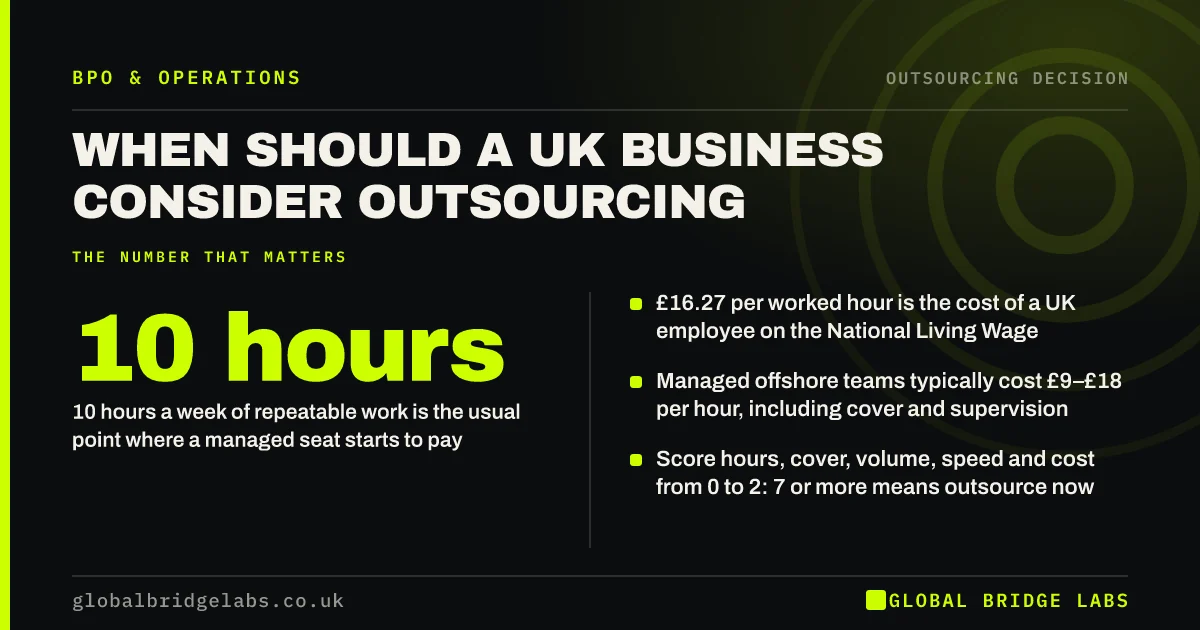
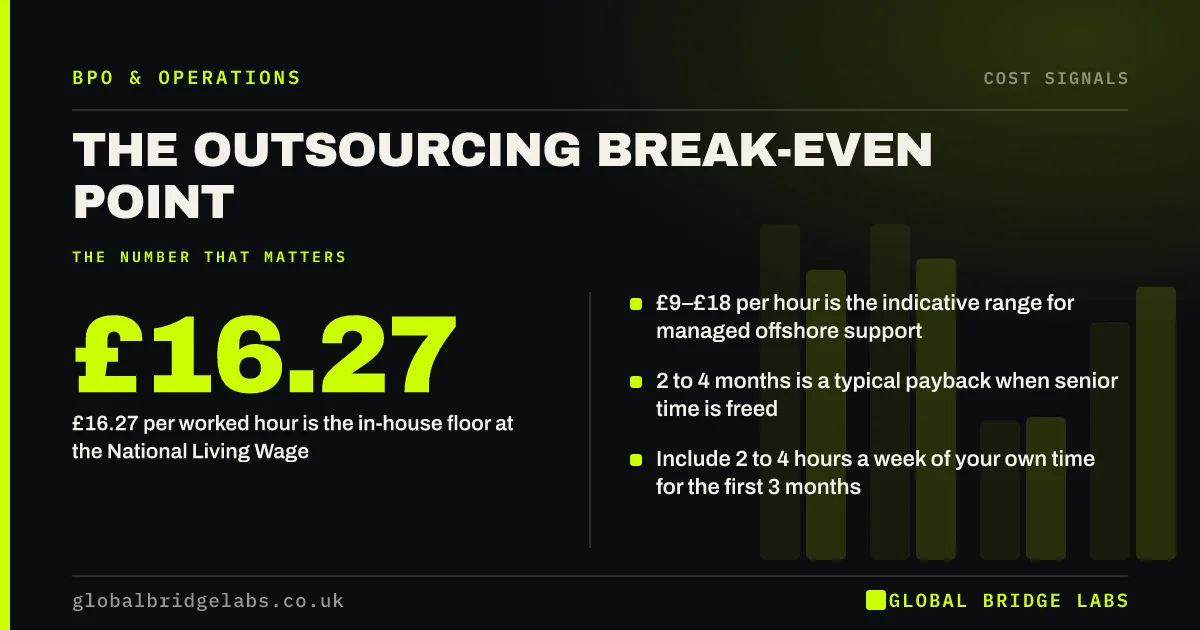
- £16.27 per worked hour is the in-house floor at the National Living Wage.
- £9–£18 per hour is the indicative range for managed offshore support.
- 2 to 4 months is a typical payback when senior time is freed.
- Include 2 to 4 hours a week of your own time for the first 3 months.
Want your break-even point worked out? Message us on WhatsApp with the process and hours.
Chat on WhatsApp →What is the outsourcing break-even point?
The outsourcing break-even point is when the total saved by outsourcing a process equals the total spent setting it up. Before it, you are paying to learn; after it, every month is a gain. It depends on three numbers: the in-house cost per hour, the outsourced cost per hour, and the one-off cost of the handover.
How do you calculate the break-even point?
Work out the monthly saving, then divide the one-off setup cost by it. The answer is the number of months to break even. Include your own time during setup at its real value, because that is usually the largest one-off cost.
- In-house monthly cost: hours per month x loaded cost per hour.
- Outsourced monthly cost: hours per month x provider rate, plus management time.
- Monthly saving: in-house cost minus outsourced cost.
- Setup cost: any fees plus internal hours spent documenting and reviewing.
- Break-even in months: setup cost divided by monthly saving.
What does a worked example look like?
Take an owner who spends 12 hours a week on invoicing and email, valued at £60 an hour. That is about £3,120 a month. An offshore seat at £12 per hour for the same hours costs about £624 a month, plus 3 hours a week of the owner's review time at first, about £780. The monthly saving is roughly £1,700 during setup.
If documenting the process and training take 20 owner hours, worth £1,200, the break-even point arrives in the first month. Where the work sits with a £14-an-hour employee instead, the saving is smaller and break-even takes longer.
Want this run with your own numbers? Send them to us on WhatsApp and we will discuss your requirements.
Chat on WhatsApp →Which costs push the break-even point out?
Setup fees, long minimum terms, poor documentation and processes that change during handover all push break-even later. So do low volumes: with only a few hours a week, the monthly saving is too small to repay the setup quickly. Hidden costs such as extra software licences also count.
When does outsourcing never break even?
When the work is already done cheaply and well by someone with spare time, when the volume is under a few hours a week, or when the process needs so much checking that management time cancels the saving. In those cases, keep the work in-house or look at automation.
Should break-even include revenue gains?
Include them separately. Cost break-even is the conservative case and the one to show a sceptical partner. Revenue gains, such as enquiries recovered through faster replies, often shorten payback further but are less certain. Show both, and make the decision on the cost case if you can.
How do you check you actually reached break-even?
Compare the numbers after three months with the baseline. Check the provider's invoices against the hours delivered, count the internal hours still spent on the process, and confirm the freed time went on the work you planned. A saving that only exists on paper, because nobody used the freed hours, is not a saving.
- Provider cost per month against the estimate.
- Internal hours still spent on the process.
- Quality and speed measures against the baseline.
- What the freed hours were used for.
How do you bring the break-even point forward?
Reduce the setup cost and increase the monthly saving. A clear written process cuts training time, starting with the highest-value hours raises the saving, and short notice terms limit the downside if the first month is slow. Most delays to break-even come from handing over an undocumented process and then answering the same questions for weeks.
- Document the ten most common cases before the start date.
- Move work off the most expensive person first.
- Batch questions from the team into one daily review.
- Avoid setup fees and long minimum terms where possible.
What does this look like in practice?
A pattern we see in UK professional services firms: a partner worries about setup cost when moving document chasing to a managed team. Once partner hours are valued at the charge-out rate, the saving in the first month covers the setup, and the practice reaches break-even before the first quarterly review.
Across our client work, back-office cost per task has fallen by 42% once the process was written down and run by a managed team.
Break-even checklist
Use these steps to find your break-even point.
- Measure the hours the process takes each month.
- Cost those hours at the loaded rate of whoever does them.
- Get an outsourced price for the same hours.
- Add your management time and any fees.
- Divide setup cost by monthly saving.
- Check the real numbers after three months.
Next step
Send us the process, the hours and who does it today. We will estimate your break-even point with real market ranges in a 30-minute call.
Message us on WhatsApp for a break-even estimate, or book a 30-minute consultation.
Chat on WhatsApp →Sources and further reading
Frequently asked questions
How long does outsourcing take to pay for itself?
When the work moves off owners or senior staff, most UK SMEs break even within 2 to 4 months, and sometimes within the first. When the work moves off a lower-paid employee, payback takes longer because the monthly saving is smaller. Setup quality and contract terms also matter.
How do you compare outsourcing with employing someone?
Compare loaded cost per hour of work delivered. For an employee, include employer National Insurance, pension, holiday, recruitment, equipment and management time. For outsourcing, include the provider rate, any fees and your review time. Then compare over 12 months.
What is a good payback period for outsourcing?
Under six months is good for a single process on short notice terms. If break-even is more than a year away, the volume is probably too small, the work is already cheap in-house, or the process needs fixing before it is handed over.
Written by

Global Bridge Labs (GBL) is a UK–Sri Lanka partner for social media, websites and BPO. Everything here comes from client delivery, not theory.