On this page
- 01Key takeaways
- 02Why do outsourcing decisions go wrong?
- 03Mistake 1: choosing on hourly rate alone
- 04Mistake 2: outsourcing too much at once
- 05Mistake 3: handing over an undocumented process
- 06Mistake 4: no baseline and no measures
- 07Mistake 5: long terms before results
- 08What other mistakes are common?
- 09How do you know if you have made one of these mistakes?
- 10What does this look like in practice?
- 11Decision checklist
- 12Next step
- 13Sources and further reading
- 14Frequently asked questions
Key takeaways
The most common outsourcing decision mistakes UK SMEs make happen before any work moves: choosing on hourly rate alone, outsourcing too much at once, handing over an undocumented process, skipping the baseline, and signing long terms before seeing results. Each is avoidable with a scorecard, a pilot and a named internal owner.
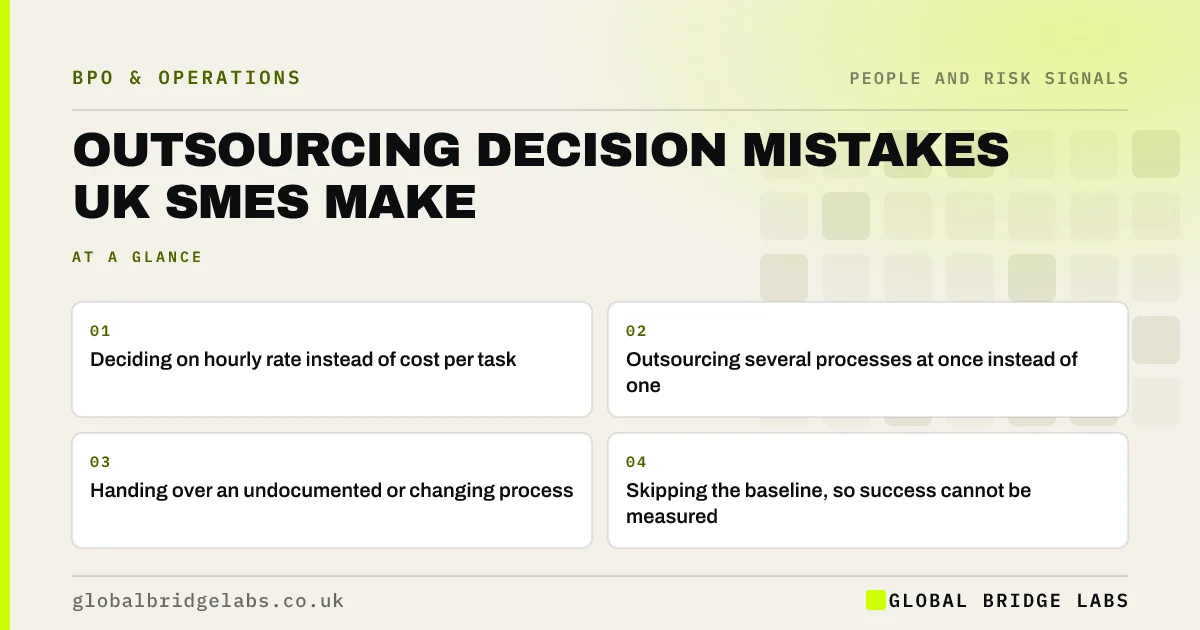
- Deciding on hourly rate instead of cost per task.
- Outsourcing several processes at once instead of one.
- Handing over an undocumented or changing process.
- Skipping the baseline, so success cannot be measured.
- Signing long minimum terms before seeing results.
About to decide? Message us on WhatsApp and we will sense-check the plan.
Chat on WhatsApp →Why do outsourcing decisions go wrong?
Most go wrong because the decision is made under pressure, on one number, without a way to measure the result. The owner is overloaded, a quote looks cheap, and the handover starts the next week. The problems that follow, such as poor quality, confusion and disappointing savings, usually trace back to that rushed decision.
Mistake 1: choosing on hourly rate alone
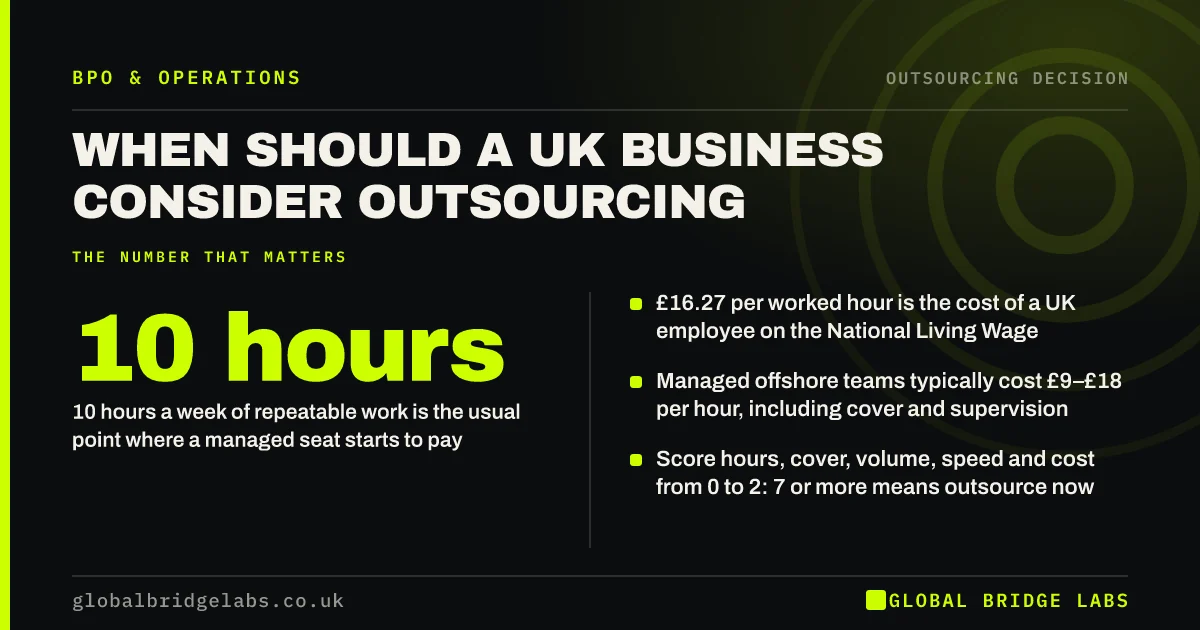
The lowest hourly rate rarely gives the lowest cost per task. Providers without supervision or quality checks produce rework that your team fixes, and some quotes exclude cover or management. Compare cost per task, include management time, and check what is included in the price.
Mistake 2: outsourcing too much at once
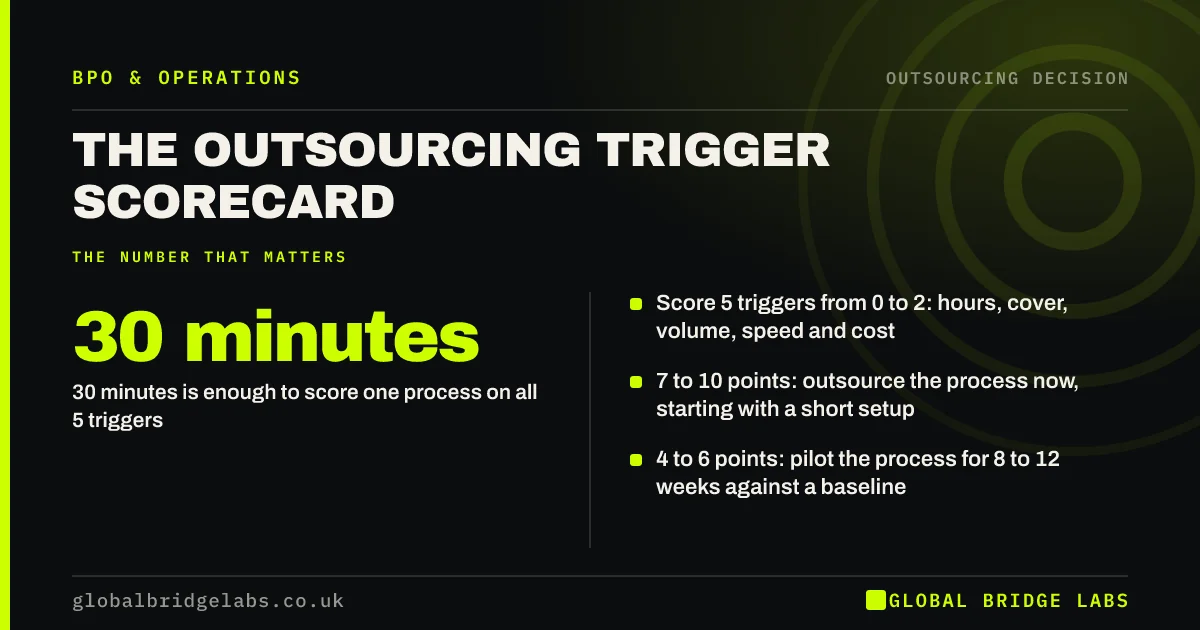
Moving several processes together multiplies questions, reviews and risk, and makes it impossible to tell what is working. Start with one process, get it running well for 8 to 12 weeks, then add the next. The habits you build on the first one make every later handover faster.
Mistake 3: handing over an undocumented process
A provider runs the process you describe. If it lives in someone's head, or changes every fortnight, the provider inherits the confusion and quality suffers. Write down the common cases and exceptions first, and wait until the process has been stable for about three months.
Want a quick readiness check before you hand over? Ask us on WhatsApp.
Chat on WhatsApp →Mistake 4: no baseline and no measures
Without a baseline, nobody can say whether outsourcing worked, and opinions replace evidence. Record two weeks of reply times, volumes, errors and internal hours before the change, agree two or three measures, and review them weekly.
Mistake 5: long terms before results
A 12 or 24-month minimum term shifts the risk to you before you have seen any work. Prefer short notice terms, at least for the first process. If a provider offers a lower rate for a long commitment, take it only after the pilot has proved the service.
What other mistakes are common?
Several others come up regularly and are just as avoidable.
- No internal owner, so questions go unanswered.
- Skipping the processor contract or sharing logins.
- Outsourcing the work customers choose you for.
- Telling staff late, or letting them hear from others.
- Judging the result on the first fortnight.
How do you know if you have made one of these mistakes?
The symptoms appear in the first two months. If your team is still checking every piece of work, if nobody can say whether things are better, if the provider keeps asking the same questions, or if the invoice is higher than expected, one of these mistakes is usually behind it. Most can be fixed without starting again: narrow the scope, write the process down and set measures.
- Your team is re-checking everything after week six.
- Nobody can say whether service has improved.
- The same questions come back every week.
- Invoices exceed the budget without more volume.
What does this look like in practice?
A pattern we see in UK SMEs switching provider after a poor first experience: the first arrangement was chosen on rate, covered three processes from day one, had no written process and a 12-month term. The second attempt starts with one process, a baseline, a pilot and 30-day terms, and is running well within the quarter.
Decision checklist
Check these before you commit.
- Compare cost per task, not hourly rate.
- Start with one process.
- Document it and check it is stable.
- Record a baseline and agree measures.
- Use short notice terms for the first process.
- Name an internal owner and tell staff early.
Next step
Tell us what you are about to outsource and how. We will point out any of these mistakes in the plan before they cost you.
Message us on WhatsApp for a plan check, or book a 30-minute consultation.
Chat on WhatsApp →Sources and further reading
- Contracts and liabilities between controllers and processors · Information Commissioner's Office
- International transfers of personal data · Information Commissioner's Office
- Business transfers, takeovers and TUPE · GOV.UK
Frequently asked questions
What are the most common outsourcing mistakes?
Choosing on hourly rate alone, outsourcing too much at once, handing over an undocumented process, skipping the baseline, signing long minimum terms before seeing results, and having no internal owner. Each is avoidable with a scorecard, a pilot and clear measures.
How do I avoid a bad outsourcing decision?
Score the process first, start with one, document it, record a baseline, run an 8 to 12-week pilot on short notice terms, and name an internal owner. Compare cost per task rather than hourly rates, and put the processor contract in place from day one.
Why does outsourcing fail for small businesses?
Usually because of rushed decisions: unclear processes, no measures, the cheapest provider, too much handed over at once, and nobody owning the relationship. Businesses that start small, measure and review weekly tend to get good results.
Written by

Global Bridge Labs (GBL) is a UK–Sri Lanka partner for social media, websites and BPO. Everything here comes from client delivery, not theory.