On this page
- 01Key takeaways
- 02What is BPO staff turnover?
- 03Why do people leave outsourced teams?
- 04What does turnover cost your service?
- 05What should you ask providers about turnover?
- 06How do you protect continuity?
- 07Is low price linked to high turnover?
- 08How does in-house turnover compare?
- 09What does this look like in practice?
- 10Checklist: manage turnover risk
- 11Next step
- 12Sources and further reading
- 13Frequently asked questions
Key takeaways
BPO staff turnover is the rate at which people leave an outsourced team. High turnover means constant retraining, inconsistent quality and customers repeating themselves. You cannot control a provider's HR, but you can choose a provider that retains people, and protect yourself with documented processes and trained cover.
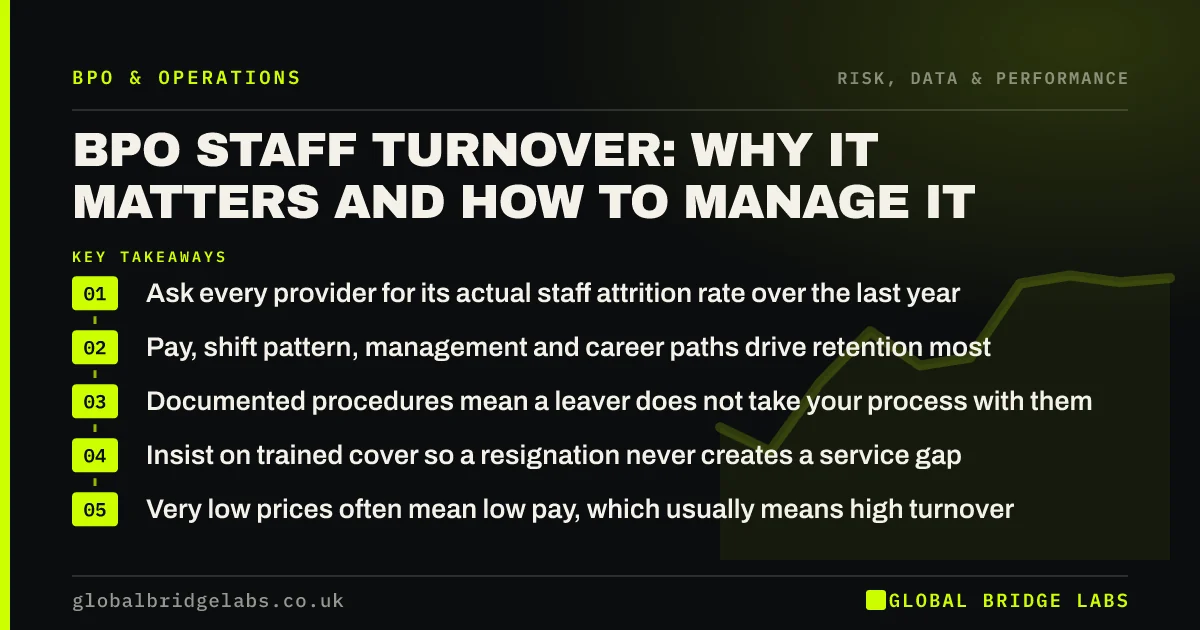
- Ask every provider for its actual staff attrition rate over the last year.
- Pay, shift pattern, management and career paths drive retention most.
- Documented procedures mean a leaver does not take your process with them.
- Insist on trained cover so a resignation never creates a service gap.
- Very low prices often mean low pay, which usually means high turnover.
Worried about churn in an outsourced team? Message us on WhatsApp and we will explain how we handle it.
Chat on WhatsApp →What is BPO staff turnover?
BPO staff turnover, or attrition, is the percentage of an outsourced team who leave over a period, usually a year. It includes resignations, dismissals and moves to other accounts within the provider. It is a known challenge in large, competitive business process outsourcing markets, where experienced people can move easily.
For clients, turnover matters because every leaver takes knowledge of your products and customers with them, and every new starter needs training.
Why do people leave outsourced teams?
People leave outsourced teams for the same reasons they leave any job: pay, shift patterns, poor management, repetitive work and no route to progress. Night shifts add strain. In very competitive markets, a small pay rise elsewhere is enough to move.
Clients influence some of this. Treating the team as colleagues, sharing context and recognising good work all help retention.
What does turnover cost your service?
Turnover costs you in quality dips during retraining, slower replies while new people learn, repeated mistakes, and your own time explaining the business again. Customers notice when they have to repeat themselves. In a managed service, the provider bears the recruitment cost, but you still bear the service impact.
What should you ask providers about turnover?
Ask directly and expect numbers, not reassurance.
- What was your staff attrition rate over the last 12 months?
- What is the average tenure on client accounts like ours?
- How do you pay compared with the local market?
- What training, career paths and wellbeing support do you offer?
- How do you cover a leaver, and how quickly is a replacement trained?
- Will we be told when team members change?
How do you protect continuity?
Protect continuity with documentation and cover. Keep procedures, model replies and training materials in your systems, updated whenever something changes. Require the provider to keep at least one trained backup on your process. Then a resignation becomes a handover rather than a crisis.
Short feedback loops help new starters too: a weekly QA sample and quick coaching get them up to standard faster.
Is low price linked to high turnover?
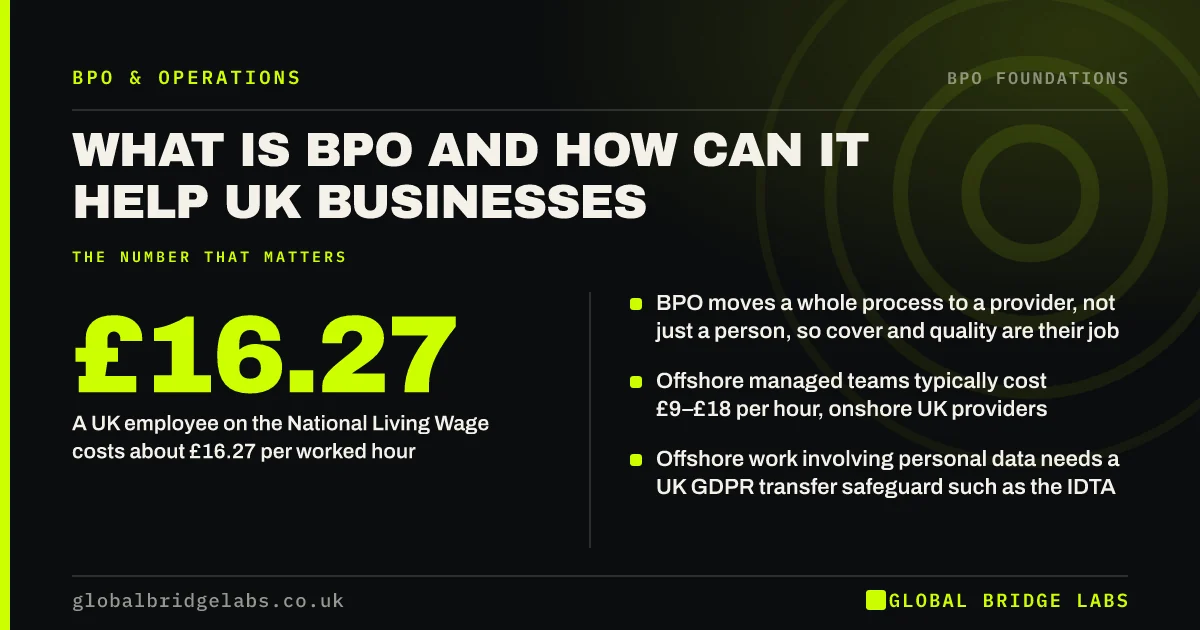
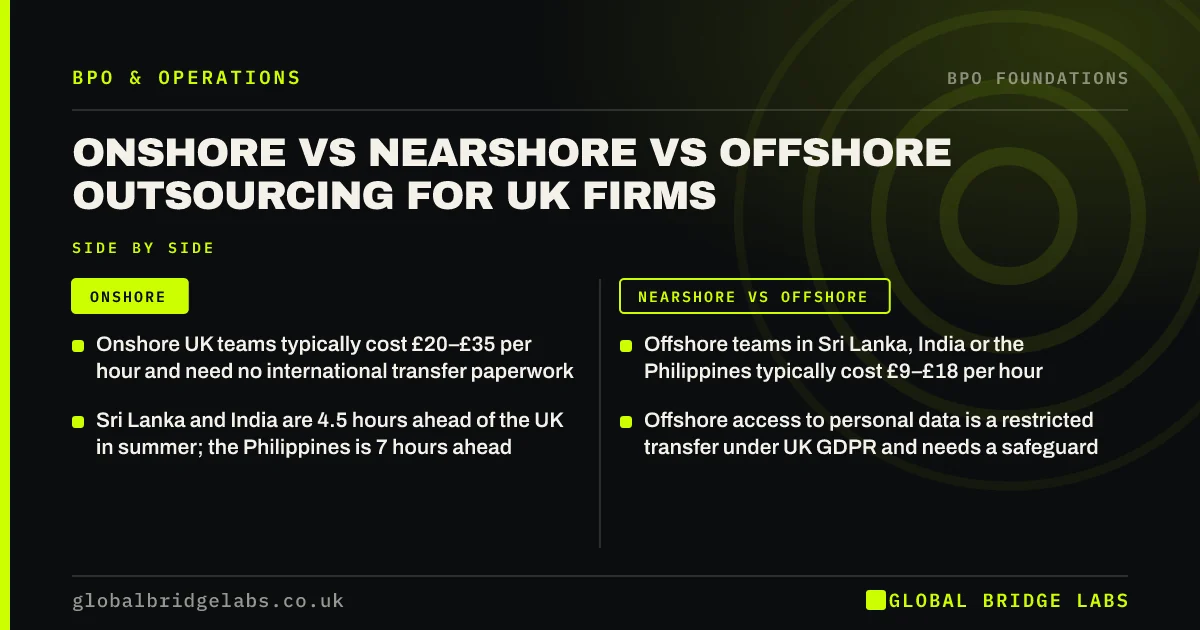
Often. The largest cost in business process outsourcing is people. A provider quoting well below the market is usually paying less, supervising less or both, and underpaid staff leave. As indicative market ranges, managed offshore teams cost around £9–£18 per hour; a quote far below that deserves questions about pay and retention.
Want a managed team where cover and retention are built into the price? Tell us about your process on WhatsApp and we will discuss your requirements.
Chat on WhatsApp →How does in-house turnover compare?
In-house roles turn over too, and small businesses feel it most because one leaver can take a whole process. Recruiting a replacement in the UK takes weeks, and a new employee on the April 2026 National Living Wage costs about £16.27 per worked hour after employer costs from their first day, while still learning. The difference with a managed provider is that cover and replacement are its job.
That shifts the risk. With an in-house hire, a resignation is your recruitment problem and your service gap. With a managed provider, it is the provider's problem to solve inside the agreed service levels, and the scorecard shows whether it did.
What does this look like in practice?
At Global Bridge Labs (GBL), we hire, train and quality-check the team against the client's standards, and replace people without a gap. Because the process is documented and we keep trained cover, there is no key-person risk on the client's side. A smaller Sri Lankan market and afternoon-to-evening shifts for UK hours also help retention.
Checklist: manage turnover risk
Put these in place.
- Ask for attrition and tenure figures before signing.
- Check pay and working conditions in the provider's market.
- Keep procedures and training materials in your systems.
- Require at least one trained backup on your process.
- Ask to be told about team changes in advance.
- Use weekly QA to bring new starters up to standard.
Next step
If turnover has hurt a past outsourcing arrangement, talk to us about how we keep teams stable and cover leavers. 30 minutes, no pitch.
Message us on WhatsApp to talk it through, or book a 30-minute consultation.
Chat on WhatsApp →Sources and further reading
- Slavery and human trafficking in supply chains: guidance for businesses · Home Office
- National Minimum Wage and National Living Wage rates · GOV.UK
- Rates and thresholds for employers 2026 to 2027 · HM Revenue & Customs
Frequently asked questions
What is attrition in BPO?
Attrition is the rate at which staff leave an outsourced team over a period, usually a year, expressed as a percentage of average headcount. High attrition means frequent retraining and inconsistent service. Ask providers for their actual rate and how they cover leavers.
Why is staff turnover high in call centres?
Common causes are modest pay, demanding targets, repetitive work, night or late shifts, limited career progression and competitive local job markets where experienced agents can move easily. Well-managed providers reduce turnover through fair pay, good supervision, training and sensible shift patterns.
How can I reduce the impact of outsourced staff leaving?
Keep procedures documented in your systems, require trained backup staff on your process, ask to be told about team changes early, and use weekly quality checks to bring new starters up to standard quickly. Then a leaver becomes a handover rather than a service failure.
Should I choose the cheapest BPO provider?
Be cautious. People are the biggest cost in outsourcing, so a price well below the market often means lower pay or less supervision, which usually leads to higher turnover and weaker quality. Compare total value, retention and what the rate includes.
Written by

Global Bridge Labs (GBL) is a UK–Sri Lanka partner for social media, websites and BPO. Everything here comes from client delivery, not theory.