On this page
- 01Key takeaways
- 02When should you switch BPO provider?
- 03What should you check in your current contract?
- 04How do you secure your data and knowledge?
- 05How do you avoid a service gap?
- 06Does TUPE apply when switching provider?
- 07What does switching cost?
- 08Should you bring the work back in-house instead?
- 09What does this look like in practice?
- 10Checklist: switch provider safely
- 11Next step
- 12Sources and further reading
- 13Frequently asked questions
Key takeaways
Switching BPO provider works when you treat it as a planned transition rather than a break-up. Confirm your notice and exit rights, secure your procedures and data, run the new provider alongside the old one for a short overlap, and move volume across in stages. Check TUPE if UK-based staff are involved.
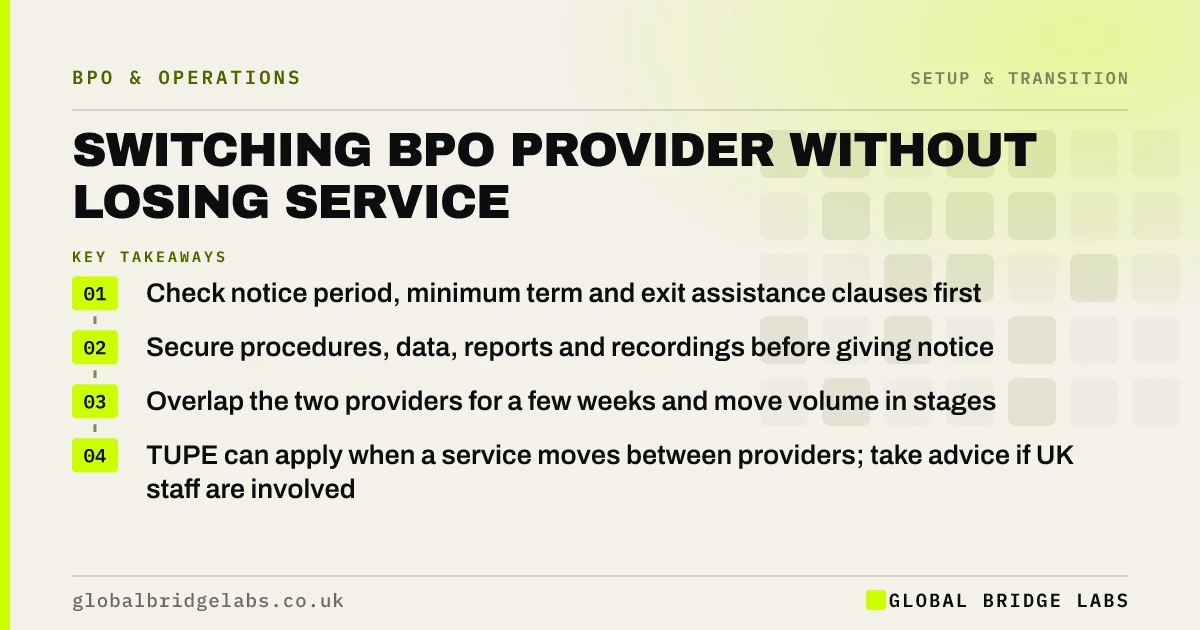
- Check notice period, minimum term and exit assistance clauses first.
- Secure procedures, data, reports and recordings before giving notice.
- Overlap the two providers for a few weeks and move volume in stages.
- TUPE can apply when a service moves between providers; take advice if UK staff are involved.
- Fix the cause of the switch, or the new provider will inherit it.
Thinking of switching provider? Message us on WhatsApp and we will tell you how we would plan the handover.
Chat on WhatsApp →When should you switch BPO provider?
Switch when service levels are missed repeatedly despite a remediation plan, when quality problems keep returning, when the provider cannot scale with you, or when the commercial terms no longer make sense. Switch on evidence from your scorecard, not on one bad week.
Before switching, ask whether the problem is the provider or the process. If the procedures are thin, the scope unclear or nobody on your side owns the relationship, a new business process outsourcing (BPO) provider will face the same problems.
What should you check in your current contract?
Read the exit terms before you talk to anyone. They decide your timeline and costs.
- Notice period and any remaining minimum term.
- Exit assistance: will the provider cooperate with a handover?
- Return of data, procedures, recordings and reports.
- Ownership of procedures and training materials.
- Non-solicitation clauses about hiring the provider's staff.
- Data deletion obligations after the contract ends.
How do you secure your data and knowledge?
Make sure you have everything needed to run the process before you give notice. If the team worked in your systems, most data is already yours. Collect the procedures, model replies, training materials, recent reports and any recordings, and confirm in writing when the provider will return or delete any data it holds, as the processor contract requires.
How do you avoid a service gap?
Overlap the providers. Start the new team during the old provider's notice period, train them from your procedures and recordings, then move volume across in stages: a channel or a share of volume at a time. Keep the old provider handling the rest until the new team meets service levels.
A two to four week overlap costs more for a short time but avoids the far higher cost of a service collapse.
Does TUPE apply when switching provider?
It can. GOV.UK guidance says TUPE covers service provision changes, including when a contract ends and the work moves to a new contractor, or moves back in-house. Employees clearly identified as providing the service may transfer to the new provider with their terms and conditions.
In practice this mostly affects UK-based teams. If the outgoing provider's staff are in the UK and dedicated to your work, take legal advice before switching.
What does switching cost?
Costs include any remaining notice or minimum term, the overlap period where you pay both providers, any setup fee from the new provider, and your team's time during transition. As indicative market ranges, managed offshore teams cost around £9–£18 per hour and onshore £20–£35, so a four-week overlap on one seat has a clear, bounded cost.
Switching is far cheaper when procedures and data live in your own systems. That is the main lesson to carry into the next contract.
Want the switch planned and costed, including the overlap? Send us your current set-up on WhatsApp and we will discuss your requirements.
Chat on WhatsApp →Should you bring the work back in-house instead?
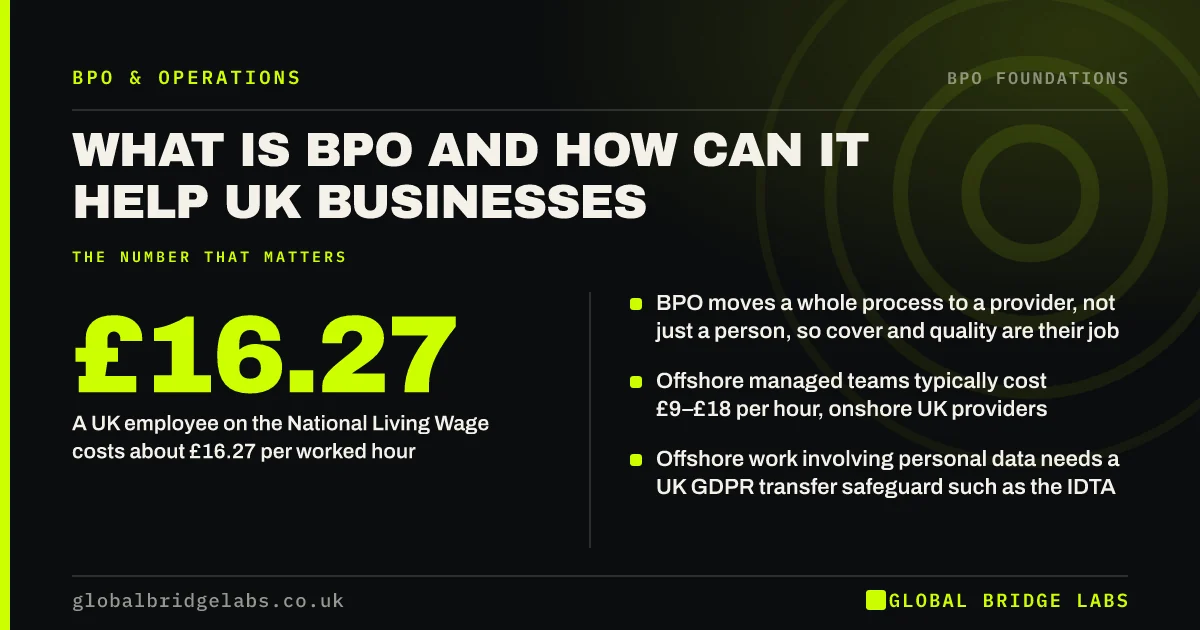
Sometimes. Bringing work in-house makes sense if volumes have fallen, if the work now needs close judgement, or if you have built an internal team that can absorb it. Cost it honestly: a UK employee on the April 2026 National Living Wage costs about £16.27 per worked hour after employer National Insurance, pension and holiday, before recruitment and cover.
What does this look like in practice?
A pattern we see when businesses switch to us: the previous provider held the only copy of the procedures, so the first two weeks are spent rebuilding them from call recordings and the client's own staff. We write them into the client's systems so the next change, if it ever comes, is easier.
Checklist: switch provider safely
Work through these in order.
- Confirm the reason for switching with scorecard evidence.
- Read notice, exit and data return clauses.
- Collect procedures, data, reports and recordings.
- Check whether TUPE could apply.
- Select the new provider with the same written scope.
- Overlap for two to four weeks and move volume in stages.
- Confirm data deletion by the old provider in writing.
Next step
If your current provider is not working, talk to us before you give notice. We will help you plan a switch without a service gap. 30 minutes, no pitch.
Message us on WhatsApp about switching, or book a 30-minute consultation.
Chat on WhatsApp →Sources and further reading
- Business transfers, takeovers and TUPE · GOV.UK
- Contracts and liabilities between controllers and processors · Information Commissioner's Office
- National Minimum Wage and National Living Wage rates · GOV.UK
Frequently asked questions
How do I change outsourcing provider?
Check your notice and exit terms, secure your procedures and data, select a new provider using a written scope, overlap the two providers for a few weeks, and move volume across in stages. Confirm in writing that the old provider has returned or deleted your data.
How long does it take to switch BPO provider?
Typically four to eight weeks from decision to full handover, depending on notice period, how well documented the process is and how many channels are involved. A two to four week overlap between providers is the safest way to avoid a gap.
Does TUPE apply when changing contractors?
It can. TUPE covers service provision changes, including when work moves from one contractor to another or back in-house. Employees clearly identified as providing the service may transfer. It mainly affects UK-based staff; take legal advice if it might apply.
What if my provider will not hand over the procedures?
Check the contract for ownership and exit assistance clauses. If procedures were never documented in your systems, rebuild them from your own staff, call recordings and system history. For future contracts, keep procedures in systems you control from day one.
Written by

Global Bridge Labs (GBL) is a UK–Sri Lanka partner for social media, websites and BPO. Everything here comes from client delivery, not theory.