On this page
- 01Key takeaways
- 02Should your homepage show blog posts?
- 03When do articles help homepage conversion?
- 04Where should articles go on the homepage?
- 05Does a blog feed help SEO?
- 06When should you remove the feed?
- 07What does this look like in practice?
- 08Homepage blog feed checklist
- 09Next step
- 10Sources and further reading
- 11Frequently asked questions
Key takeaways
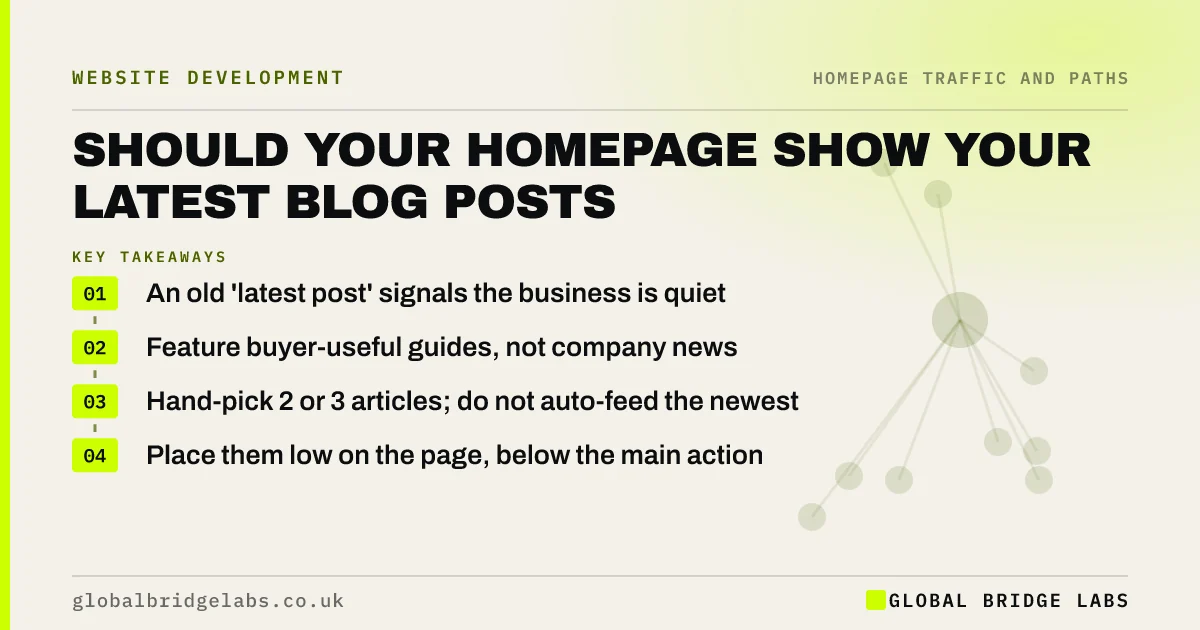
Blog posts on a homepage help only when they are useful to buyers and kept current. An automatic 'latest news' feed showing a post from two years ago signals neglect, and a feed of company news rarely helps buyers decide. If you show articles, hand-pick two or three that answer common pre-purchase questions, placed low on the page.
- An old 'latest post' signals the business is quiet.
- Feature buyer-useful guides, not company news.
- Hand-pick 2 or 3 articles; do not auto-feed the newest.
- Place them low on the page, below the main action.
Not sure whether your blog belongs on your homepage? Message us on WhatsApp.
Chat on WhatsApp →Should your homepage show blog posts?
Only if they help buyers and stay current. Most small business homepages that show 'latest news' display posts that are months or years old, which suggests the business is quiet. A feed of company announcements also rarely answers the questions visitors arrive with.
When do articles help homepage conversion?
Articles help when they answer the questions buyers ask before choosing, such as 'How much does a loft conversion cost?' or 'What to ask an accountant before switching'. They show expertise and give researchers a reason to stay. Hand-pick two or three of these rather than showing the newest.
Where should articles go on the homepage?
Low on the page, after proof and the main repeated call to action. Articles serve visitors who are not ready to act, so they should not compete with the main path. A link to the full blog in the menu or footer is enough for most visitors.
Does a blog feed help SEO?
A homepage feed adds internal links to articles, which can help them be found, but the effect is modest compared with linking from relevant service pages. Publishing helpful articles matters more than where the feed sits. Do not keep a stale feed for SEO reasons.
When should you remove the feed?
Remove it if you publish less than every couple of months, if the posts are company news nobody outside the business needs, or if it slows the page with large images. Replace it with hand-picked guides or nothing.
What does this look like in practice?
A pattern we see: the homepage's 'Latest news' shows a Christmas message from three years ago. Removing the feed, or replacing it with two evergreen buyer guides, instantly makes the business look more active without writing anything new.
Homepage blog feed checklist
- Check the date of the newest post on your homepage.
- Remove auto-feeds if you post rarely.
- Hand-pick 2 or 3 buyer-useful guides.
- Place them below the main call to action.
- Link articles from relevant service pages too.
Next step
Check the date of the newest post shown on your homepage. If it is more than three months old, remove the feed or replace it with hand-picked guides.
Message us on WhatsApp to choose the guides, or book a 30-minute consultation.
Chat on WhatsApp →Sources and further reading
- Creating helpful, reliable, people-first content · Google Search Central
- SEO link best practices for Google · Google Search Central
Frequently asked questions
Should I show blog posts on my homepage?
Only if they are useful to buyers and you publish regularly. An old 'latest post' suggests the business is inactive. Hand-picking two or three evergreen guides that answer common pre-purchase questions usually works better than an automatic feed.
Does a news section on my homepage help SEO?
It can add internal links to articles, but the effect is modest. Linking articles from relevant service pages and publishing genuinely helpful content matters more. Do not keep a stale feed for SEO reasons.
Where should blog posts go on a homepage?
Low on the page, after the proof and repeated call to action, because they serve visitors who are still researching. Keep a link to the full blog in the menu or footer for those who want more.
Written by

Global Bridge Labs (GBL) is a UK–Sri Lanka partner for social media, websites and BPO. Everything here comes from client delivery, not theory.