On this page
- 01Key takeaways
- 02Why do mission statements rarely help on a homepage?
- 03When do values matter to buyers?
- 04Where should the mission statement go?
- 05What if the mission is the product?
- 06What does this look like in practice?
- 07Mission statement checklist
- 08Next step
- 09Sources and further reading
- 10Frequently asked questions
Key takeaways
A mission statement on homepage space rarely helps a buyer decide, because it describes your intentions rather than what you do for them. Keep the mission for your About page and team. If a value genuinely matters to buyers, such as fixed prices or local sourcing, show it as a concrete promise with proof.
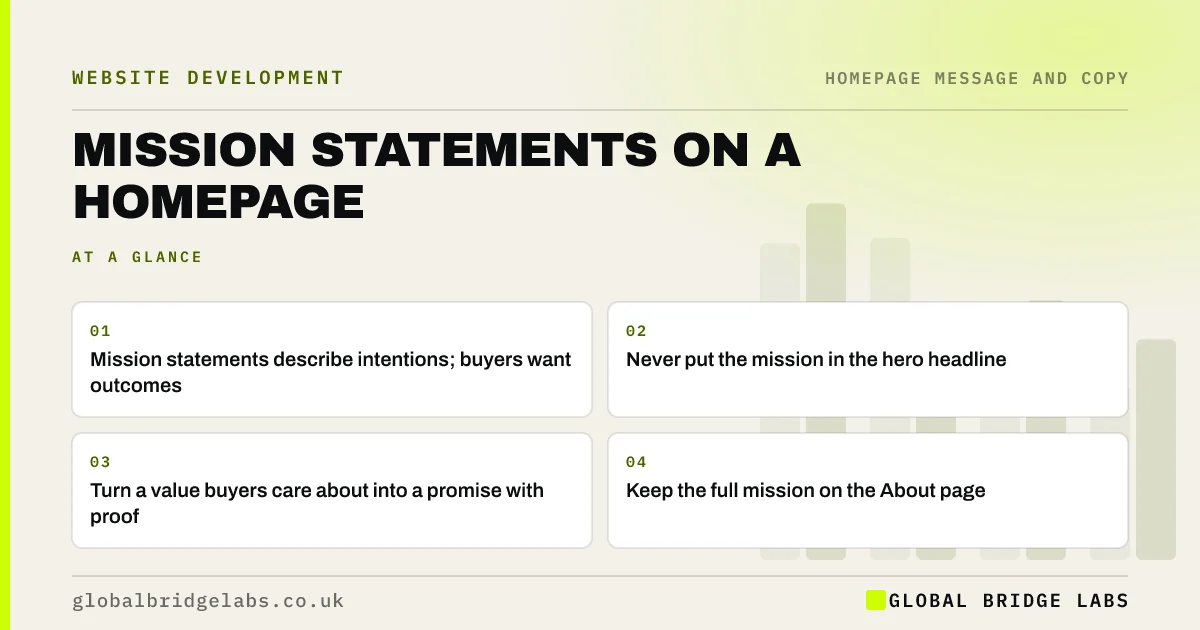
- Mission statements describe intentions; buyers want outcomes.
- Never put the mission in the hero headline.
- Turn a value buyers care about into a promise with proof.
- Keep the full mission on the About page.
Want to turn your values into homepage proof? Message us on WhatsApp.
Chat on WhatsApp →Why do mission statements rarely help on a homepage?
Mission statements rarely help because they are written for the business, not the buyer. 'To deliver excellence through innovation and integrity' could belong to any firm and answers none of the questions a visitor arrives with. On the homepage, where attention is short, it takes space from the description, proof and next step.
When do values matter to buyers?
Values matter when they change what the customer gets: fixed prices, no subcontractors, local suppliers, a named contact, sustainable materials. Those are buying reasons. Show them as specific promises with evidence, such as 'Every job priced in writing before we start', not as abstract words like 'transparency'.
Where should the mission statement go?
Put the full mission on the About page, where people who want to know who you are go looking. It also helps recruitment and keeps the team aligned. On the homepage, a short line in an 'about us' teaser lower down is enough, with a link to the full page.
What if the mission is the product?
For social enterprises, charities and B Corp businesses, the mission may be part of why people buy. Then express it as an outcome with a number: 'Every order funds a day of training for a care leaver; 3,200 days so far.' That is proof, not a statement.
What does this look like in practice?
A pattern we see after branding workshops: the new mission is placed proudly in the hero. Enquiries fall because the headline no longer says what the firm does. Moving the mission to the About page and restoring a plain headline usually reverses the drop.
Mission statement checklist
- Remove the mission from the hero.
- List values that change what customers get.
- Rewrite each as a specific promise with proof.
- Put the full mission on the About page.
- Link to it from a short homepage teaser.
Next step
List your values and cross out any a competitor could also claim. Turn the ones left into one-line promises with evidence.
Message us on WhatsApp to test your list, or book a 30-minute consultation.
Chat on WhatsApp →Sources and further reading
- 'About Us' information on corporate websites · Nielsen Norman Group
- Substantiation: advice on backing up marketing claims · ASA and CAP
Frequently asked questions
Should I put my mission statement on my homepage?
Not in the hero. Mission statements describe intentions, while visitors want to know what you do for them. Put the full mission on your About page and, if a value matters to buyers, show it on the homepage as a specific promise with proof.
Should company values be on the homepage?
Only values that change what the customer gets, shown as concrete promises with evidence, such as fixed written quotes or a named contact. Abstract values like integrity or passion rarely persuade on their own and are better placed on the About page.
Where does a vision statement belong on a website?
On the About page or a careers page, where people who want to understand the business or join it will look. It helps recruitment and partners more than buyers, so it rarely earns space on the homepage.
Written by

Global Bridge Labs (GBL) is a UK–Sri Lanka partner for social media, websites and BPO. Everything here comes from client delivery, not theory.