
On this page
- 01Key takeaways
- 02What is the month-end close?
- 03Why does it take so long?
- 04What does a slow close cost?
- 05How do you close faster?
- 06Which steps can be handed over?
- 07What should not be rushed?
- 08What does this look like in practice?
- 09Month-end close checklist
- 10Next step
- 11Sources and further reading
- 12Frequently asked questions
Key takeaways
The month end close process is the routine of finalising a month's accounting records so reliable figures can be produced. It drags when work that could be done daily is saved for the end. Moving bank matching, invoicing and receipt capture into the month, and using a fixed checklist, lets most small businesses close in about five working days.
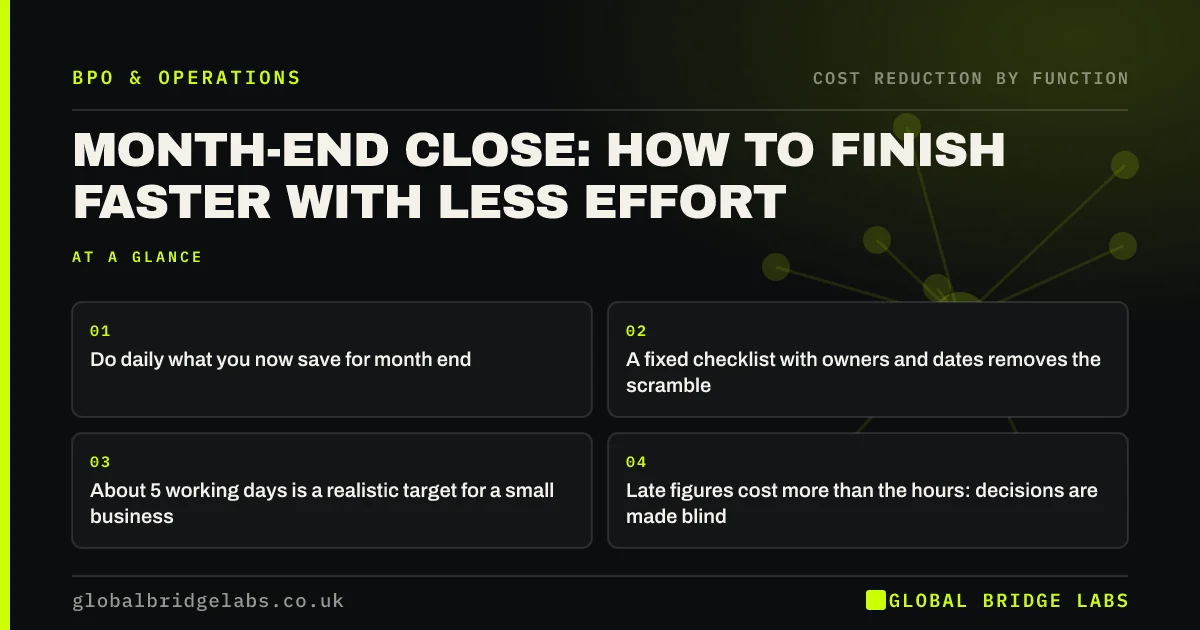
- Do daily what you now save for month end.
- A fixed checklist with owners and dates removes the scramble.
- About 5 working days is a realistic target for a small business.
- Late figures cost more than the hours: decisions are made blind.
Want your month-end routine reviewed? Message us on WhatsApp with how long it takes today.
Chat on WhatsApp →What is the month-end close?
The month-end close is the set of accounting tasks carried out after a month finishes to make sure every transaction is recorded, accounts are reconciled and the figures are accurate. The result is a profit and loss account and balance sheet the owner can trust.
Why does it take so long?
It takes long because a month of small jobs is done in a few days, by people who are also doing their normal work. Receipts are missing, invoices have not been raised, bank lines are unmatched and queries have to be sent to colleagues who have forgotten the detail.
- Transactions recorded in batches, not as they happen.
- Missing receipts and supplier invoices.
- Sales invoices raised late.
- Reconciliations left for the end.
- No fixed list, so steps are remembered differently each month.
What does a slow close cost?
A slow close costs the hours spent on it and the value of the information arriving late. In an illustrative firm, the close takes 12 working days. The owner sees March's figures in the third week of April, and any problem in them has been running for seven weeks.
Shortening the close to 5 working days gives the same figures a week and a half sooner. The effort usually falls too, because work done daily takes less time than work reconstructed from memory.
Want to know which steps are slowing your close? Send us your current routine on WhatsApp.
Chat on WhatsApp →How do you close faster?
Close faster by spreading the work across the month and fixing the order of what remains. The principle is that month end should be a check, not a catch-up.
- 1. Match bank transactions daily or weekly.
- 2. Capture receipts and supplier invoices as they arrive.
- 3. Raise sales invoices on completion.
- 4. Set a cut-off date and tell the team.
- 5. Follow the same checklist every month.
- 6. Review what slowed you down and fix one cause.
Which steps can be handed over?
The preparation can be handed over: transaction coding, bank matching, supplier statement checks, chasing missing documents and preparing reconciliations. Review, judgement and sign-off stay with your accountant or finance lead.
A managed team in an earlier time zone can also complete each day's processing overnight, so the books are current every morning.
What should not be rushed?
Do not rush reconciliations or skip review to hit a date. A fast close with errors is worse than a slow correct one, because decisions and tax filings rest on it. Company accounting records must be accurate and kept for six years, and late filing of annual accounts carries automatic penalties.
What does this look like in practice?
A pattern we see in small finance teams: the first week of each month is lost to the close, and the bookkeeper spends most of it asking colleagues for receipts. Collecting those documents through the month, by a simple photo-and-send routine, removes the chase and with it most of the delay.
Month-end close checklist
A basic list to adapt with your accountant.
- All sales invoices raised and sent.
- All supplier invoices and receipts entered.
- Bank and card accounts reconciled.
- Debtors and creditors reviewed.
- Payroll and VAT accounts checked.
- Unusual items queried and explained.
- Reports produced and reviewed with the owner.
Next step
Tell us how many working days your close takes and who does it. We will show you which tasks can move into the month and which could be prepared for you.
Message us on WhatsApp to shorten your month-end, or book a 30-minute consultation.
Chat on WhatsApp →Sources and further reading
Frequently asked questions
How long should month-end close take?
For a small business with tidy records, around five working days is a realistic target, and some manage less. If it takes more than ten, work that could be done during the month is probably being left to the end. Measure your own and aim to shorten it steadily.
What are the steps in a month-end close?
The usual steps are recording all income and expenses, reconciling bank and card accounts, reviewing what customers owe and what you owe suppliers, checking payroll and VAT accounts, making adjustments, and producing and reviewing the profit and loss account and balance sheet.
Why is a faster close valuable?
Because the figures are useful sooner. An owner who sees last month's results in the first week can act on a cost overrun or a margin drop while it still matters. It also spreads the workload and reduces the monthly peak for the finance team.
Can month-end tasks be outsourced?
The preparation can: coding transactions, matching bank lines, chasing documents and drafting reconciliations. Review and sign-off should stay with a qualified person who knows the business. Many firms use a managed team for daily processing and an accountant for review.
Written by

Global Bridge Labs (GBL) is a UK–Sri Lanka partner for social media, websites and BPO. Everything here comes from client delivery, not theory.


