On this page
- 01Key takeaways
- 02What are the main disadvantages of BPO?
- 03Will quality drop if we outsource?
- 04Do you lose control when you outsource?
- 05Is outsourcing a data protection risk?
- 06What hidden costs should you expect?
- 07What about communication and time zones?
- 08Can you become too dependent on a provider?
- 09When do the disadvantages outweigh the benefits?
- 10What does this look like in practice?
- 11Checklist: controls for every disadvantage
- 12Next step
- 13Sources and further reading
- 14Frequently asked questions
Key takeaways
The disadvantages of BPO are real but mostly manageable: quality can dip during handover, communication takes deliberate effort, data protection needs paperwork, and hidden costs can erode the saving. Almost every outsourcing failure traces back to an undocumented process or an unowned relationship.
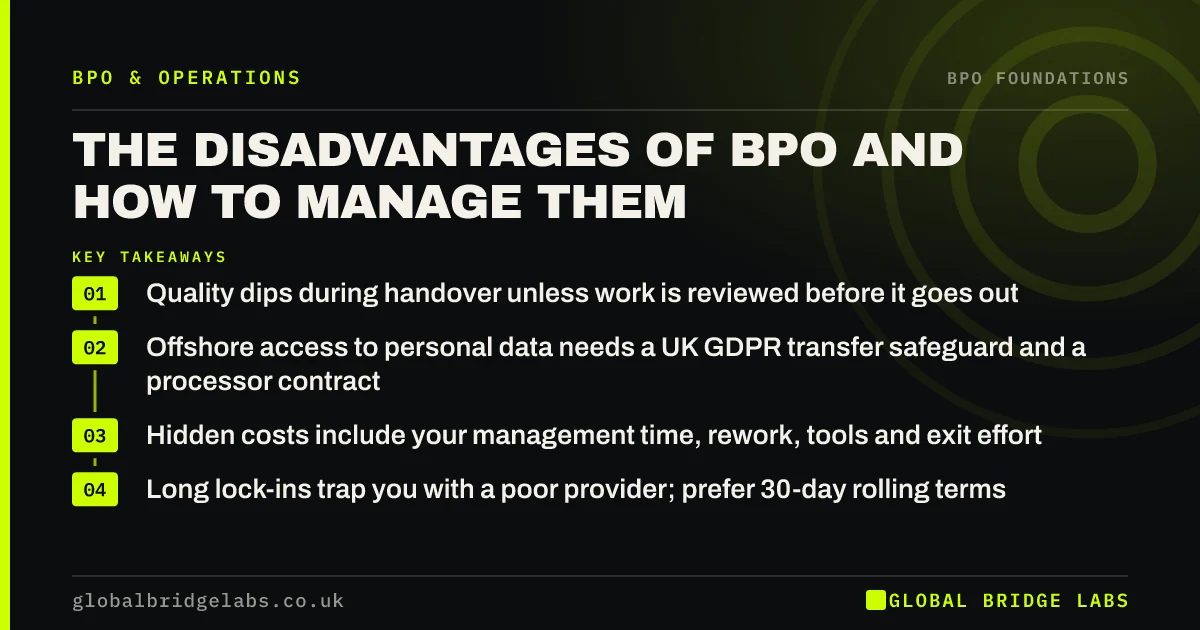
- Quality dips during handover unless work is reviewed before it goes out.
- Offshore access to personal data needs a UK GDPR transfer safeguard and a processor contract.
- Hidden costs include your management time, rework, tools and exit effort.
- Long lock-ins trap you with a poor provider; prefer 30-day rolling terms.
- Keep strategy, pricing and final sign-off in-house to avoid losing control.
Worried about a specific risk? Message us on WhatsApp and we will tell you how we would control it.
Chat on WhatsApp →What are the main disadvantages of BPO?
The main disadvantages of business process outsourcing (BPO) are a temporary drop in quality during handover, less direct control over day-to-day work, communication overhead, data protection risk, hidden costs, and dependency on a provider. None is unique to outsourcing; each also happens with a new in-house hire.
The difference is that outsourcing makes them visible early, because the process has to be written down and measured. Treat each disadvantage as a design problem with a specific control, and most of the risk disappears.
Will quality drop if we outsource?
Quality usually dips for four to eight weeks while the team learns your products, tone and exceptions. It does not have to reach customers. The control is a staged go-live: the team drafts, your staff review before anything is sent, and review drops as accuracy holds above an agreed threshold.
Long-term quality depends on a quality-assurance routine: a set sample of work scored every week against the procedure, with coaching for errors and a procedure update when the same error repeats.
Do you lose control when you outsource?
You lose control only of what you choose to delegate. The team should work inside your own systems, to your written procedure, with defined escalation for anything commercial, such as refunds above a threshold, complaints or pricing exceptions.
Decisions stay with you. What you hand over is the execution. A weekly review against the same scorecard gives you more visibility than most businesses have over their own in-house admin.
Is outsourcing a data protection risk?
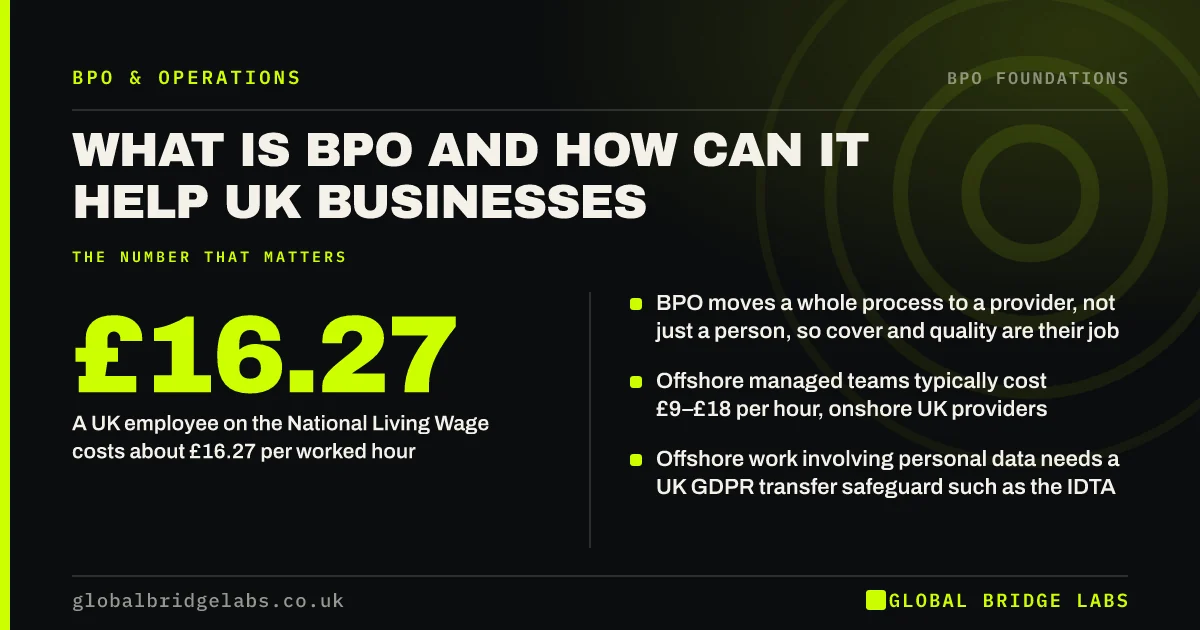
It is a risk you can manage with the right paperwork and access controls. Under UK GDPR, the ICO requires a written contract between controller and processor covering instructions, confidentiality, security, sub-processors, audit and end-of-contract data handling. If the team is outside the UK in a country without adequacy regulations, you also need a transfer safeguard such as the IDTA and a transfer risk assessment.
Security matters as much as paperwork. The DSIT Cyber Security Breaches Survey 2025/2026 found 43% of UK businesses reported a breach or attack in the previous year. Insist on role-based access, multi-factor authentication, logged activity and work done inside your systems rather than on copies of your data.
What hidden costs should you expect?
Expect your own management time, especially in the first 90 days, plus rework during training, extra tool licences, and the effort of exiting if it goes wrong. As a rule of thumb, budget two to four hours a week of an internal owner's time for the first three months, falling to about an hour a week once the process is stable.
Also check what the headline rate excludes: setup fees, minimum seat numbers, out-of-hours premiums and charges for reports. A low hourly rate with a six-month minimum can cost more than a higher rate on 30-day terms.
Want the full cost of outsourcing one process worked out, including your own time? Send us the details on WhatsApp and we will discuss your requirements.
Chat on WhatsApp →What about communication and time zones?
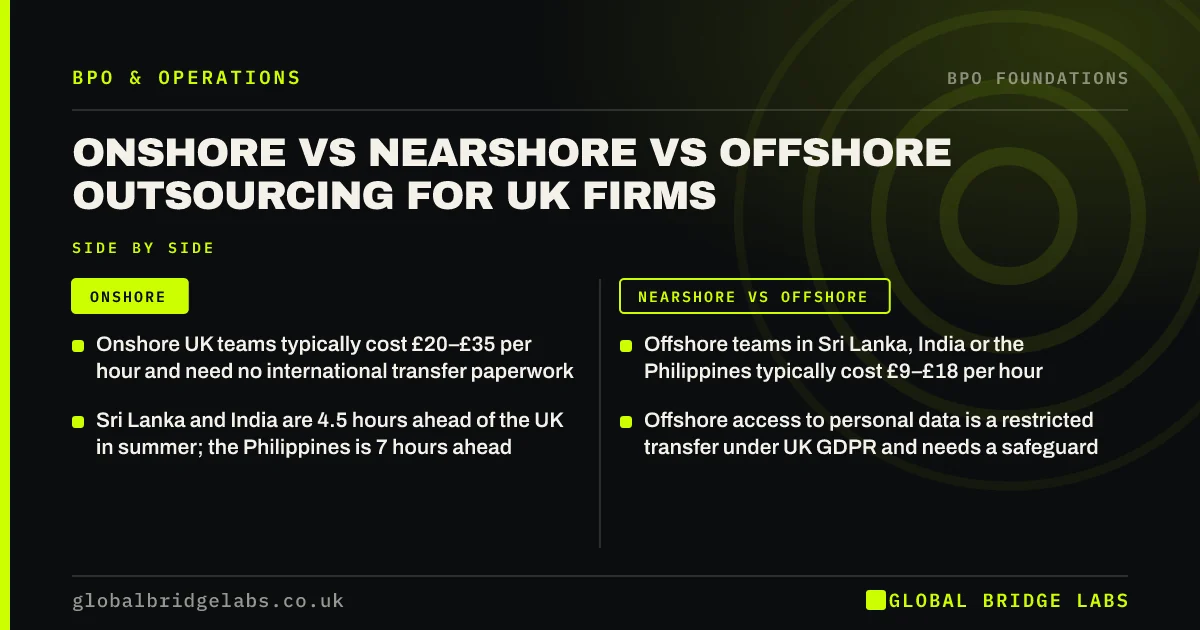
Communication takes more deliberate effort with any external team, and more again across time zones. Sri Lanka and India are 4.5 hours ahead of the UK in summer and 5.5 in winter, so a UK-hours team works into its evening. The control is a named team lead, a shared channel, a daily handover note and a weekly call.
Tone and accent concerns are usually solved by training and call review rather than by changing location.
Can you become too dependent on a provider?
Yes, if the provider owns the only copy of the process. Protect yourself by keeping the procedures in your own systems, making sure the contract gives you all documentation and data at exit, and preferring short notice periods. Then switching provider, or bringing the work back in-house, is a project rather than a crisis.
When do the disadvantages outweigh the benefits?
They outweigh the benefits when the process changes weekly, when the volume is only a few hours a week, when the work is your competitive edge, or when nobody can own the relationship. In those cases, fix the process first, use a part-time hire, or wait.
What does this look like in practice?
A pattern behind many failed outsourcing attempts: the business hands over its inbox with a 20-minute call and no written rules, the team guesses at refunds and tone, customers complain, and the owner concludes outsourcing does not work.
The same process, documented with ten common scenarios and an escalation list, and run with drafts reviewed for the first fortnight, usually settles within a month. The disadvantage was the handover, not outsourcing.
Checklist: controls for every disadvantage
Put these in place before go-live.
- Document the process, including exceptions and escalation contacts.
- Run a staged go-live with reviewed drafts until accuracy holds.
- Agree a weekly QA sample and a monthly scorecard.
- Sign a processor contract and, if offshore, an IDTA or Addendum.
- Use role-based access and multi-factor authentication on every tool.
- Name one internal owner and protect their time for 90 days.
- Keep procedures in your own systems and prefer 30-day notice.
Next step
If a past outsourcing attempt went wrong, or you are worried one will, talk to us. We will walk through the risks for your process and show how each one is controlled. 30 minutes, no pitch.
Message us on WhatsApp to talk through the risks, or book a 30-minute consultation.
Chat on WhatsApp →Sources and further reading
- Contracts and liabilities between controllers and processors · Information Commissioner's Office
- International transfers of personal data · Information Commissioner's Office
- Cyber security breaches survey 2025/2026 · DSIT and Home Office
Frequently asked questions
What is the biggest risk of outsourcing?
The biggest risk is handing over a process that is not documented. The team then guesses, quality drops and customers notice. Writing the process down, including exceptions and escalation rules, and reviewing work before it goes out for the first few weeks removes most of that risk.
Why do outsourcing relationships fail?
Most fail because of a rushed handover, no internal owner, unclear service levels or a scorecard nobody reviews. Cost-driven provider choices and long lock-ins make it worse. Relationships with a documented process, weekly reviews in the first months and short notice periods fail far less often.
Do customers mind talking to an outsourced team?
Customers mind slow or unhelpful service, not who provides it. A well-trained outsourced team answering in your brand voice, with authority to resolve common issues and a quick route to your staff for the rest, is usually an improvement on an overstretched in-house team.
Can I bring outsourced work back in-house?
Yes, if the contract gives you the procedures, data and reports at exit and the notice period is reasonable. Keep procedures in your own systems from day one. Then bringing work back in-house, or moving to another provider, is a planned handover rather than starting from nothing.
Written by

Global Bridge Labs (GBL) is a UK–Sri Lanka partner for social media, websites and BPO. Everything here comes from client delivery, not theory.