On this page
- 01Key takeaways
- 02What happens when you outsource a process?
- 03Step 1: How do you scope a BPO engagement?
- 04Step 2: Why is documentation so important?
- 05Step 3: How are access and data protection set up?
- 06Step 4: How do training and go-live work?
- 07Step 5: How is performance managed after go-live?
- 08How long does it take and what does it cost?
- 09What can go wrong in the process?
- 10What does this look like in practice?
- 11Checklist: before you start
- 12Next step
- 13Sources and further reading
- 14Frequently asked questions
Key takeaways
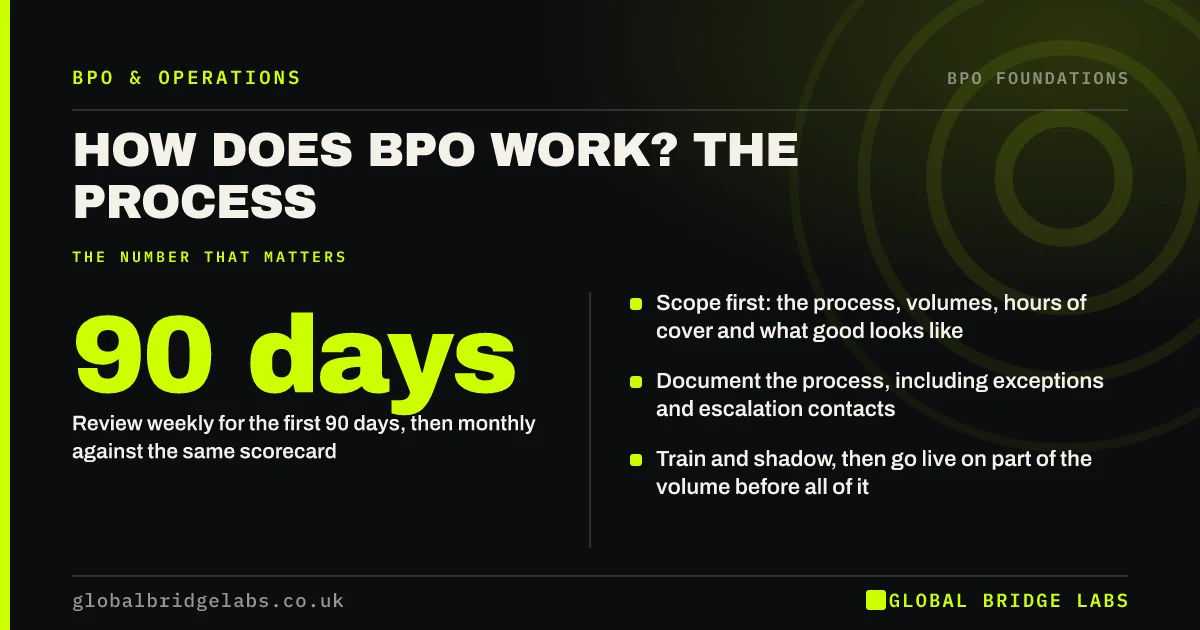
How does BPO work? You agree a scope, the provider documents your process and trains a team, the team goes live in stages inside your systems, and performance is reviewed against an agreed scorecard. A single seat on a documented process can start in about two weeks; larger scopes take four to eight.
- Scope first: the process, volumes, hours of cover and what good looks like.
- Document the process, including exceptions and escalation contacts.
- Train and shadow, then go live on part of the volume before all of it.
- Review weekly for the first 90 days, then monthly against the same scorecard.
- A single documented seat can start in about 2 weeks.
Want to see how this would run for your business? Message us on WhatsApp and we will outline the steps and timescale.
Chat on WhatsApp →What happens when you outsource a process?
When you outsource a process through business process outsourcing (BPO), a provider takes responsibility for running it to agreed service levels. You define the outcome; the provider recruits, trains, schedules, supervises and replaces the people, and reports on whether the outcome was met.
In practice it runs as a short setup project followed by an ongoing managed service. The setup project is where most of the value is won or lost, because it turns knowledge in your team's heads into a written process someone else can follow.
Step 1: How do you scope a BPO engagement?
Scoping defines exactly what the team will do, how much of it, when, and how success is measured. A good scope fits on one page and answers five questions: which process, what weekly volume, what hours of cover, which systems, and which service levels.
- Process: for example, customer emails and WhatsApp messages, plus CRM logging.
- Volume: for example, 300 contacts a week, peaking on Mondays.
- Hours: for example, 8:00 to 18:00 UK time, Monday to Friday.
- Systems: helpdesk, CRM, shared inbox, phone platform.
- Service levels: for example, first reply within 1 business hour.
Step 2: Why is documentation so important?
Documentation turns your process into something a trained person can follow consistently. It covers the standard steps, the ten or so most common scenarios, the exceptions, the tone of voice, and who to escalate to for what. Without it, the team guesses, and quality suffers.
The documents belong to you and should live in your systems. They also protect you from key-person risk, whether the work stays outsourced or comes back in-house.
Step 3: How are access and data protection set up?
The team gets individual logins to your own tools, with only the permissions it needs, multi-factor authentication and activity logs. Working inside your systems, rather than on exported copies, keeps data under your control.
Under UK GDPR you need a written controller-processor contract with the provider. If the team is outside the UK in a country without adequacy regulations, the ICO requires an appropriate safeguard, such as the International Data Transfer Agreement, plus a transfer risk assessment.
Step 4: How do training and go-live work?
Training starts with the documents, then moves to shadowing: the team watches your staff handle real work. Next comes reverse shadowing, where the team does the work and your staff review it before it goes out. Go-live then happens in stages, such as email first, then chat, then phone, or 25% of volume rising to 100%.
Each stage moves on only when quality holds above an agreed threshold. This is slower than a big-bang switch but avoids the quality dip customers would otherwise notice.
Step 5: How is performance managed after go-live?
Performance is managed through a scorecard, a quality-assurance sample and a meeting rhythm. Weekly reviews in the first 90 days, then monthly, using the same measures every time: volumes, response times, resolution, quality score and cost per task.
The provider handles staff coaching, cover and replacement. Your role is to own the relationship, answer escalations and update the procedure when your business changes.
How long does it take and what does it cost?
A single seat on a well-documented process can go live in about two weeks. Multi-channel support or several back-office processes usually take four to eight weeks, mostly because documentation and training take longer. Undocumented processes take longest.
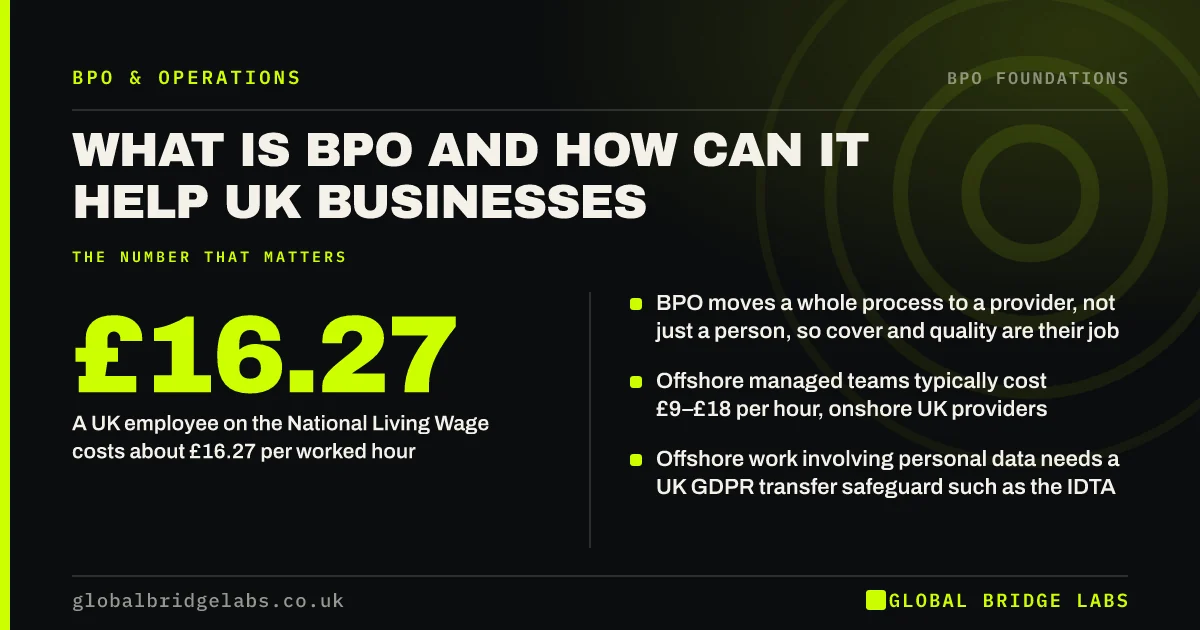
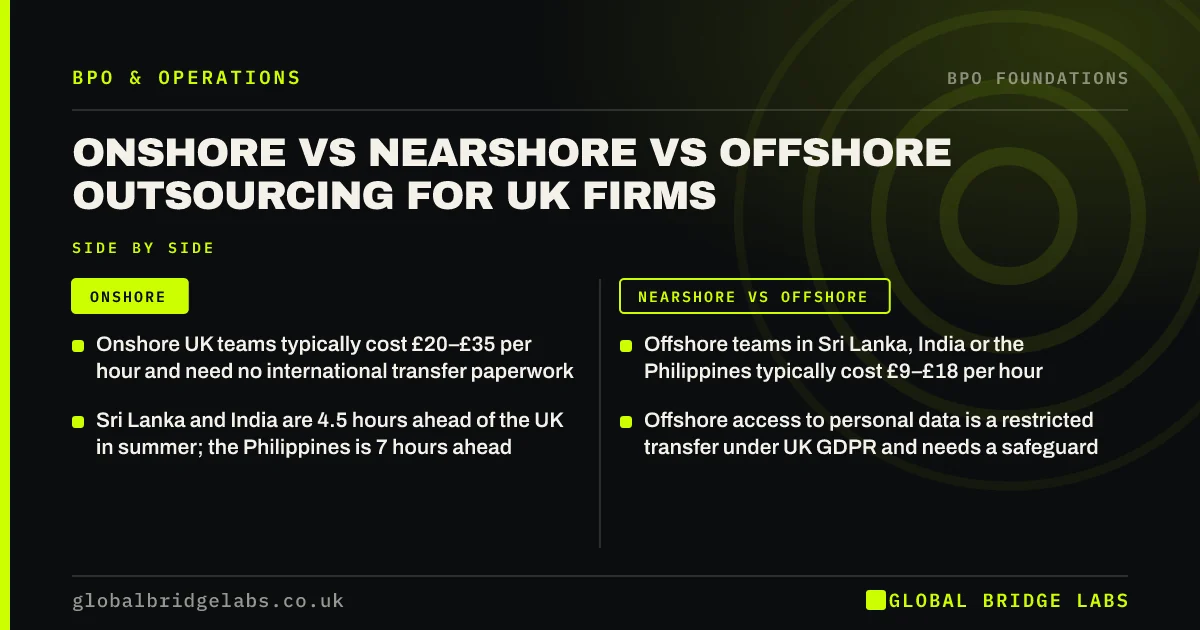
As indicative market ranges, managed offshore teams cost around £9–£18 per hour and onshore UK providers £20–£35. Some providers charge a setup fee; others absorb it into the monthly rate. For comparison, a UK employee on the National Living Wage costs about £16.27 per worked hour once employer National Insurance, pension and holiday are counted.
Want a timeline and a costed plan for your process? Send us the scope on WhatsApp and we will discuss your requirements.
Chat on WhatsApp →What can go wrong in the process?
The common failures are a rushed scope, thin documentation, a big-bang go-live and no internal owner. Each is avoidable. If a provider promises to go live on a complex process within days without asking for your procedures, treat that as a warning.
What does this look like in practice?
At Global Bridge Labs (GBL), a typical first engagement is one support or admin seat. Week one is scoping and documentation, week two is access, training and shadowing, and the seat goes live on part of the volume at the end of week two. Larger teams are phased so training and quality checks keep up.
Checklist: before you start
Have these ready and setup will be faster.
- Write the one-page scope: process, volume, hours, systems, service levels.
- Collect existing procedures, templates and example replies.
- List the ten most common scenarios and how you handle them.
- Name escalation contacts for commercial and complaint issues.
- Prepare user accounts and permissions in each system.
- Agree the scorecard and review rhythm.
- Name the internal owner for the first 90 days.
Next step
If you want to know how BPO would run for your business, we will walk through each step with your process and give you a realistic timeline. 30 minutes, no pitch.
Message us on WhatsApp to map the process, or book a 30-minute consultation.
Chat on WhatsApp →Sources and further reading
- International transfers of personal data · Information Commissioner's Office
- Contracts and liabilities between controllers and processors · Information Commissioner's Office
- National Minimum Wage and National Living Wage rates · GOV.UK
Frequently asked questions
How does a BPO company work?
A BPO company recruits, trains and manages teams that run defined processes for client businesses, such as customer support or data entry. It works to the client's procedures and service levels, usually inside the client's systems, and reports performance against an agreed scorecard, handling staffing, cover and quality itself.
Who manages the outsourced team day to day?
The provider manages the team day to day: scheduling, supervision, coaching, quality checks and cover. You manage the relationship: setting standards, answering escalations, reviewing the scorecard and updating procedures when your business changes. A named team lead on the provider side is your daily contact.
Does the outsourced team use my systems or theirs?
Usually yours. Working inside your helpdesk, CRM and phone platform keeps data under your control, keeps records in one place and makes it easy to switch provider or bring work back in-house. The provider may add its own quality and workforce tools on top.
What do I need to prepare before outsourcing?
Prepare a one-page scope, your existing procedures and templates, a list of common scenarios and exceptions, escalation contacts, system accounts and a draft scorecard. Most importantly, name one internal owner with time to support the team through the first 90 days.
Written by

Global Bridge Labs (GBL) is a UK–Sri Lanka partner for social media, websites and BPO. Everything here comes from client delivery, not theory.