On this page
- 01Key takeaways
- 02What are the main benefits of BPO for a small business?
- 03How much time can BPO give back to an owner?
- 04Does BPO improve customer service?
- 05How does BPO lower costs?
- 06Why does continuity of cover matter so much?
- 07Can BPO help a small business scale?
- 08When do the benefits not materialise?
- 09What does this look like in practice?
- 10Checklist: measure the benefit
- 11Next step
- 12Sources and further reading
- 13Frequently asked questions
Key takeaways
The benefits of BPO for small business owners are practical rather than abstract: time back, faster customer replies, lower cost per task, and cover that survives holidays and resignations. Business process outsourcing (BPO) delivers them only when the process is documented and someone owns the relationship.
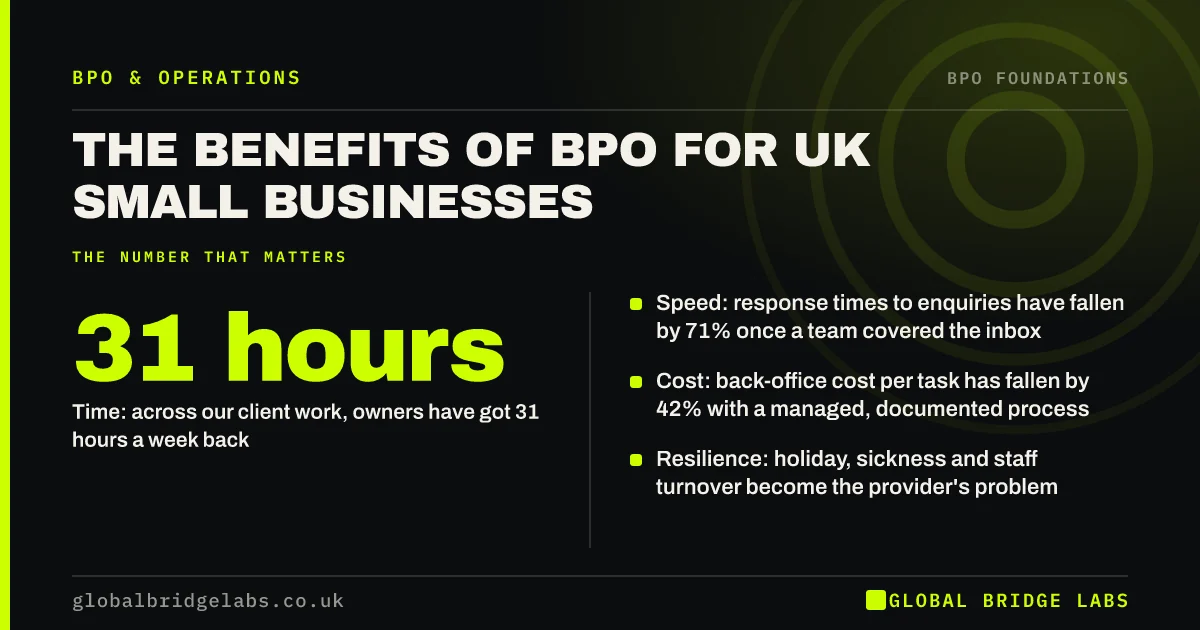
- Time: across our client work, owners have got 31 hours a week back.
- Speed: response times to enquiries have fallen by 71% once a team covered the inbox.
- Cost: back-office cost per task has fallen by 42% with a managed, documented process.
- Resilience: holiday, sickness and staff turnover become the provider's problem.
- Flexibility: seats scale up or down monthly instead of hiring and making redundant.
Want to know which of these benefits you could realistically see? Message us on WhatsApp with where your week goes.
Chat on WhatsApp →What are the main benefits of BPO for a small business?
The main benefits of BPO for a small business are recovered owner time, faster and more consistent customer service, lower cost per task, continuity of cover, and the ability to scale without hiring. Each one depends on handing over a defined process, not just a pile of tasks.
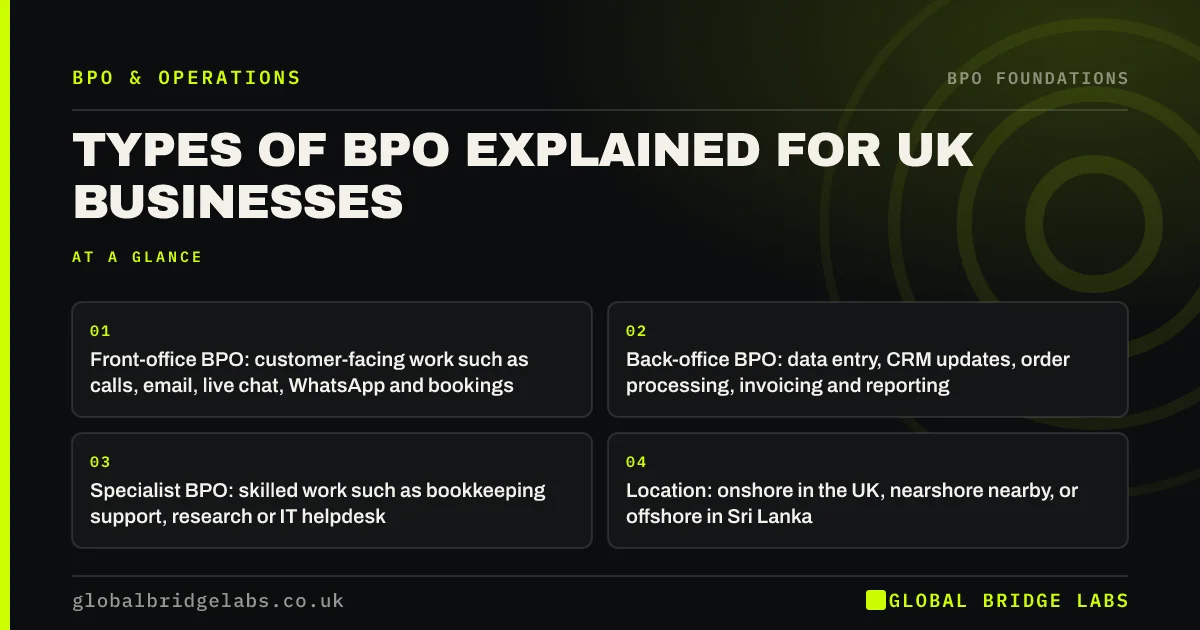
Business process outsourcing means a provider staffs and runs a repeatable process, such as support or admin, to agreed service levels. For a small business, the value is less about the hourly rate and more about what the owner and key staff do with the time they get back.
How much time can BPO give back to an owner?
BPO gives back the hours an owner spends on work someone else could do to a procedure: inbox triage, chasing, data entry and quote admin. Across our client work, that has averaged 31 hours of owner time returned each week, which is close to a full working week.
The value of those hours depends on what replaces them. An owner who moves from invoicing at 10pm to selling, quoting and managing the team is usually worth far more than the cost of the seat. That is why the first benefit to measure is time, and the second is what the business did with it.
Does BPO improve customer service?
BPO improves customer service when the team is trained in your voice and has clear escalation rules. The biggest gain is speed: a dedicated team answers during all trading hours instead of when someone finds a gap between jobs. Across our client work, response time to enquiries has fallen by 71%.
Customers notice. The Institute of Customer Service's UK Customer Satisfaction Index was 78.3 out of 100 in July 2026, and prompt, first-time resolution is consistently what separates high scorers from the rest. For a small business, a reply within the hour often decides whether the enquiry becomes a job.
How does BPO lower costs?
BPO lowers costs by reducing the cost per completed task, not just the hourly rate. A managed team works to a documented process, is measured on throughput and accuracy, and does not carry recruitment, equipment, sick pay or management overheads on your books.
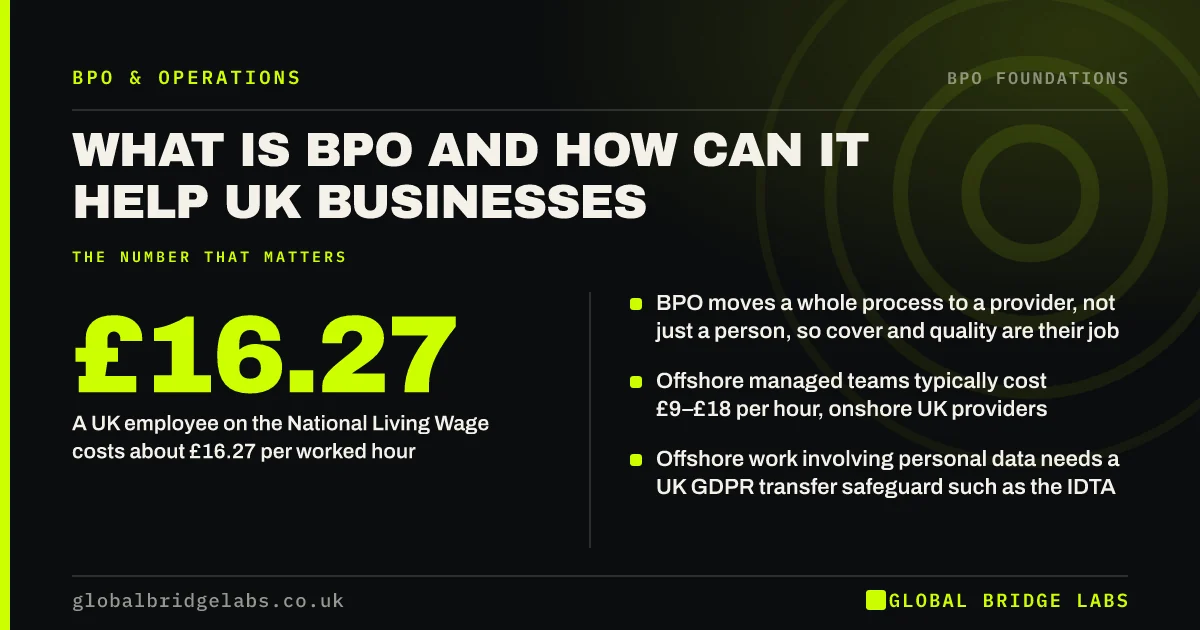
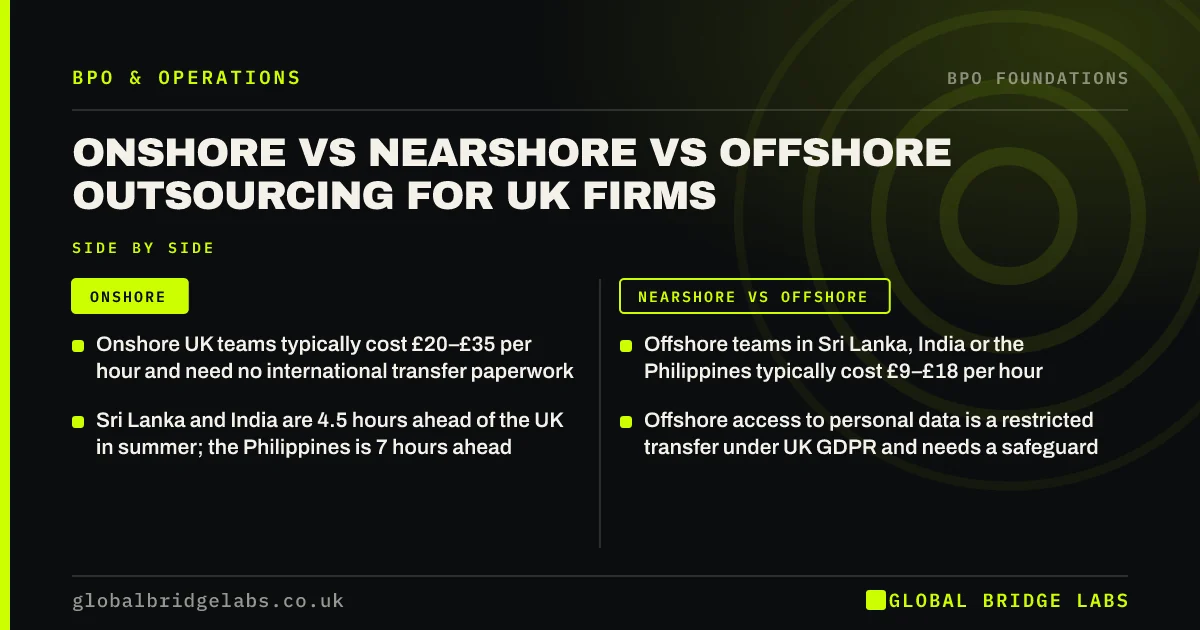
The UK comparison is sharper than it was. From April 2026 the National Living Wage is £12.71 an hour and employer National Insurance is 15% on earnings above £5,000. Including the 3% pension contribution and 28 days of statutory holiday, a full-time employee on the minimum wage costs about £16.27 per worked hour before overheads. Managed offshore teams typically cost £9–£18 per hour, fully loaded.
Want a costed plan comparing your in-house cost with a managed team? Send us the roles on WhatsApp and we will discuss your requirements.
Chat on WhatsApp →Why does continuity of cover matter so much?
Continuity matters because small businesses often depend on one person for a whole process. When that person is on holiday, off sick or leaves, the process stops and the backlog lands on the owner. A BPO provider keeps trained cover and a written procedure, so the work continues.
This is one of the least visible benefits until the day it is needed. It is also why documentation is part of any good BPO setup: the process belongs to your business, not to whoever happens to know it.
Can BPO help a small business scale?
Yes. BPO lets a small business add capacity for a busy season, a new product or a big contract without a long recruitment cycle, then reduce it afterwards. Many providers work on 30-day rolling terms, which turns a fixed hiring decision into a monthly one.
It also scales hours. Extended or weekend cover that would need two or three part-time hires can be added as a shift pattern.
When do the benefits not materialise?
The benefits disappear when the process is undocumented, when nobody owns the relationship, or when the business outsources a problem it has not diagnosed. If quotes go out late because pricing decisions are slow, an outsourced team will simply send late quotes faster.
Hidden costs also erode the savings: management time in the first months, rework while the team learns, and tool licences. Plan for them and they are small; ignore them and they swallow the benefit.
What does this look like in practice?
A mortgage brokerage on our projects page describes the benefit in its own words: tighter follow-up from enquiry to application, cases visible across the team, less noise in hand-offs between advisers and admin, and less time chasing paper.
That is the typical shape of the benefit. Not a dramatic cost cut on day one, but advisers spending their time advising, with the admin running to a process in the background.
Checklist: measure the benefit
Set these baselines before you start, so the benefit can be proven.
- Record owner and senior-staff hours spent on the process each week.
- Record current average response time to enquiries.
- Work out the current cost per task, including employer costs.
- Note how often the process stalls due to holiday or sickness.
- Agree the same measures with the provider for the monthly report.
- Review at 30, 60 and 90 days against the baseline.
Next step
Tell us where your week goes and we will estimate which benefits are realistic for your business, and which are not, before you commit to anything. 30 minutes, no pitch.
Message us on WhatsApp for a capacity plan, or book a 30-minute consultation.
Chat on WhatsApp →Sources and further reading
- UK Customer Satisfaction Index · Institute of Customer Service
- National Minimum Wage and National Living Wage rates · GOV.UK
- Rates and thresholds for employers 2026 to 2027 · HM Revenue & Customs
- Holiday entitlement · GOV.UK
Frequently asked questions
What is the biggest benefit of BPO?
For most small businesses the biggest benefit is recovered time for the owner and senior staff. Faster customer replies and lower cost per task follow, but the time owners get back for selling, quoting and managing is usually worth more than the direct cost saving.
Is outsourcing cheaper than hiring in the UK?
Usually, for repeatable work. A full-time UK employee on the National Living Wage costs about £16.27 per worked hour after employer National Insurance, pension and holiday, before overheads. Managed offshore teams typically cost £9–£18 per hour including management, cover and quality assurance.
How quickly do BPO benefits appear?
Response-time improvements can show within the first two weeks of go-live. Time savings build over the first month as the team takes on more of the volume. Cost-per-task savings are clearest after two to three months, once training and early rework are finished.
Does outsourcing mean losing control?
Not if it is set up properly. The team works inside your systems, to your written procedure, and reports against a scorecard you agree. You keep decisions, escalations and final sign-off. Many owners find they have more visibility than before, because the process is finally written down and measured.
Written by

Global Bridge Labs (GBL) is a UK–Sri Lanka partner for social media, websites and BPO. Everything here comes from client delivery, not theory.