On this page
- 01Key takeaways
- 02What do onshore, nearshore and offshore mean?
- 03How do the three models compare?
- 04Why is offshore outsourcing cheaper?
- 05How do time zones affect UK cover?
- 06What does UK GDPR require for each model?
- 07Which work suits which model?
- 08When is offshore the wrong choice?
- 09What does this look like in practice?
- 10Checklist: choosing a location
- 11Next step
- 12Sources and further reading
- 13Frequently asked questions
Key takeaways
Onshore vs nearshore vs offshore outsourcing is a choice about where your outsourced team sits: in the UK, in a nearby country, or further away. For UK firms, offshore gives the lowest cost per hour, onshore gives the simplest compliance and local knowledge, and nearshore sits between them.
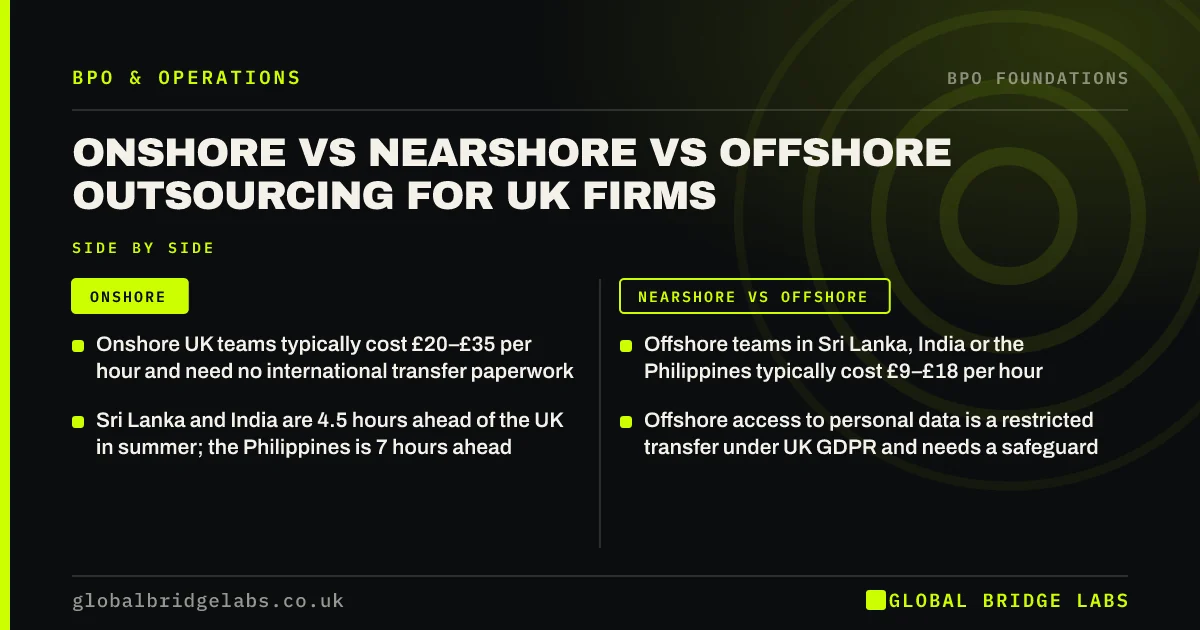
- Onshore UK teams typically cost £20–£35 per hour and need no international transfer paperwork.
- Offshore teams in Sri Lanka, India or the Philippines typically cost £9–£18 per hour.
- Sri Lanka and India are 4.5 hours ahead of the UK in summer; the Philippines is 7 hours ahead.
- Offshore access to personal data is a restricted transfer under UK GDPR and needs a safeguard.
- Many UK SMEs mix models: offshore for volume work, UK staff for sign-off and local judgement.
Want to see which model fits your processes? Message us on WhatsApp with the work and the hours you need covered.
Chat on WhatsApp →What do onshore, nearshore and offshore mean?
Onshore outsourcing means the provider's team works in the same country as you, so in the UK. Nearshore outsourcing means a nearby country with a similar time zone, such as Ireland, Portugal or Eastern Europe. Offshore outsourcing means a more distant country, commonly Sri Lanka, India, the Philippines or South Africa.
All three are forms of business process outsourcing (BPO): you still hand over a defined process and the provider still recruits, trains and manages the team. What changes is the cost of labour, the hours of overlap with your day, and the legal work needed to let the team access your customers' data.
How do the three models compare?
The comparison below uses indicative market ranges for managed services, not freelance rates. Cost per hour is the headline, but time-zone fit and compliance effort usually decide the answer for a given process.
- Onshore (UK): £20–£35 per hour; full overlap with UK hours; no restricted transfer; best for regulated, local or senior work.
- Nearshore (Europe): mid-range cost; zero to two hours' difference; UK adequacy regulations cover the EU and EEA.
- Offshore (Sri Lanka, India): £9–£18 per hour; UTC+5:30, so UK hours run into the local evening; IDTA or Addendum needed.
- Offshore (Philippines): similar cost; UTC+8, so UK hours are a local night shift; IDTA or Addendum needed.
Why is offshore outsourcing cheaper?
Offshore outsourcing is cheaper because wages and office costs are lower in the destination country, not because the provider is cutting corners. A good offshore provider still pays competitive local salaries, trains its people and supervises quality; the saving comes from the local cost base.
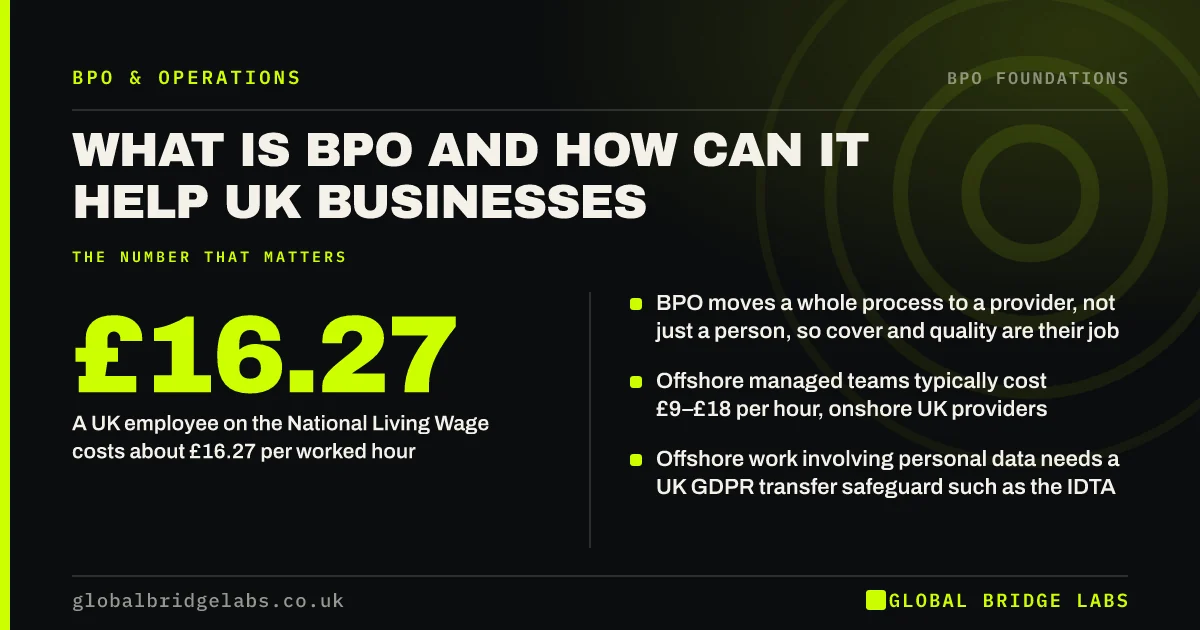
The UK side of the comparison has become more expensive. From April 2026 the National Living Wage is £12.71 an hour, and employer National Insurance is 15% above £5,000 a year. A full-time employee on the minimum wage costs about £16.27 per worked hour once National Insurance, the 3% pension contribution and 28 days' holiday are counted, before any overheads.
Want the three models costed against your own in-house numbers? Send us the role and hours on WhatsApp and we will discuss your requirements.
Chat on WhatsApp →How do time zones affect UK cover?
Time zones decide whether your outsourced team works a normal day or a night shift to cover UK hours. Sri Lanka and India are at UTC+5:30 with no daylight saving, so a UK 9:00 to 17:30 day runs from 13:30 to 22:00 locally in British Summer Time and 14:30 to 23:00 in winter.
The Philippines is at UTC+8, so the same UK day runs from 16:00 to 00:30 local time in summer and 17:00 to 01:30 in winter. Night shifts are normal in Philippine BPO, but they affect recruitment and retention. Afternoon-to-evening shifts are easier to staff, which is one reason Sri Lanka suits UK-hours work.
What does UK GDPR require for each model?
Onshore outsourcing needs a controller-processor contract but no international transfer safeguard. Nearshore teams in the EU or EEA are covered by UK adequacy regulations, so data can flow without an extra transfer agreement, though the processor contract is still required.
Offshore teams in countries without UK adequacy regulations need an appropriate safeguard such as the ICO's International Data Transfer Agreement (IDTA) or the UK Addendum to the EU standard contractual clauses, plus a transfer risk assessment. The ICO is clear that giving someone abroad remote access to data counts as a transfer, even if the data stays on UK servers.
Which work suits which model?
Match the model to the work rather than picking one for everything. Volume work that follows a written process suits offshore. Work that needs local knowledge, regulated advice or face-to-face contact suits onshore. Nearshore suits European-language support and work needing full UK-hours overlap at a mid-range cost.
- Offshore: email and chat support, call answering to a script, data entry, CRM updates, order processing.
- Onshore: regulated advice, complex complaints, site visits, senior account management.
- Nearshore: multilingual European support, work needing a same-day overlap with minimal shift change.
- Hybrid: offshore team does the volume; a UK lead handles escalations and sign-off.
When is offshore the wrong choice?
Offshore is the wrong choice when the work cannot be separated from a UK location, when a regulator expects UK-based staff for a specific activity, or when the volume is so small that setup and governance outweigh the hourly saving. It is also wrong if nobody in your business will own the relationship for the first three months.
Accent and cultural fit are raised often. In our experience, training in your tone of voice and a clear escalation route matter far more than location. Customers notice unresolved problems, not where the person answering sits.
What does this look like in practice?
A common pattern for UK SMEs: an onshore answering service handles calls at a per-call rate, costs climb as volumes grow, and callers still get a message-taker rather than someone who can book the job. Moving to an offshore managed seat that answers and books directly, with a UK-based lead for escalations, gives the business a real team for a similar monthly spend.
That hybrid is how we work at Global Bridge Labs (GBL): a UK-facing account lead and delivery from our Sri Lanka hub, scheduled to UK hours.
Checklist: choosing a location
Answer these for each process you plan to outsource.
- Write down the hours of cover the process needs, in UK time.
- Convert them to local time for each candidate country.
- List the personal data the team will access.
- Check whether a transfer safeguard is needed and who will prepare it.
- Compare fully loaded in-house cost with each model's managed rate.
- Decide which decisions must stay with UK staff.
- Agree how escalations reach your team during and outside hours.
Next step
If you are weighing onshore against offshore, we will map your processes to the model that fits each one, with the time-zone plan and data protection steps written out. 30 minutes, no pitch.
Message us on WhatsApp for a location plan, or book a 30-minute consultation.
Chat on WhatsApp →Sources and further reading
- International transfers of personal data · Information Commissioner's Office
- National Minimum Wage and National Living Wage rates · GOV.UK
- Rates and thresholds for employers 2026 to 2027 · HM Revenue & Customs
Frequently asked questions
What is the difference between offshore and nearshore?
Offshore means outsourcing to a distant country with a larger time difference and usually lower costs, such as Sri Lanka, India or the Philippines. Nearshore means a nearby country with a similar time zone, such as Portugal or Poland for UK firms. Nearshore costs more per hour but overlaps fully with UK hours.
Is offshore outsourcing legal in the UK?
Yes. UK businesses can outsource to any country, provided they comply with UK GDPR when personal data is involved. For countries without UK adequacy regulations that means an appropriate safeguard, such as the ICO's International Data Transfer Agreement, plus a transfer risk assessment and a processor contract.
Can offshore teams cover UK business hours?
Yes. Teams in Sri Lanka and India cover UK hours by working an afternoon-to-evening shift, because they are 4.5 or 5.5 hours ahead depending on the season. Philippine teams cover UK hours on a night shift. Good providers schedule rotas around your trading hours as standard.
Is onshore outsourcing better quality?
Not automatically. Quality depends on training, documentation, supervision and quality assurance far more than location. Onshore teams have an edge on local knowledge and regulated work; offshore teams can match them on process-driven work when the provider runs a proper quality programme.
Written by

Global Bridge Labs (GBL) is a UK–Sri Lanka partner for social media, websites and BPO. Everything here comes from client delivery, not theory.