On this page
- 01Key takeaways
- 02How do Sri Lanka, India and the Philippines compare?
- 03Why does the time zone matter so much?
- 04What are the strengths of each country?
- 05How do costs compare?
- 06What does UK GDPR require for each?
- 07What about staff turnover?
- 08When is none of them the right answer?
- 09What does this look like in practice?
- 10Checklist: choose a destination
- 11Next step
- 12Sources and further reading
- 13Frequently asked questions
Key takeaways
Sri Lanka vs India vs Philippines outsourcing is less about which country is best and more about which fits your work and hours. All three offer English-speaking talent at similar managed rates. The biggest practical differences for UK firms are time zone, scale of the market and how competitive local hiring is.
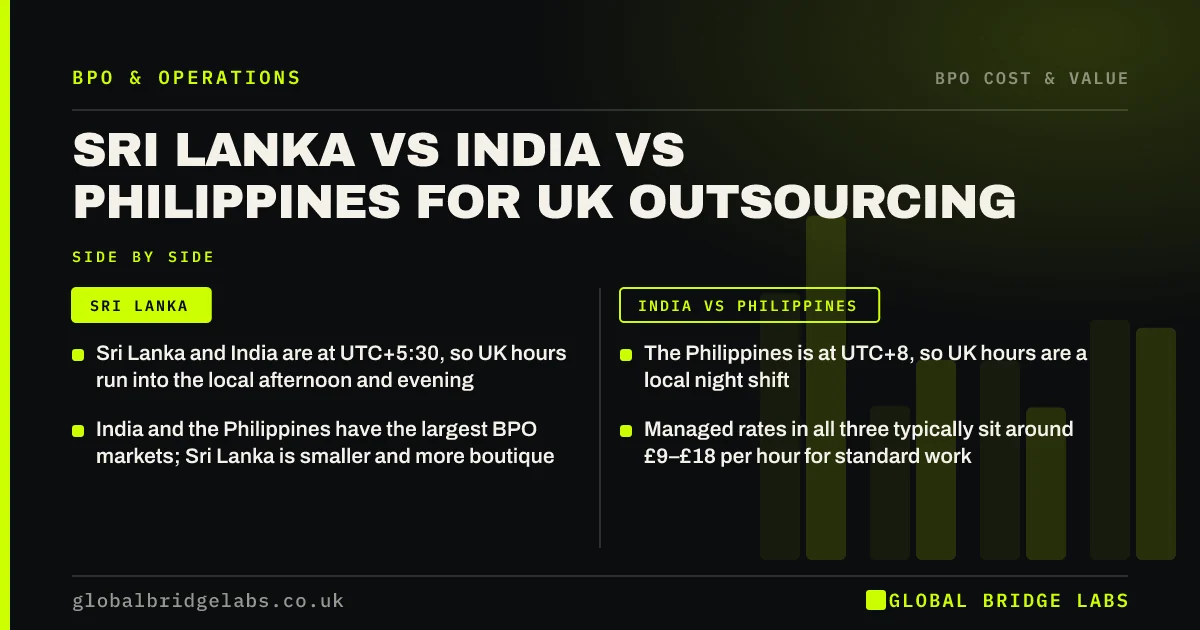
- Sri Lanka and India are at UTC+5:30, so UK hours run into the local afternoon and evening.
- The Philippines is at UTC+8, so UK hours are a local night shift.
- India and the Philippines have the largest BPO markets; Sri Lanka is smaller and more boutique.
- Managed rates in all three typically sit around £9–£18 per hour for standard work.
- None has UK adequacy regulations, so each needs a UK GDPR transfer safeguard.
Comparing destinations for your team? Message us on WhatsApp and we will give you a straight comparison for your work.
Chat on WhatsApp →How do Sri Lanka, India and the Philippines compare?
All three are established destinations for business process outsourcing (BPO) serving English-speaking markets. We deliver from Sri Lanka, so read this with that in mind; the comparison below sticks to factors you can verify.
- Time zone: Sri Lanka UTC+5:30; India UTC+5:30; Philippines UTC+8. None observes daylight saving.
- UK 9:00–17:30 in summer: 13:30–22:00 in Sri Lanka and India; 16:00–00:30 in the Philippines.
- Market scale: India and the Philippines are very large; Sri Lanka is much smaller.
- English: widely used in business in all three; the Philippines has English as an official language.
- Typical managed rates: broadly similar, around £9–£18 per hour for standard work.
- UK GDPR: none has UK adequacy regulations; an IDTA or UK Addendum is needed.
Why does the time zone matter so much?
The time zone decides what shift your team works to cover UK hours, and shift pattern affects who applies and how long they stay. In Sri Lanka and India, a UK business day is an afternoon-to-evening shift. In the Philippines it is a night shift, which is normal in its BPO industry but carries higher wellbeing and retention challenges.
For UK early mornings, from 7:00 or 8:00, South Asian teams are already mid-afternoon. For UK evenings, the Philippines covers more naturally in its morning, which some providers use for late UK cover.
What are the strengths of each country?
India's strength is scale and breadth: a very large talent pool, deep IT and back-office capability, and providers of every size. The Philippines is strong in voice-based customer service, with neutral accents and a large, experienced contact-centre workforce. Sri Lanka is smaller, which suits dedicated teams where relationships and continuity matter more than scale.
Within each country, the provider matters more than the flag. A well-run small provider in any of the three will outperform a poorly run large one.
How do costs compare?
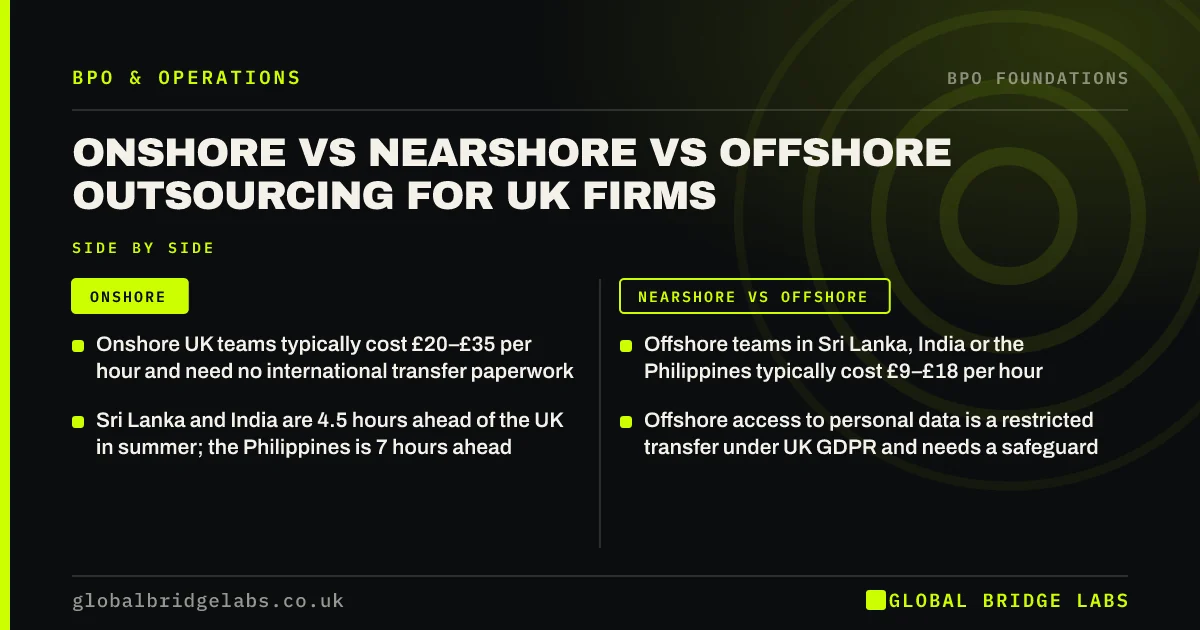
For managed services, costs overlap heavily. As indicative market ranges, standard support and admin work in all three sits around £9–£18 per hour, with differences driven more by skill level, hours and provider than by country. Night shifts and specialist skills cost more wherever they are.
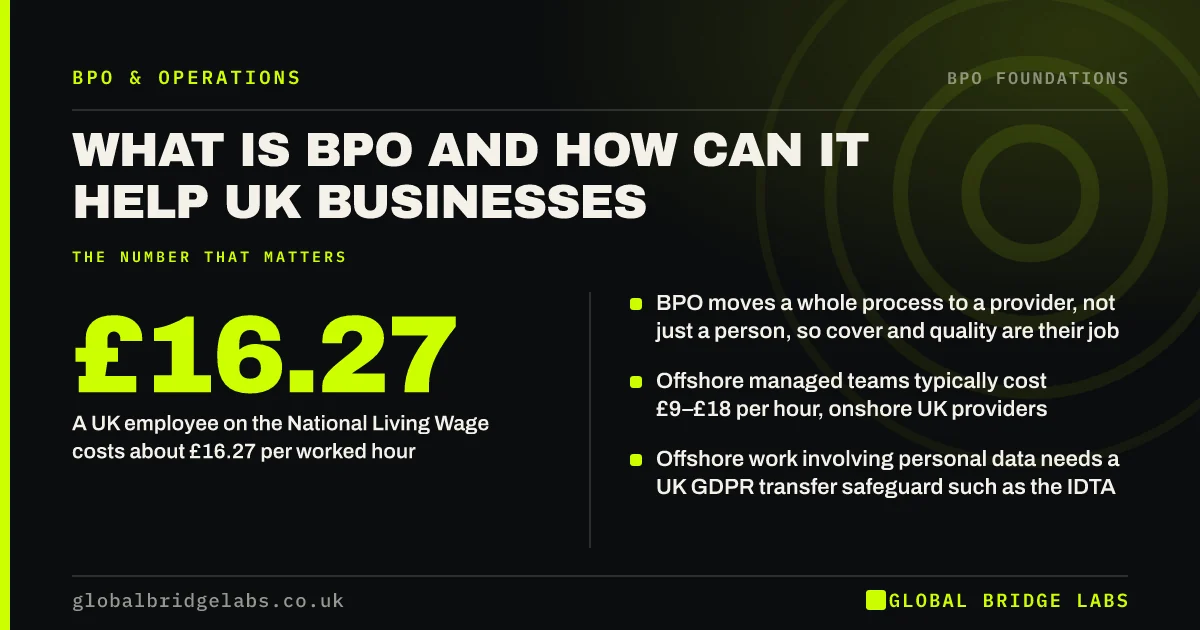
Every option is well below the cost of a UK employee for the same hours. A full-time employee on the April 2026 National Living Wage costs about £16.27 per worked hour after employer National Insurance, pension and holiday, before overheads.
Want quotes compared across providers on the same scope? Send us your scope on WhatsApp and we will discuss your requirements.
Chat on WhatsApp →What does UK GDPR require for each?
The requirement is the same for all three. None has UK adequacy regulations, so giving a team there access to personal data is a restricted transfer. The ICO requires an appropriate safeguard, usually the International Data Transfer Agreement (IDTA) or the UK Addendum to the EU standard contractual clauses, plus a transfer risk assessment, alongside a controller-processor contract.
Each country also has its own data protection law, such as Sri Lanka's Personal Data Protection Act, India's Digital Personal Data Protection Act and the Philippines' Data Privacy Act. Ask the provider how it complies locally as part of your risk assessment.
What about staff turnover?
Turnover is a known challenge in large, competitive BPO markets, where experienced agents can move for small pay rises. It is not a country trait so much as a market dynamic, and it varies greatly by provider. Ask for the provider's actual attrition rate, how it retains people, and how it covers leavers without a gap.
When is none of them the right answer?
Offshore is not the right answer for work needing UK presence, UK regulatory status for specific activities, or very local knowledge. It is also wrong for tiny volumes. In those cases, onshore or a hybrid, with a UK lead and an offshore team, fits better.
What does this look like in practice?
Global Bridge Labs (GBL) runs a UK–Sri Lanka model: a UK-facing account lead and delivery from our Colombo hub, with teams scheduled to UK hours on an afternoon-to-evening shift. We chose it because the time zone suits UK-hours cover without a night shift, and a smaller market suits dedicated teams that stay with a client.
Checklist: choose a destination
Answer these for your process.
- Write the hours of cover you need in UK time.
- Convert them into local time for each country.
- Decide whether the work is mainly voice or written.
- Ask shortlisted providers for attrition rates and cover plans.
- Confirm who prepares the IDTA or Addendum and the risk assessment.
- Compare quotes on the same scope and inclusions.
- Visit or video-call the actual team lead before signing.
Next step
If you are weighing destinations, we will give you an honest view of which fits your work, including when it is not Sri Lanka. 30 minutes, no pitch.
Message us on WhatsApp for a destination comparison, or book a 30-minute consultation.
Chat on WhatsApp →Sources and further reading
- International transfers of personal data · Information Commissioner's Office
- Contracts and liabilities between controllers and processors · Information Commissioner's Office
- National Minimum Wage and National Living Wage rates · GOV.UK
Frequently asked questions
Which country is best for outsourcing from the UK?
There is no single best country. Sri Lanka and India suit UK-hours cover on an afternoon-to-evening shift; the Philippines is strong in voice support but covers UK hours on a night shift. The provider's quality, retention and data protection practices matter more than the country.
Is the Philippines better than India for customer service?
The Philippines is known for voice-based customer service and a large contact-centre workforce. India offers greater scale and breadth, especially in back-office and technical work. For UK-hours cover, India's time zone avoids a night shift. Judge individual providers rather than countries.
Is Sri Lanka good for outsourcing?
Sri Lanka suits UK businesses wanting dedicated teams for support, admin and back-office work. It shares India's UTC+5:30 time zone, so UK hours fall in the local afternoon and evening. Its market is smaller than India's or the Philippines', which suits continuity rather than very large scale.
Do I need a data transfer agreement for offshore teams?
Yes, if the team can access personal data you control. Sri Lanka, India and the Philippines do not have UK adequacy regulations, so you need a safeguard such as the ICO's International Data Transfer Agreement or the UK Addendum, plus a transfer risk assessment and a processor contract.
Written by

Global Bridge Labs (GBL) is a UK–Sri Lanka partner for social media, websites and BPO. Everything here comes from client delivery, not theory.