On this page
- 01Key takeaways
- 02What is the difference between BPO and KPO?
- 03What are examples of BPO and KPO?
- 04How do BPO and KPO costs compare?
- 05Which should a UK SME outsource first?
- 06How is quality managed differently?
- 07When is neither BPO nor KPO the answer?
- 08What does this look like in practice?
- 09Checklist: BPO or KPO?
- 10Next step
- 11Sources and further reading
- 12Frequently asked questions
Key takeaways
BPO vs KPO comes down to what you are buying. Business process outsourcing (BPO) buys a repeatable process run to a written procedure. Knowledge process outsourcing (KPO) buys expert judgement, such as research, analysis or specialist finance work. KPO costs more and needs closer oversight.
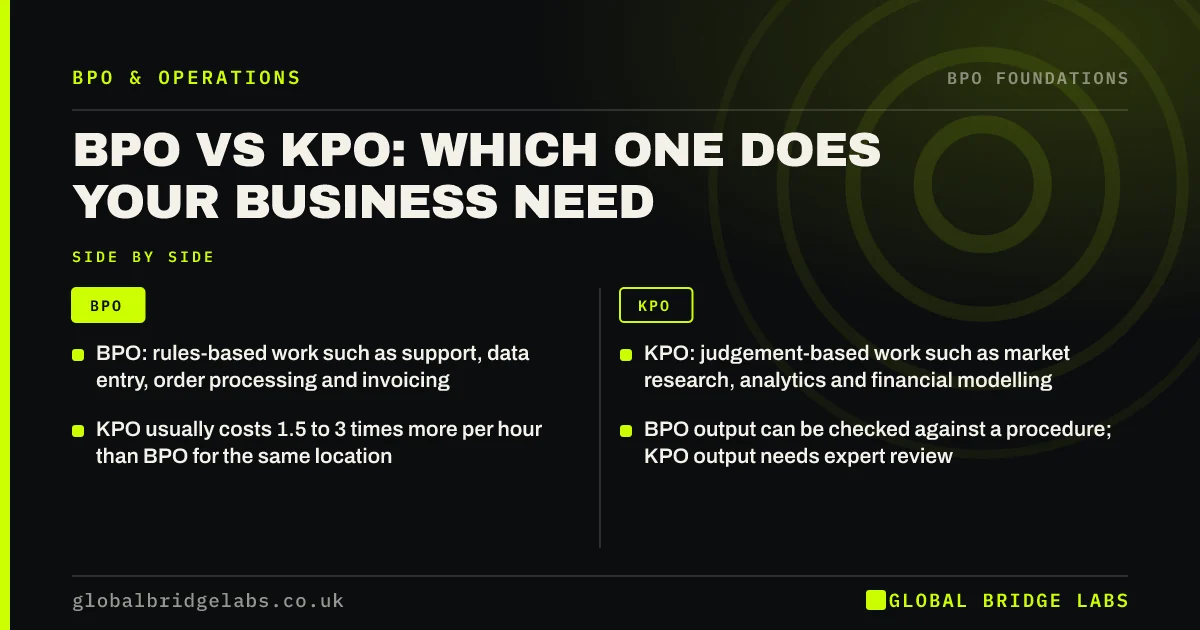
- BPO: rules-based work such as support, data entry, order processing and invoicing.
- KPO: judgement-based work such as market research, analytics and financial modelling.
- KPO usually costs 1.5 to 3 times more per hour than BPO for the same location.
- BPO output can be checked against a procedure; KPO output needs expert review.
- Most UK SMEs get faster returns from BPO first, then add KPO once governance works.
Unsure whether your work is BPO or KPO? Message us on WhatsApp with the tasks and we will tell you.
Chat on WhatsApp →What is the difference between BPO and KPO?
BPO is the outsourcing of defined, repeatable business processes that follow a procedure, while KPO is the outsourcing of work whose value depends on the expertise and judgement of the person doing it. The difference is not prestige; it is how the work is specified and checked.
A BPO task can be written as steps: when an order query arrives, check the courier portal, reply with the tracking link, log it in the CRM. A KPO task can only be written as a goal: analyse why repeat purchase rates fell last quarter and recommend what to change. The first can be quality-checked against the steps. The second needs someone qualified to judge whether the answer is right.
What are examples of BPO and KPO?
The easiest way to tell them apart is by example. If a trained person with a clear procedure could do it consistently, it is BPO. If the output depends on a qualification, deep domain knowledge or original analysis, it is KPO.
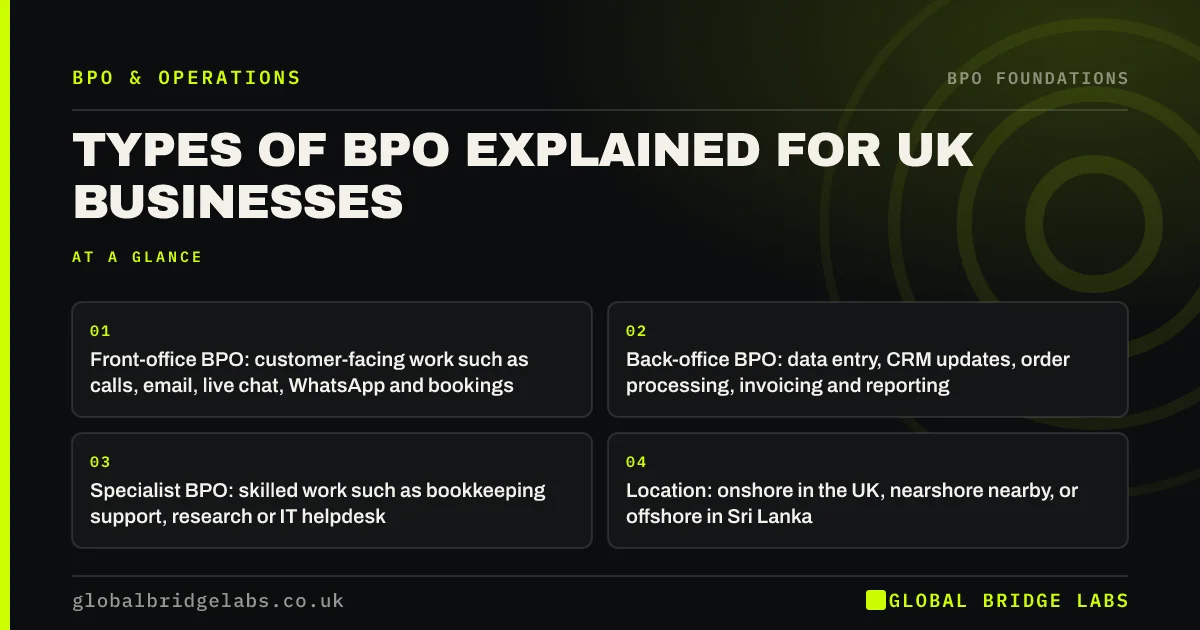
- BPO: answering customer emails, calls and chats to agreed scripts and rules.
- BPO: data entry, CRM updates, order processing and returns.
- BPO: raising invoices and running a credit control chase sequence.
- KPO: market and competitor research reports.
- KPO: data analysis, forecasting and dashboard design.
- KPO: specialist finance, legal support or technical writing that needs expert review.
How do BPO and KPO costs compare?
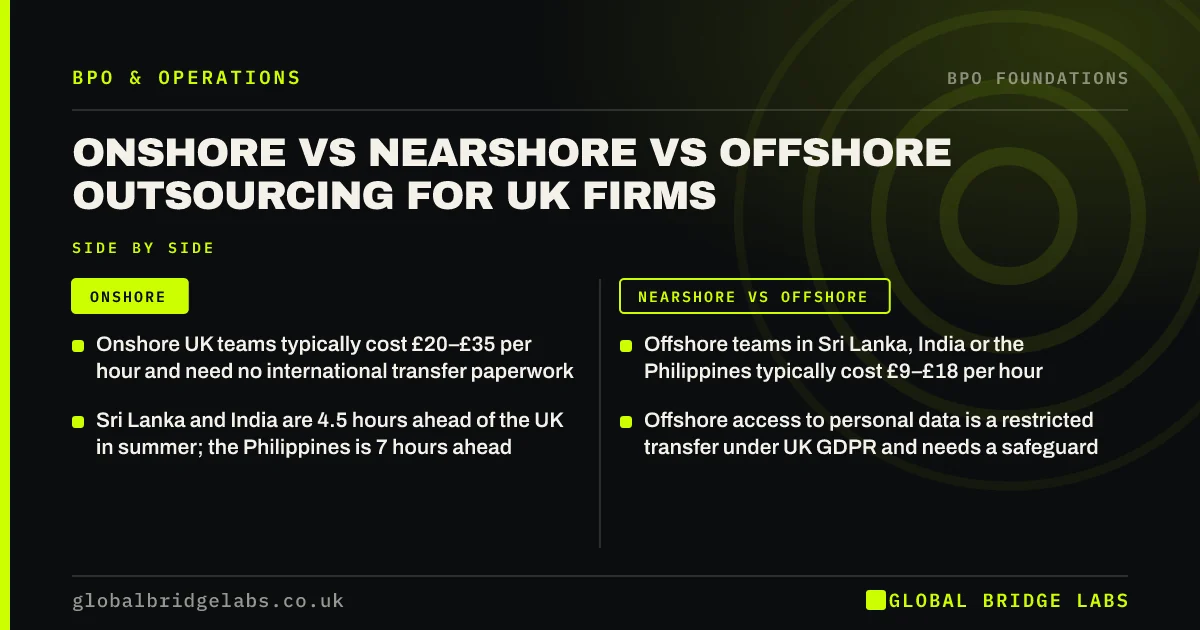
KPO typically costs 1.5 to 3 times more per hour than BPO in the same location, because it needs graduates or qualified specialists and more senior supervision. As indicative market ranges, managed offshore BPO sits around £9–£18 per hour, while offshore KPO commonly starts above that range.
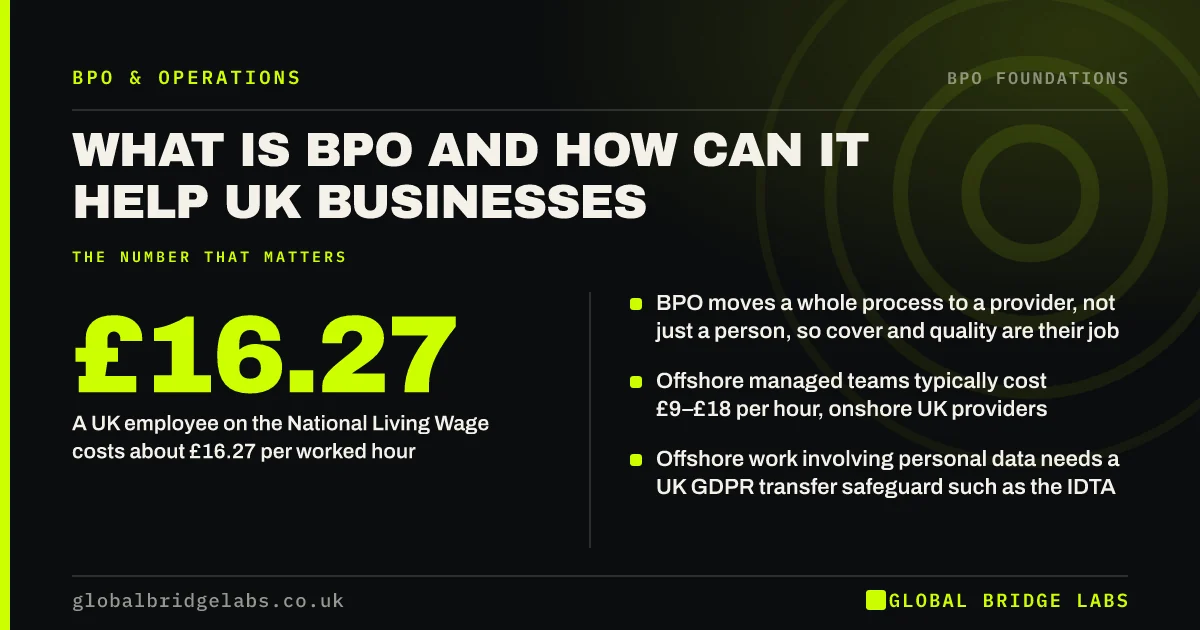
The more useful comparison is cost per outcome. A BPO seat handling 60 customer emails a day has a clear cost per email. KPO is usually priced per project or per deliverable, so compare it with what the same analysis would cost from a UK consultant or a new hire. For context, a UK employee on £26,000 costs about £17.09 per worked hour once employer National Insurance, pension and holiday are counted, and experienced analysts cost far more.
Want BPO and KPO options costed side by side for your workload? Send us the tasks on WhatsApp and we will discuss your requirements.
Chat on WhatsApp →Which should a UK SME outsource first?
Most UK SMEs should outsource BPO work first. It is easier to specify, easier to measure and quicker to show a return, because it frees owner time on tasks that happen every day. It also builds the governance habits, such as weekly reviews and a scorecard, that KPO needs even more.
KPO first makes sense only when there is a specific, bounded project, such as a one-off market study, and someone in-house qualified to judge the result. Without that reviewer, KPO output tends to be either accepted uncritically or redone internally.
How is quality managed differently?
BPO quality is managed by sampling work against the procedure: a quality analyst checks a set percentage of emails, calls or records each week and scores them. Errors lead to coaching or a procedure update. The scorecard is mostly numbers: accuracy, turnaround, response time and customer satisfaction.
KPO quality is managed by expert review of each deliverable, clear briefs and agreed acceptance criteria. It depends much more on the individual, so continuity of the named specialist matters. That is why KPO contracts often name people, while BPO contracts name service levels.
When is neither BPO nor KPO the answer?
Neither fits work that is your core advantage, work that changes every week, or decisions that need someone accountable inside the business. Pricing strategy, key client relationships and hiring decisions should stay in-house even if the analysis behind them is outsourced.
Automation is another alternative. Some repetitive tasks, such as copying data between two systems, are better solved with an integration than with people. Check that first, then outsource what is left.
What does this look like in practice?
A pattern we see with growing professional services firms: they want an "analyst" to produce weekly reports, but most of the hours go on gathering and cleaning data from three systems. That part is BPO. The interpretation, perhaps an hour a week, is KPO and often stays with a partner.
Splitting the two means the expensive judgement is only paid for where it adds value, and the volume work runs to a procedure.
Checklist: BPO or KPO?
Ask these of each task.
- Can the task be written as steps a trained person could follow?
- Can a supervisor check the output against those steps?
- Does the output depend on a qualification or original analysis?
- Who in your business is qualified to review the result?
- Is the work continuous or a one-off project?
- What would the same work cost from a UK hire or consultant?
Next step
Send us the work you are thinking of outsourcing and we will split it into process and judgement, cost the process part, and tell you what should stay with you. 30 minutes, no pitch.
Message us on WhatsApp to sort your tasks, or book a 30-minute consultation.
Chat on WhatsApp →Sources and further reading
- Rates and thresholds for employers 2026 to 2027 · HM Revenue & Customs
- Workplace pensions: what you, your employer and the government pay · GOV.UK
- The Sourcing and Consultancy Playbooks · Cabinet Office
Frequently asked questions
What does KPO stand for?
KPO stands for knowledge process outsourcing. It is the outsourcing of work that depends on specialist expertise and judgement, such as research, analytics, financial modelling or technical writing, rather than work that follows a fixed procedure. It usually costs more and needs expert review of each deliverable.
Is KPO better than BPO?
Neither is better; they solve different problems. BPO is right for repeatable, rules-based work where consistency and cost per task matter. KPO is right for bounded expert work with someone in-house able to judge the output. Most SMEs need BPO first and KPO occasionally.
Can one provider do both BPO and KPO?
Some can, but check each separately. Ask for examples of the specific KPO work, the qualifications of the people doing it, and how deliverables are reviewed. Strength in running support or admin processes does not automatically mean strength in research or analysis.
Is bookkeeping BPO or KPO?
Routine bookkeeping support, such as entering bills, matching bank transactions and preparing invoices, is BPO because it follows a procedure. Accounts preparation, tax advice and management accounting interpretation are closer to KPO and in the UK should be reviewed by a qualified accountant.
Written by

Global Bridge Labs (GBL) is a UK–Sri Lanka partner for social media, websites and BPO. Everything here comes from client delivery, not theory.