
On this page
- 01Key takeaways
- 02Where do clinic costs go?
- 03What do empty slots cost?
- 04What does clinician admin cost?
- 05What can be handed over safely?
- 06What do data protection and regulation require?
- 07What should a clinic not cut?
- 08What does this look like in practice?
- 09Clinic cost checklist
- 10Next step
- 11Sources and further reading
- 12Frequently asked questions
Key takeaways
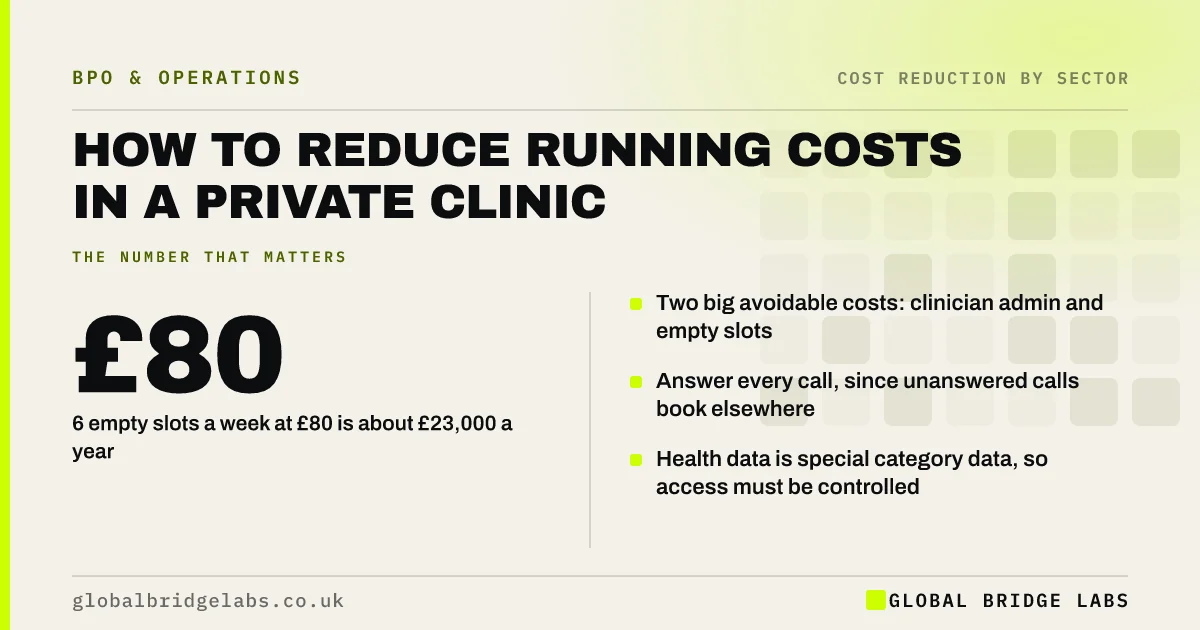
To reduce private clinic running costs, protect clinical time and fill the diary. The two largest avoidable costs in most private clinics are clinicians doing administration and appointment slots that go unused. In our example, six empty slots a week at £80 is about £23,000 a year. Reception and admin routines are where both are fixed.
- Two big avoidable costs: clinician admin and empty slots.
- 6 empty slots a week at £80 is about £23,000 a year.
- Answer every call, since unanswered calls book elsewhere.
- Health data is special category data, so access must be controlled.
Want your clinic's admin and empty-slot costs estimated? Message us on WhatsApp with your weekly appointments.
Chat on WhatsApp →Where do clinic costs go?
Clinic costs go on clinical staff, reception and administration, premises, equipment, consumables, insurance and regulatory compliance. Most are fixed in the short term. A treatment room costs the same whether it is in use or empty, which is why utilisation matters more to a clinic's economics than almost any saving on supplies.
What do empty slots cost?
Empty slots cost their full fee, because the room, the clinician and the reception team are already paid for. In an illustrative clinic charging £80 per appointment, six unused slots a week over 48 working weeks is 288 appointments and about £23,000 of income lost against costs that did not fall.
Slots go unused for three reasons: enquiries that were never answered, late cancellations that were not refilled, and patients who did not attend. Each has an administrative fix.
- Unanswered calls and messages.
- Cancellations not offered to a waiting list.
- Missed appointments with no reminder.
- Outsourced appointment booking and diary management
- Slow response to enquiries: what it costs and the fix
Want to know what your unused slots are worth? Send us your diary numbers on WhatsApp.
Chat on WhatsApp →What does clinician admin cost?
Clinician admin costs the appointments that could have been seen in that time. A practitioner who spends four hours a week on letters, referrals, booking queries and chasing results has given up several appointments. At £80 each and two per hour, four hours is eight appointments, or £640 a week.
Some of that work needs clinical input. Much of it is formatting, sending, filing and chasing, which does not.
What can be handed over safely?
Non-clinical administration can be handed over with proper controls. Clinical decisions, advice and anything requiring registration cannot.
- Call answering, online enquiries and booking.
- Reminders, confirmations and waiting list management.
- Invoicing, insurer paperwork and payment chasing.
- Typing and sending letters from dictation or templates.
- Recall lists and routine follow-up messages.
What do data protection and regulation require?
Health information is special category data under UK GDPR, which demands a higher standard of protection. You need a lawful basis and a condition for processing, a written contract with any provider, access limited to what each task needs, and an appropriate safeguard for any transfer outside the UK. Regulated providers in England must also meet Care Quality Commission standards on governance and records.
Start with tasks that need the least clinical detail, such as booking and reminders.
What should a clinic not cut?
A clinic should not cut front-desk capacity at busy times, infection control, equipment maintenance or staff training. Savings there surface as complaints, incidents or inspection findings. Cutting reception hours to save wages while calls go unanswered is the classic clinic false economy.
What does this look like in practice?
A pattern we see in single-site clinics: the receptionist is greeting patients, taking payments and answering the phone at once, and at peak times the phone loses. Those callers are new patients trying to book. Moving call answering and booking to a team that does only that fills slots the front desk never knew it was missing.
Clinic cost checklist
Measure these over four weeks.
- Count unused appointment slots.
- Count missed calls during opening hours.
- Count cancellations and how many were refilled.
- Log clinician hours spent on non-clinical admin.
- Check reminders are sent for every appointment.
- Review who has access to patient records and why.
Next step
Tell us your weekly appointment capacity, how many slots go unused and who handles calls. We will estimate what the gaps are costing and outline which admin could be handled for you.
Message us on WhatsApp for a clinic admin review, or book a 30-minute consultation.
Chat on WhatsApp →Sources and further reading
- Special category data · Information Commissioner's Office
- Contracts and liabilities between controllers and processors · Information Commissioner's Office
- International transfers of personal data · Information Commissioner's Office
Frequently asked questions
What are the biggest running costs for a private clinic?
Clinical and reception staff, premises, equipment, consumables, insurance and compliance are the main costs. Most are fixed regardless of how many patients are seen, so unused appointment slots and clinician time spent on administration are the largest avoidable costs.
How can a clinic reduce missed appointments?
Send reminders by text or email before every appointment, make cancelling and rebooking easy, and keep a waiting list to fill late gaps. A clear cancellation policy explained at booking also helps. Track the missed appointment rate monthly.
Can a clinic outsource reception and admin?
Yes, for non-clinical work such as call answering, booking, reminders, invoicing and typing. Because health data is special category data, a written contract, restricted access and appropriate safeguards are required. Clinical advice and decisions must stay with registered staff.
Is it safe to share patient data with an outsourced team?
It can be done lawfully with the right controls: a lawful basis, a data processing contract, access limited to what the task needs, secure systems and a safeguard for any international transfer. Start with tasks needing minimal clinical information.
Written by

Global Bridge Labs (GBL) is a UK–Sri Lanka partner for social media, websites and BPO. Everything here comes from client delivery, not theory.


