
On this page
- 01Key takeaways
- 02Where do costs leak in a trades business?
- 03What does owner admin cost?
- 04What should you fix first?
- 05Which tasks can be handed over?
- 06What about late payment?
- 07What does not work?
- 08What does this look like in practice?
- 09Trades cost checklist
- 10Next step
- 11Sources and further reading
- 12Frequently asked questions
Key takeaways
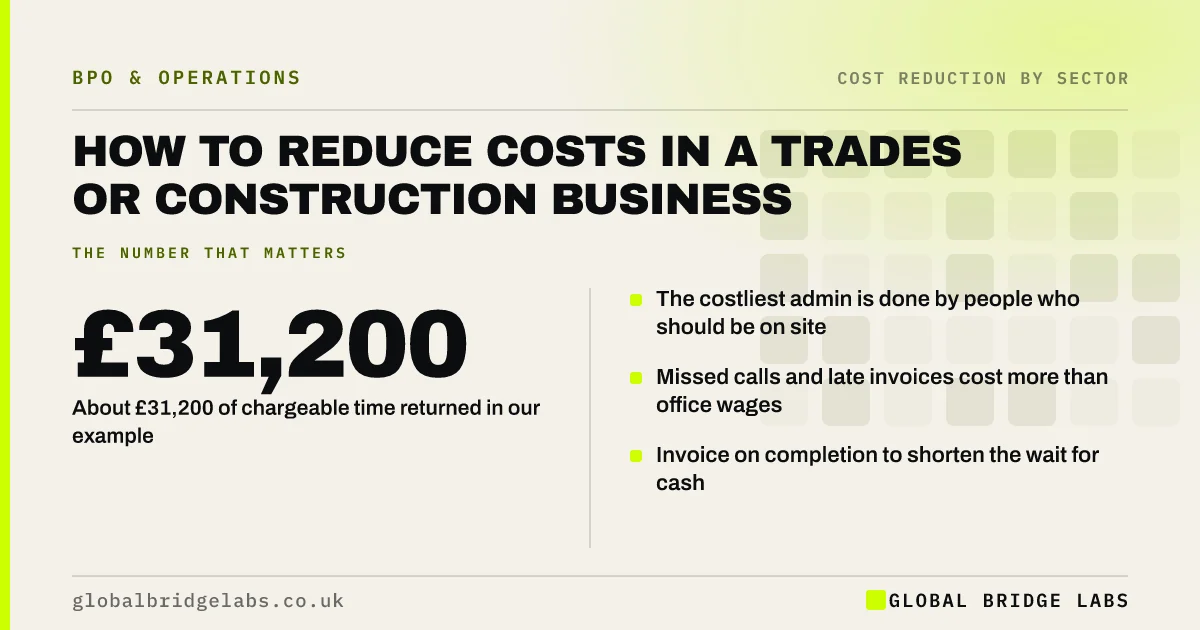
To reduce costs in a trades business, protect billable hours first. The most expensive admin in a trades or construction firm is done by the people who should be on the tools or pricing work. In our example, moving 15 hours a week of calls, quotes and invoicing off the owner returns about £31,200 of chargeable time a year.
- The costliest admin is done by people who should be on site.
- About £31,200 of chargeable time returned in our example.
- Missed calls and late invoices cost more than office wages.
- Invoice on completion to shorten the wait for cash.
Want to see what your paperwork costs in lost site time? Message us on WhatsApp with your team size.
Chat on WhatsApp →Where do costs leak in a trades business?
Costs leak in three places: skilled people doing office work, jobs lost to missed calls and slow quotes, and cash tied up in invoices sent late. Materials and fuel get the attention because they have invoices. The leaks have none, so they go unmanaged.
What does owner admin cost?
Take an illustrative firm with eight engineers whose owner spends 15 hours a week on calls, scheduling, quotes and invoicing. If the owner's time is chargeable at £40 an hour, that is £600 a week, or about £31,200 a year of work not done or done in the evenings.
The same 15 hours handled by a managed team at an indicative £12 an hour costs about £9,360 a year. The gap is not a wage saving. It is chargeable time coming back.
- Owner admin: 15 hours a week.
- Value at £40 an hour: about £31,200 a year.
- Managed team at £12 an hour: about £9,360 a year.
Want this sum done for your own week? Send us your hours on WhatsApp.
Chat on WhatsApp →What should you fix first?
Fix the things that lose revenue before the things that cost wages. A call that goes to voicemail while the team is on a roof is often a job that goes to someone else.
- 1. Make sure every call is answered and logged.
- 2. Send quotes within a set time, from a template.
- 3. Invoice on the day a job completes.
- 4. Chase overdue invoices on a weekly schedule.
- 5. Enter job details once, not on paper and again in software.
Which tasks can be handed over?
Tasks that follow rules and can be done from a screen hand over well: call answering and booking, diary management, quote preparation from your price list, invoicing, payment reminders, certificates and compliance paperwork. Pricing complex jobs, site decisions and supplier negotiation stay with you.
Contractors in the Construction Industry Scheme must file monthly returns with HMRC, which is the kind of recurring, rule-based task that benefits from a fixed routine.
What about late payment?
Late payment is a cost in its own right. Where no payment date is agreed for a business-to-business sale, payment is late 30 days after the customer receives the invoice or the goods or service. Statutory interest of 8% above the Bank of England base rate can be charged on late commercial payments. The bigger win is usually sending the invoice sooner.
What does not work?
Cutting the office does not work. A firm that saves an administrator's wage and has engineers doing their own paperwork has swapped a low-cost hour for a high-cost one. Nor does outsourcing help if job information is not captured on site. Fix how details are recorded first.
What does this look like in practice?
A pattern we see across UK trades: invoices are written up on Sunday evening for work finished two or three weeks earlier, from memory and photos. Details are missed and customers query them. Having job sheets sent in daily and invoices raised the next morning removes the Sunday shift and brings cash in sooner.
Across our client work, owners have got 31 hours a week back.
Trades cost checklist
Check these over a typical fortnight.
- Count missed calls and how many were returned.
- Measure days from enquiry to quote.
- Measure days from job completion to invoice.
- Log office hours done by engineers and the owner.
- Calculate debtor days.
- List paperwork entered more than once.
Next step
Tell us how many engineers you have and who handles calls, quotes and invoices. We will show you what that work is costing in site time and what could be taken off your hands.
Message us on WhatsApp for a trades admin review, or book a 30-minute consultation.
Chat on WhatsApp →Sources and further reading
Frequently asked questions
How can a trades business reduce overheads?
Start by getting skilled people off office work. Have calls answered and logged, send quotes from templates, invoice on completion and chase payment on a schedule. These reduce lost jobs and waiting for cash, which usually cost more than the office wage bill.
What admin can a construction firm outsource?
Call answering, booking and diary management, quote preparation from a price list, invoicing, payment reminders, data entry and routine compliance paperwork are commonly outsourced. Complex pricing, site decisions and supplier negotiations are best kept in-house.
How much does a missed call cost a tradesperson?
It depends on the average job value and how many callers ring a competitor instead. Estimate it by multiplying missed calls per week by the share that would have become jobs and by your average job value. Even a few a week add up quickly.
Is it cheaper to employ an office administrator or outsource?
It depends on the hours needed. A full-time role suits a firm with a full week of office work and a need for someone on site. A managed team suits part of a week, variable volume or cover beyond office hours. Compare the cost per task for your own workload.
Written by

Global Bridge Labs (GBL) is a UK–Sri Lanka partner for social media, websites and BPO. Everything here comes from client delivery, not theory.


