On this page
- 01Key takeaways
- 02Why do solo founders hit a ceiling?
- 03What should a solo founder outsource first?
- 04What does it cost against your own time?
- 05How is this different from a first employee?
- 06How do you hand over when it is all in your head?
- 07When should a solo founder not outsource?
- 08What does this look like in practice?
- 09Solo founder outsourcing checklist
- 10Next step
- 11Sources and further reading
- 12Frequently asked questions
Key takeaways
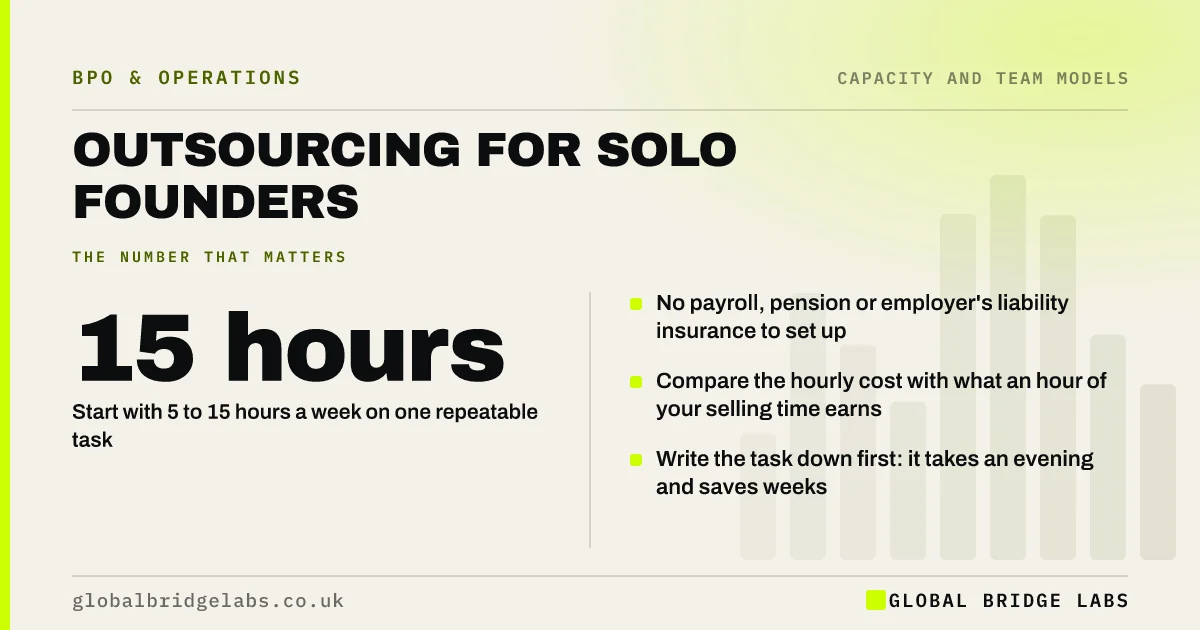
Outsourcing for solopreneurs means buying a few hours a week of admin, customer contact or production so the founder's time goes on selling and delivering. It lets a one-person business grow without registering as an employer. Start with 5 to 15 hours a week on the most repeatable task, and only once you can describe it in writing.
- Start with 5 to 15 hours a week on one repeatable task.
- No payroll, pension or employer's liability insurance to set up.
- Compare the hourly cost with what an hour of your selling time earns.
- Write the task down first: it takes an evening and saves weeks.
Running everything yourself? Message us on WhatsApp with the tasks that eat your week.
Chat on WhatsApp →Why do solo founders hit a ceiling?
Solo founders hit a ceiling because every activity competes for the same hours. Selling, delivering, invoicing and replying to customers cannot all be done at once, so growth stops when the calendar is full. The next step is not necessarily a first employee. It is getting routine hours off the founder's desk.
What should a solo founder outsource first?
Outsource first the task that is repeatable, takes several hours a week and does not need your judgement. For most one-person businesses that is the inbox and diary, invoicing and payment chasing, or order and booking admin. Keep selling, pricing and the work customers are paying you for.
- Inbox triage and standard replies.
- Diary management and booking confirmations.
- Invoicing and polite payment chasing.
- Order processing and customer updates.
- Formatting, scheduling and data entry.
What does it cost against your own time?
Compare the cost with what your own hour is worth. If an hour of your selling or delivery time earns £40 and the task can be done for an indicative £9–£18 per hour by a managed offshore team, each hour handed over is worth more than it costs, provided you use the freed time on paid work.
Ten hours a week at £12 is about £520 a month. That is a real commitment for a solo business, so start with a pilot.
Want the sums done for your own hourly value? Send it to us on WhatsApp.
Chat on WhatsApp →How is this different from a first employee?
Buying a service is different from employing someone. A first employee means registering as an employer with HM Revenue & Customs, running payroll, providing a workplace pension, taking out employers' liability insurance and managing a person. A service contract has a monthly fee, a notice period and a provider responsible for cover.
How do you hand over when it is all in your head?
Hand over by recording yourself doing the task. Capture your screen while you process five real examples and talk through each decision. Turn that into a one-page guide with the common cases and what to do with exceptions. Expect to spend an evening on it, and to answer questions for the first fortnight.
When should a solo founder not outsource?
Do not outsource if income is too irregular to commit to a monthly cost, if the task takes under about five hours a week, or if you would not use the freed time on revenue-earning work. In those cases simplify the task, automate reminders and templates, and revisit in a quarter.
What does this look like in practice?
A pattern we see among UK consultants and sole-trader service businesses: the founder does client work all day and admin all evening, and has not sent a proposal in a month. Handing the inbox, diary and invoicing to a part-time managed seat typically frees one to two working days a week for selling.
Solo founder outsourcing checklist
Work through this before you sign anything.
- Log your time for one week by task.
- Pick one repeatable task of five hours or more.
- Record yourself doing it and write a one-page guide.
- Decide what the freed hours will be used for.
- Agree a data processing contract if personal data is involved.
- Run a 60-day pilot and compare hours and income.
Next step
Send us your one-week time log. We will pick out what could be handed over first and what a small pilot would involve.
Message us on WhatsApp to plan your first handover, or book a 30-minute consultation.
Chat on WhatsApp →Sources and further reading
- Employing staff for the first time · GOV.UK
- Employers' liability insurance · GOV.UK
- Contracts and liabilities between controllers and processors · Information Commissioner's Office
Frequently asked questions
Can a sole trader outsource work?
Yes. A sole trader can buy services from another business, such as admin support, call answering or bookkeeping, without becoming an employer. You remain responsible for the work and for any personal data involved, so use a written contract that covers scope, confidentiality and data protection.
What should a one-person business outsource?
A one-person business should outsource repeatable tasks that take several hours a week and do not need the owner's judgement: inbox and diary management, invoicing and payment chasing, order or booking admin, and content formatting or scheduling. Keep sales, pricing and the core service.
Is outsourcing better than hiring a first employee?
For a few hours a week of routine work, usually yes. It avoids payroll, pension and insurance setup and can be stopped with notice. When the work becomes a steady, full role that benefits from being in the business every day, a first employee starts to make more sense.
How many hours should a solo founder outsource?
Start with 5 to 15 hours a week on one task. That is enough to notice the difference without a large fixed cost. Increase only once the freed time is producing more income than the service costs, which you can check after a 60-day pilot.
Written by

Global Bridge Labs (GBL) is a UK–Sri Lanka partner for social media, websites and BPO. Everything here comes from client delivery, not theory.