On this page
- 01Key takeaways
- 02Myth: is an employee's cost just their salary?
- 03Myth: does the cheapest hourly rate always win?
- 04Myth: is outsourcing only for large companies?
- 05Myth: does outsourcing always save money?
- 06Myth: does offshore mean low quality?
- 07Myth: are there no costs after signing?
- 08Myth: once outsourced, can you never bring it back?
- 09Myth: is outsourcing only about cutting cost?
- 10What does this look like in practice?
- 11Myth-busting checklist
- 12Next step
- 13Sources and further reading
- 14Frequently asked questions
Key takeaways
The biggest outsourcing cost myths come from comparing the wrong numbers. Salary is not the cost of an employee, the lowest hourly rate is not the lowest total cost, and outsourcing is neither always cheaper nor only for large companies. Compare fully loaded cost per useful output on both sides.
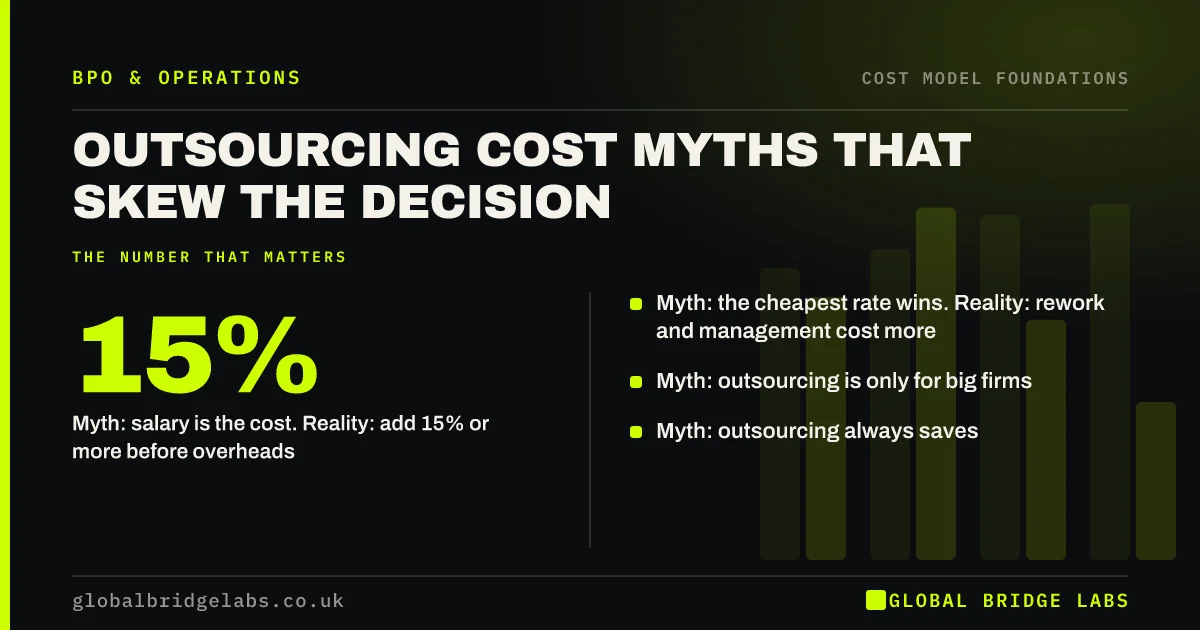
- Myth: salary is the cost. Reality: add 15% or more before overheads.
- Myth: the cheapest rate wins. Reality: rework and management cost more.
- Myth: outsourcing is only for big firms. Reality: SMEs can start with one process.
- Myth: outsourcing always saves. Reality: fully used core roles are cheaper in-house.
Heard a claim about outsourcing costs you want checked? Ask us on WhatsApp.
Chat on WhatsApp →Myth: is an employee's cost just their salary?
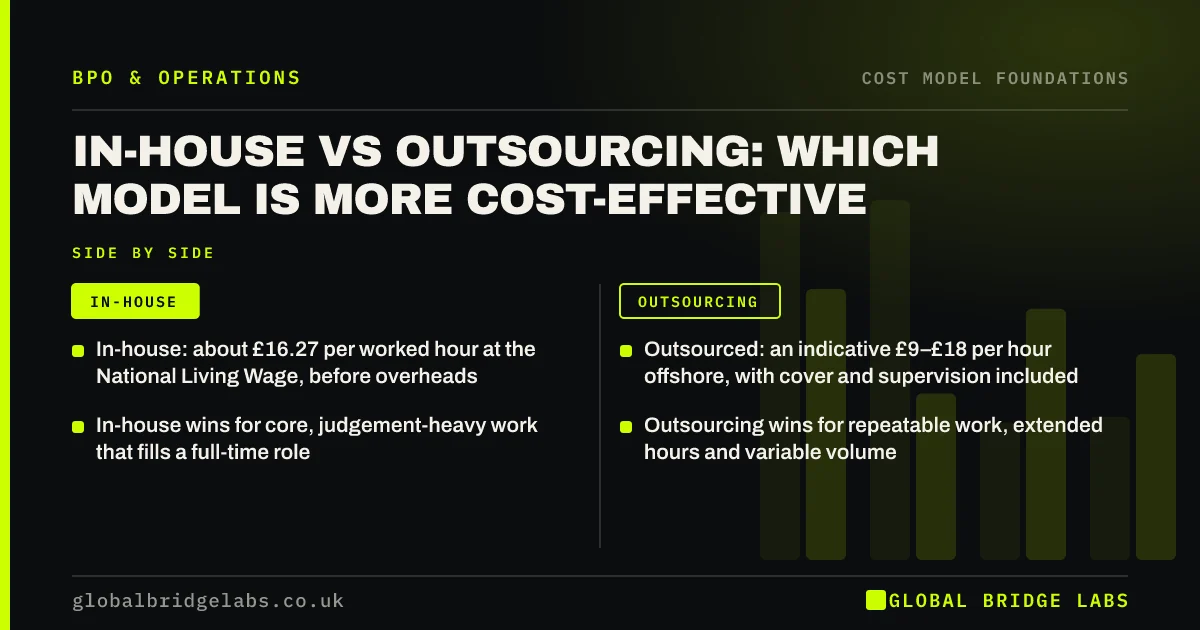
No. Employer National Insurance at 15% above £5,000, pension contributions and 28 days of paid holiday lift the cost per worked hour well above the hourly wage. At the National Living Wage of £12.71, the cost is about £16.27 per worked hour before recruitment, equipment, software, desk space and management.
Myth: does the cheapest hourly rate always win?
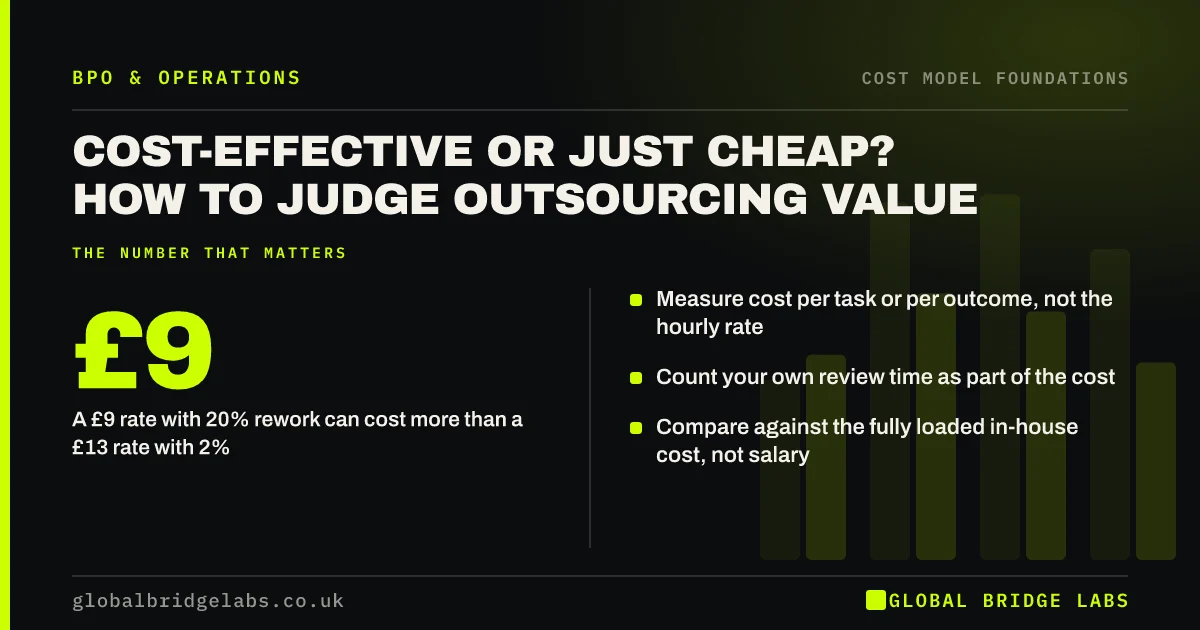
No. A low rate with poor productivity, errors or missing supervision can cost more per task than a higher rate. Compare cost per useful output, including rework and your own review time, before choosing on price.
Myth: is outsourcing only for large companies?
No. Managed providers work with SMEs on part-time seats and single processes, such as inbox management or invoice chasing. Small firms often gain the most, because they have no spare people to cover holidays, peaks or extended hours.
Myth: does outsourcing always save money?
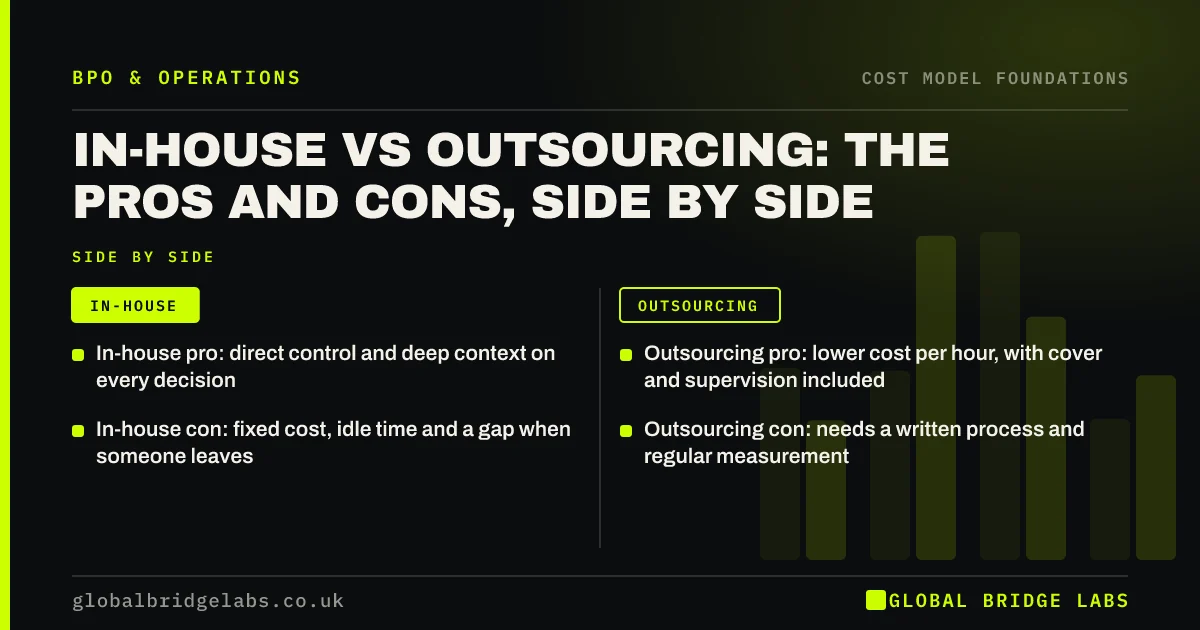
No. When an in-house role is fully used on core, judgement-heavy work, the loaded cost may be lower than any provider once setup and management are counted. Tiny volumes and undocumented processes also erase savings. Outsourcing saves money on the right work, not on all work.
Myth: does offshore mean low quality?
No. Quality depends on the process, training, supervision and measurement, not the country. A managed team with written procedures and quality sampling is often more consistent than one busy employee. Choose on process maturity and references, not geography.
Myth: are there no costs after signing?
No. Plan for your own time during setup, usually 2 to 4 hours a week for the first months, plus tool licences, documentation and a monthly review. These are small against the saving on the right work, but leaving them out makes the business case look better than reality.
Want a comparison with every cost included? Send us the numbers on WhatsApp.
Chat on WhatsApp →Myth: once outsourced, can you never bring it back?
No. With documented processes and sensible notice terms, you can bring work back in-house, and some businesses do as volumes grow. Keeping the process documentation in your name makes that move far easier.
Myth: is outsourcing only about cutting cost?
No. Many SMEs outsource first for cover, speed or skills, and the saving is a side effect. Extended hours, faster replies to enquiries and removing key-person risk often matter more to the business than the rate difference. A decision based only on cost can miss the reasons outsourcing works best.
What does this look like in practice?
A pattern we see in UK professional services firms: a partner rejects outsourcing because the quote per hour is close to an administrator's hourly wage. Once employer costs, holiday, idle time and cover are added, the in-house cost per productive hour is well above the quote.
Myth-busting checklist
Check these before trusting any comparison.
- Is the in-house side fully loaded, not salary only?
- Is the outsourced side including your review time?
- Are you comparing cost per useful output?
- Is the work core or non-core?
- Is there enough volume to justify setup?
Next step
Send us the comparison you have. We will check it for these myths and rebuild it with full costs in a 30-minute call.
Message us on WhatsApp for a myth-free cost comparison, or book a 30-minute consultation.
Chat on WhatsApp →Sources and further reading
- National Minimum Wage and National Living Wage rates · GOV.UK
- Rates and thresholds for employers 2026 to 2027 · HM Revenue & Customs
- Holiday entitlement · GOV.UK
Frequently asked questions
Is outsourcing really cheaper than hiring?
For documented, repeatable work, usually yes once every in-house cost is counted, including employer National Insurance, pension, holiday, overheads and idle time. It is not always cheaper for fully used core roles, tiny volumes or undocumented processes, where setup and management time can cancel the saving.
Why do outsourcing savings look bigger than they are?
Because the outsourced side often leaves out setup, your own review time, tool licences and exit terms. Equally, the in-house side often leaves out idle time, turnover and management. A fair comparison counts both sides fully and tests the result with pessimistic assumptions before deciding.
Is offshore outsourcing lower quality?
Not inherently. Quality comes from a written process, training, supervision and quality sampling. Mature offshore providers deliver consistent quality at scale; poorly managed teams anywhere, onshore or offshore, do not. Judge providers on process maturity, references and measured results rather than location.
Do you lose control when you outsource?
You change how you control the work rather than losing it. Instead of watching people, you set the process, agree service levels and review a monthly scorecard. Many owners find they have clearer control afterwards, because the work is measured in a way it never was in-house.
Written by

Global Bridge Labs (GBL) is a UK–Sri Lanka partner for social media, websites and BPO. Everything here comes from client delivery, not theory.