On this page
- 01Key takeaways
- 02Is falling margin normal during growth?
- 03What are the five usual causes?
- 04How do you find which one applies?
- 05How do you restore margin without shrinking?
- 06What should you not cut?
- 07When is lower margin acceptable?
- 08What does this look like in practice?
- 09Margin recovery checklist
- 10Next step
- 11Sources and further reading
- 12Frequently asked questions
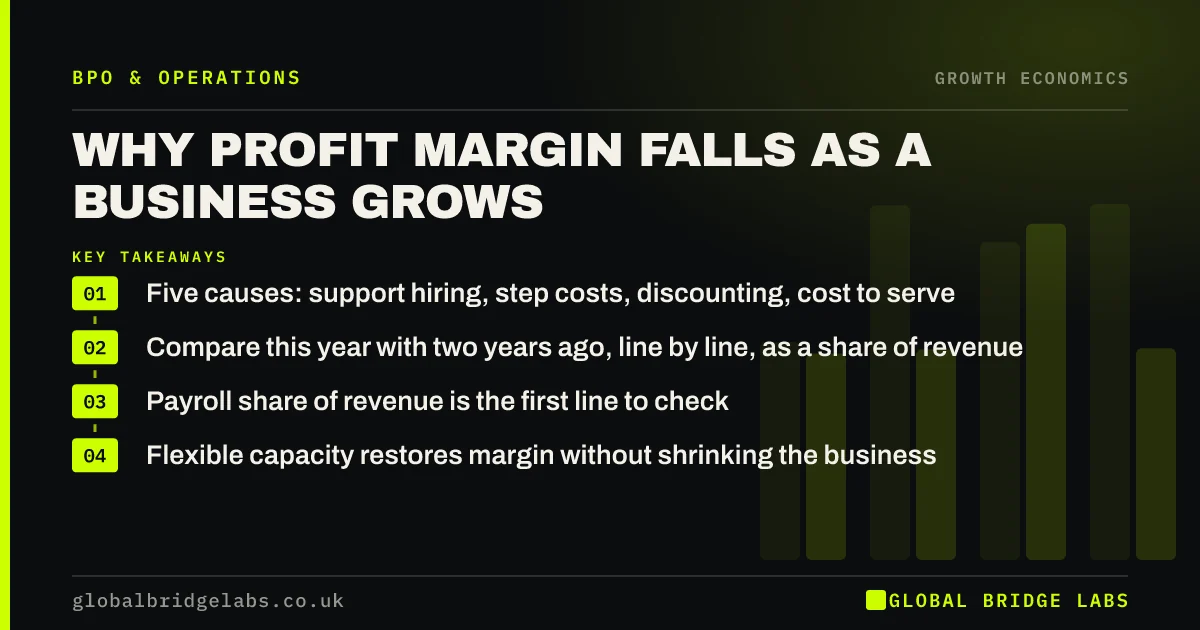
Key takeaways
Profit margin falling as a business grows usually has one of five causes: support staff added faster than sales, step costs taken together, discounting to win volume, rising cost to serve, or less profitable customers. Each shows up in a different number. Find the cause before cutting cost, or you may cut the wrong thing.
- Five causes: support hiring, step costs, discounting, cost to serve, customer mix.
- Compare this year with two years ago, line by line, as a share of revenue.
- Payroll share of revenue is the first line to check.
- Flexible capacity restores margin without shrinking the business.
Turnover up and profit flat? Message us on WhatsApp with two years of headline figures.
Chat on WhatsApp →Is falling margin normal during growth?
A temporary dip in margin during growth is normal, because costs are added before the revenue they support arrives. A margin that keeps falling for two years or more is not. It means the business is getting bigger without getting more efficient, and each new sale is costing more to deliver than the last.
What are the five usual causes?
The five causes below account for most margin erosion in growing UK small businesses. More than one may apply.
- Support hiring: admin, coordination and management roles outpacing sales.
- Step costs: staff, premises and systems all stepped up together.
- Discounting: lower prices to win larger or more customers.
- Cost to serve: more contacts, errors and rework per sale.
- Customer mix: growth coming from less profitable work.
How do you find which one applies?
Find the cause with a common-size comparison. Express each cost line as a percentage of revenue for this year and for two years ago. The lines whose share has risen are where the margin went. Then check gross margin by customer or product to see whether price or mix has moved.
- 1. Put two years of profit and loss side by side.
- 2. Convert each line to a percentage of revenue.
- 3. Mark every line whose share has grown.
- 4. Check gross margin by customer or product.
- 5. Check contacts and errors per order.
How do you restore margin without shrinking?
Restore margin by changing how the next unit of capacity is bought. Hold support headcount level, reduce the work each sale creates, and move variable volume to flexible capacity that costs less per hour and can be adjusted. Review prices for the customers who consume the most time.
- The lean team model: a bigger business, the same headcount
- What scaling a business costs: hire-led vs partner-led
Want to discuss your requirements for holding headcount while volume grows? Message us on WhatsApp.
Chat on WhatsApp →What should you not cut?
Do not cut the things that produce revenue or protect quality: sales effort, the people customers value, and checks that prevent errors. Across-the-board cuts feel fair and usually damage the best parts of the business along with the worst. Cut by cause, not by percentage.
When is lower margin acceptable?
Lower margin is acceptable when it is a deliberate, time-limited investment, such as entering a new market or building a team ahead of a signed contract. It should have an end date and a target. Margin that falls with no plan behind it is drift.
What does this look like in practice?
A pattern we see in UK firms that have doubled turnover: net margin has roughly halved, and the owner suspects pricing. The common-size comparison shows prices held up, but payroll has climbed several points as a share of revenue, almost all of it in support roles. The fix is in how work is organised, not in the price list.
Margin recovery checklist
Work through this before making cuts.
- Compare cost lines as a share of revenue over two years.
- Split payroll into revenue-earning and support roles.
- Check gross margin by customer and product.
- Measure contacts, errors and rework per order.
- Identify variable work held in fixed roles.
- Reprice or redesign the least profitable work.
- Set a margin target with a date.
Next step
Send us two years of headline profit and loss figures and headcount. We will show you which lines have grown faster than revenue and what could be done about each.
Message us on WhatsApp for a margin review, or book a 30-minute consultation.
Chat on WhatsApp →Sources and further reading
- Labour productivity · Office for National Statistics
- Rates and thresholds for employers 2026 to 2027 · HM Revenue & Customs
Frequently asked questions
Why is my revenue going up but profit going down?
Revenue can rise while profit falls when costs grow faster than sales. Common causes are hiring support staff ahead of revenue, taking on premises and systems at the same time, discounting to win volume, more errors and customer contacts per sale, and growth in less profitable work.
Is it normal for profit margin to drop as a company grows?
A short-term drop is normal, because capacity is added before the revenue it supports. A sustained decline over several years suggests the business is adding cost in proportion to, or faster than, sales. That calls for a review of how capacity is bought and work is organised.
How can I improve profit margin without cutting staff?
Improve margin by holding headcount steady while revenue grows: remove rework and avoidable customer contacts, automate routine steps, use flexible outside capacity for additional volume, and review prices for time-consuming customers. Margin recovers as revenue rises against a stable fixed cost base.
What is a common-size profit and loss?
A common-size profit and loss shows each line as a percentage of revenue instead of in pounds. Comparing two or more years this way reveals which costs have grown faster than sales, which is hard to see in absolute figures when the whole business is getting bigger.
Written by

Global Bridge Labs (GBL) is a UK–Sri Lanka partner for social media, websites and BPO. Everything here comes from client delivery, not theory.