On this page
- 01Key takeaways
- 02What makes in-house cheaper?
- 03At what utilisation does in-house win?
- 04Is in-house cheaper for small volumes?
- 05Which roles are usually cheaper in-house?
- 06When does onshore outsourcing cost more than in-house?
- 07Can in-house become cheaper over time?
- 08How do you test whether in-house is cheaper?
- 09What does this look like in practice?
- 10In-house cost check
- 11Next step
- 12Sources and further reading
- 13Frequently asked questions
Key takeaways
In-house is cheaper than outsourcing when a role is fully used, on core or judgement-heavy work, at a salary close to the outsourced rate once loaded. It is also cheaper for very small volumes, where setup and management outweigh savings. For repeatable work that needs cover or varies in volume, outsourcing is usually cheaper.
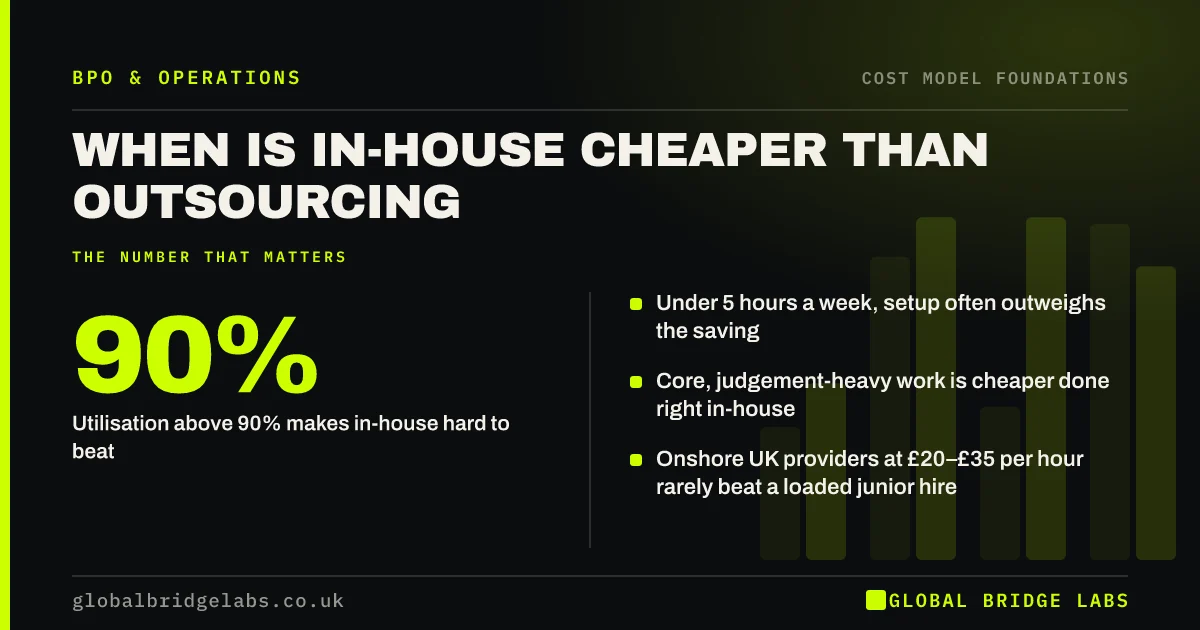
- Utilisation above 90% makes in-house hard to beat.
- Under 5 hours a week, setup often outweighs the saving.
- Core, judgement-heavy work is cheaper done right in-house.
- Onshore UK providers at £20–£35 per hour rarely beat a loaded junior hire.
Think a role is cheaper in-house? Send us the numbers on WhatsApp and we will check.
Chat on WhatsApp →What makes in-house cheaper?
Three conditions make in-house cheaper: high utilisation, low loaded cost relative to the outsourced rate, and work that would need heavy management if outsourced. When all three are true, the provider's margin and your oversight time outweigh anything the provider saves you.
At what utilisation does in-house win?
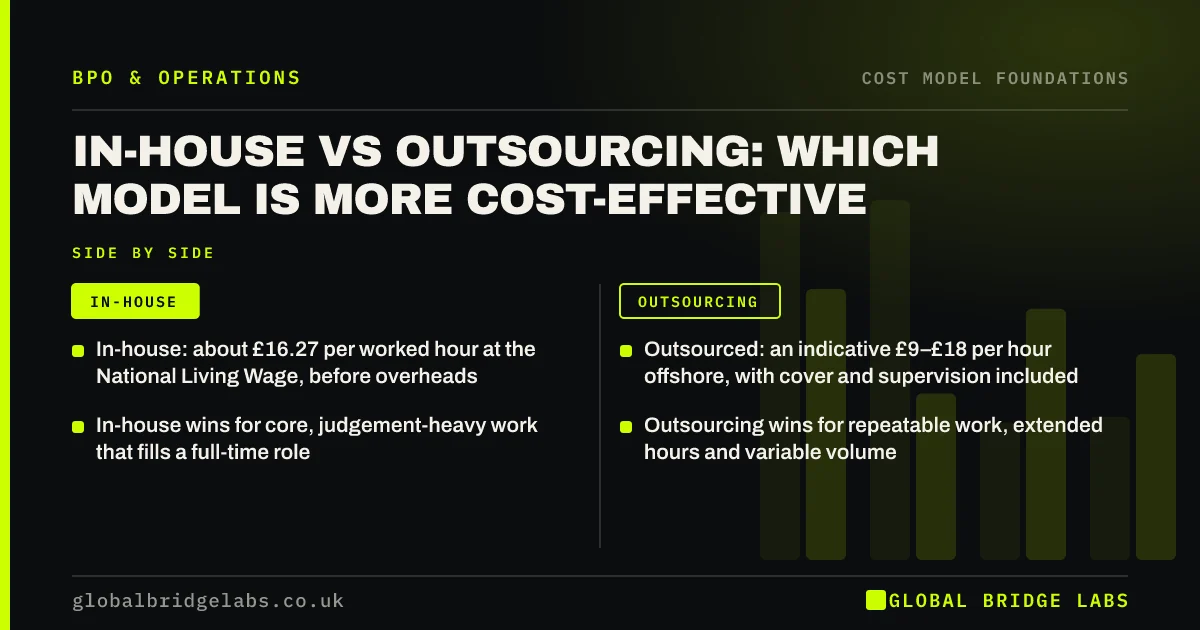
Utilisation is the share of paid hours spent on productive work. A £25,000 hire costs about £16.42 per worked hour; at 90% utilisation that is about £18.24 per productive hour, close to many outsourced rates. At 60% it is about £27.37, and outsourcing is clearly cheaper.
Is in-house cheaper for small volumes?
Often, yes. If a task takes 2 to 3 hours a week and someone with spare time already does it well, the saving from outsourcing is small, and setup, documentation and review time may never pay back. Group small tasks together until there is enough volume to hand over.
Which roles are usually cheaper in-house?
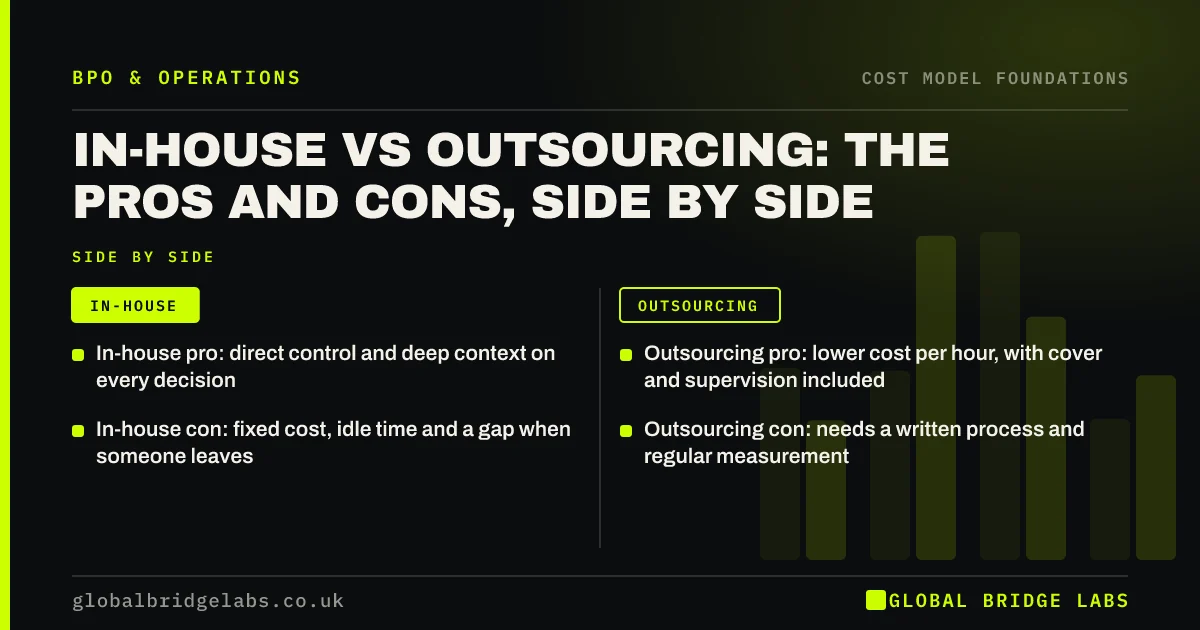
Roles that combine judgement, relationships and deep context are usually cheaper in-house, because outsourcing them needs extensive documentation and oversight. So are roles that must be on site.
- Account management and key client relationships.
- Pricing, estimating and commercial decisions.
- Product ownership and strategy.
- On-site roles: reception at a busy site, warehouse, field work.
- Senior specialists whose knowledge is the product.
When does onshore outsourcing cost more than in-house?
Onshore UK providers typically charge an indicative £20–£35 per hour. A fully used junior UK hire at £25,000 to £30,000 costs about £16–£20 per worked hour, plus overheads. For steady, full-time volumes, onshore outsourcing is often more expensive than a well-used hire; it earns its place on cover, skills and flexibility.
Want onshore, offshore and in-house costed side by side? Message us on WhatsApp.
Chat on WhatsApp →Can in-house become cheaper over time?
Yes. As volume grows to the point where a dedicated team is fully used, bringing work in-house can become cheaper, especially for specialist functions. Review the numbers each year, and keep processes documented so either move is possible.
How do you test whether in-house is cheaper?
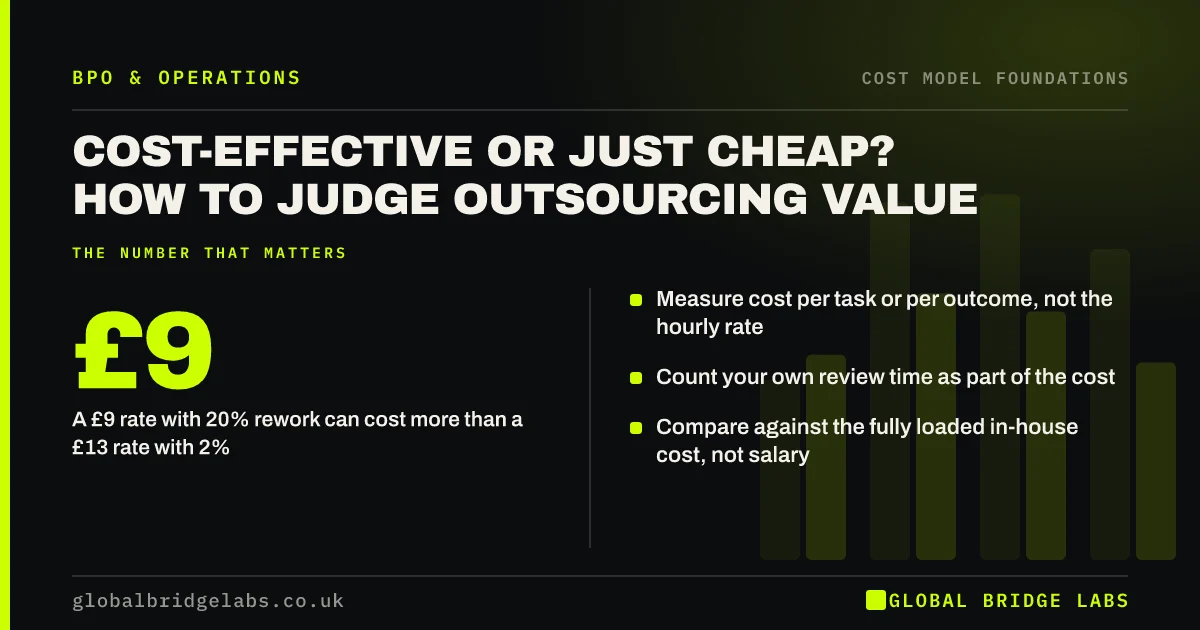
Run the comparison twice. First with realistic figures: loaded in-house cost, measured utilisation and a real outsourced quote including your oversight time. Then with assumptions that favour in-house: utilisation 10 points higher and the outsourced rate at the top of its range. If in-house wins both times, keep the work in-house.
What does this look like in practice?
A pattern we see in UK e-commerce brands: customer email is outsourced because it varies with the season and needs weekend cover, while product content stays in-house because it is steady, full-time and depends on product knowledge. Each function sits where it is cheaper.
In-house cost check
Keep work in-house if most of these are true.
- The role is used at 90% or more of paid hours.
- The work is core or needs deep context.
- Someone must be physically present.
- Volume is steady all year.
- The task is under 5 hours a week and done well today.
Next step
We will cost your role in-house and outsourced in a 30-minute call, and tell you plainly if in-house is cheaper.
Message us on WhatsApp for an honest in-house vs outsourcing check, or book a 30-minute consultation.
Chat on WhatsApp →Sources and further reading
Frequently asked questions
When is it cheaper to keep work in-house?
When the role is fully used, the work is core or needs deep context, someone must be physically on site, volume is steady all year, or the task is so small that setup and management time would outweigh the saving from outsourcing. Check with a full cost comparison.
Is a UK onshore provider cheaper than hiring?
Often not for steady, full-time work. Onshore UK providers typically charge an indicative £20–£35 per hour, while a fully used junior hire costs about £16–£20 per worked hour before overheads. Onshore providers earn their place through cover, specialist skills and flexibility rather than a lower rate.
How do I know if my team is fully used?
Track time or workload for two to four weeks, including quiet days, and compare productive hours with paid hours. Utilisation of 90% or more is high. Under about 75% usually means paid idle time that a shared or outsourced service could absorb more cheaply.
Can outsourcing still make sense if in-house is cheaper?
Sometimes, for reasons other than cost. Outsourcing can add out-of-hours cover, remove key-person risk or supply a skill you cannot hire. In that case, treat the extra cost as buying resilience or capability, and decide whether that is worth it to the business.
Written by

Global Bridge Labs (GBL) is a UK–Sri Lanka partner for social media, websites and BPO. Everything here comes from client delivery, not theory.