On this page
- 01Key takeaways
- 02What inputs does the calculator need?
- 03How do you calculate the in-house side?
- 04How do you calculate the outsourced side?
- 05What does a worked example look like?
- 06How should you read the result?
- 07What does the calculator leave out?
- 08What are the most common calculator mistakes?
- 09What does this look like in practice?
- 10Calculator checklist
- 11Next step
- 12Sources and further reading
- 13Frequently asked questions
Key takeaways
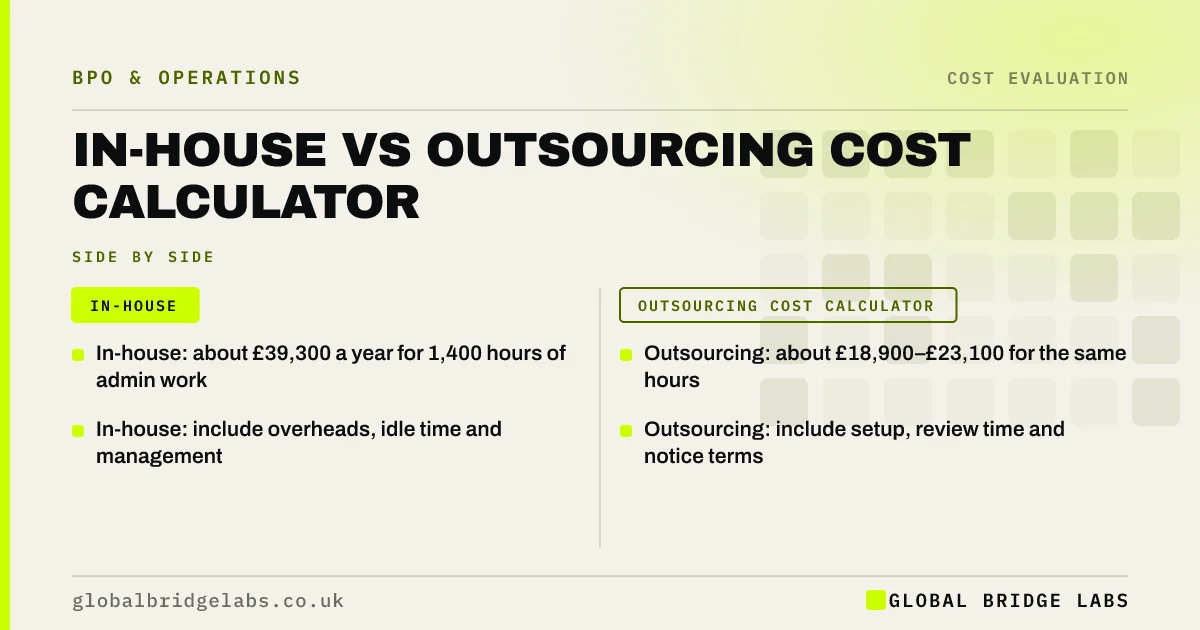
An in-house vs outsourcing cost calculator needs six inputs: hours of work, salary, overheads, utilisation, management time and the outsourced rate. Run both sides as annual totals and as cost per productive hour. In our worked example, 1,400 hours of admin costs about £39,300 in-house and £18,900–£23,100 outsourced.
- In-house: about £39,300 a year for 1,400 hours of admin work.
- Outsourcing: about £18,900–£23,100 for the same hours.
- In-house: include overheads, idle time and management.
- Outsourcing: include setup, review time and notice terms.
Want the calculator run with your numbers? Message us on WhatsApp.
Chat on WhatsApp →What inputs does the calculator need?
Collect these before you start. Use real figures where you have them and state assumptions clearly where you do not.
- Hours of work per year that the role or process needs.
- Salary and hours of the in-house person.
- Overheads per employee per year.
- Utilisation: the share of paid hours that is productive.
- Management hours per week on each side, and their value.
- Outsourced rate per hour or per task, and any setup fee.
How do you calculate the in-house side?
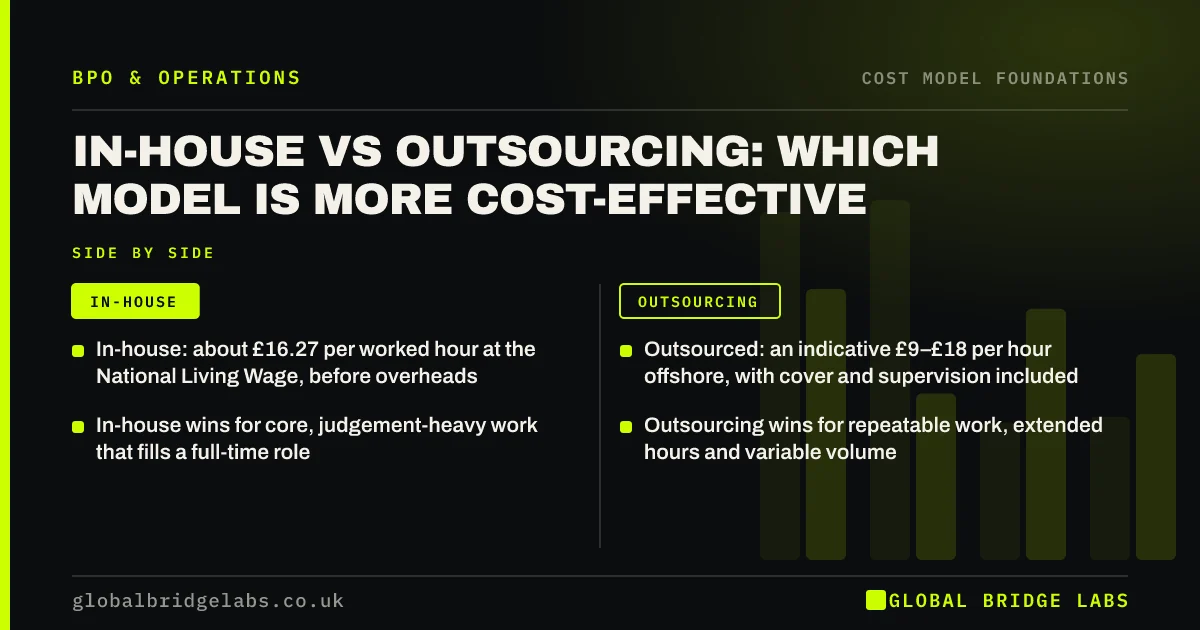
Start with employment cost: salary, plus employer National Insurance at 15% on earnings above £5,000, plus pension at 3% of qualifying earnings above £6,240. Add overheads and management time. Divide by worked hours (about 1,740 for a full-time employee after 28 days' holiday) for cost per worked hour, then by utilisation for cost per productive hour.
- Employer NI: 15% x (salary - £5,000).
- Pension: 3% x (salary - £6,240), capped at the upper limit.
- Annual cost: salary + NI + pension + overheads + management.
- Cost per productive hour: annual cost / (1,740 x utilisation).
How do you calculate the outsourced side?
Multiply the hours of work by the outsourced rate, add your own management time at its real value, and add one-off setup costs spread over the period you are comparing. If the provider prices per task, multiply tasks by the unit price instead.
- Service cost: hours x rate, or tasks x unit price.
- Oversight: your hours per week x value x 52.
- Setup: fees plus internal hours, spread over the period.
What does a worked example look like?
A business needs 1,400 hours a year of email, order and admin work. In-house, one £28,000 hire costs about £32,103 in employment costs, plus £3,000 overheads and 2 hours a week of management at £40, about £4,160. Total: about £39,300, or £28 per hour of work actually needed.
Outsourced at £12–£15 per hour, 1,400 hours cost £16,800–£21,000, plus 1 hour a week of oversight, £2,080. Total: about £18,900–£23,100. The saving is about £16,000–£20,000 a year.
Want this template filled in for your roles? Send us the inputs on WhatsApp.
Chat on WhatsApp →How should you read the result?
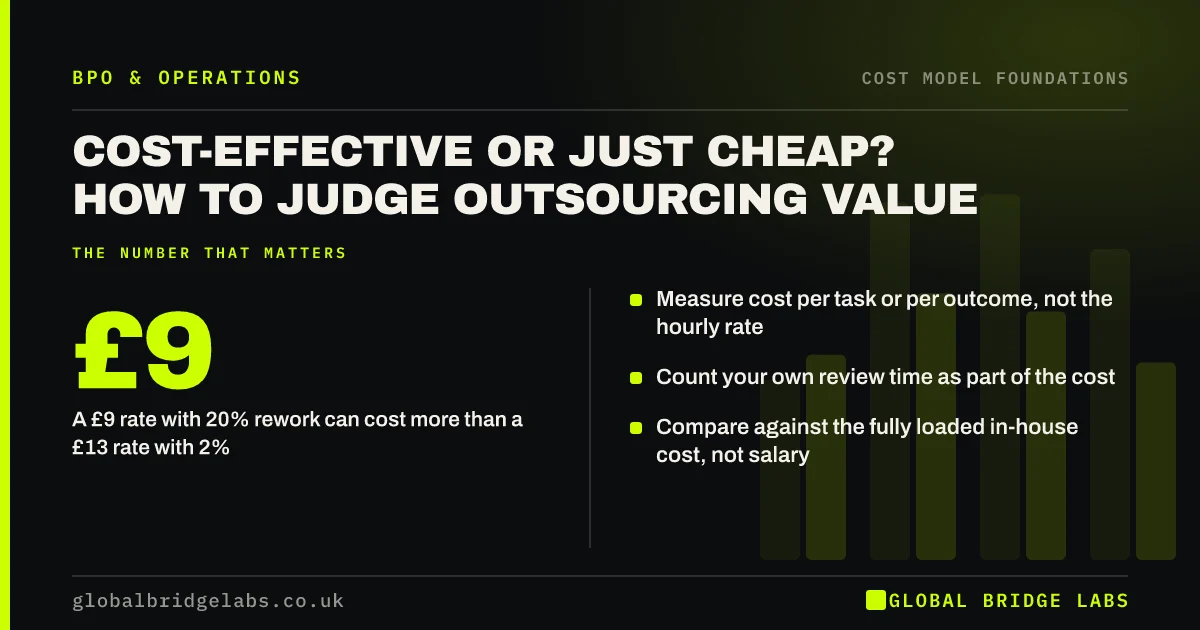
Treat the answer as a range, not a single number. Test it with the in-house utilisation 10 points higher and the outsourced rate at the top of its range. If outsourcing still wins, the case is robust. If the answer flips, look harder at quality, cover and flexibility before deciding.
What does the calculator leave out?
Recruitment, turnover, sickness cover and exit costs on the in-house side, and minimum terms or price reviews on the outsourced side. Add them for a three-year view. The calculator also cannot value quality or opportunity cost; assess those separately.
What are the most common calculator mistakes?
Most wrong answers come from a few repeated mistakes. Check for them before trusting the result, especially if the answer surprises you.
- Using salary instead of loaded employment cost.
- Assuming 100% utilisation for the in-house role.
- Leaving out your own oversight time on the outsourced side.
- Comparing different scopes or hours of cover.
- Ignoring VAT if your business cannot recover it.
What does this look like in practice?
A pattern we see in UK SMEs: the first calculation compares salary with an outsourced quote and shows a small saving. Adding employer costs, overheads, utilisation and management turns it into a clear decision, either way, and gives the owner numbers to take to a partner or bank.
Calculator checklist
Run through these steps.
- Measure hours of work needed per year.
- Calculate in-house employment cost with 2026/27 rates.
- Add overheads and management time.
- Apply realistic utilisation.
- Price the outsourced side with your oversight time.
- Test the result with pessimistic assumptions.
Next step
Send us your inputs. We will run the calculator with you in a 30-minute call and show the result as a range.
Message us on WhatsApp for the cost calculator, or book a 30-minute consultation.
Chat on WhatsApp →Sources and further reading
- Rates and thresholds for employers 2026 to 2027 · HM Revenue & Customs
- Workplace pensions: what you, your employer and the government pay · GOV.UK
- Holiday entitlement · GOV.UK
- National Minimum Wage and National Living Wage rates · GOV.UK
Frequently asked questions
How do I calculate in-house vs outsourcing costs?
For in-house, add salary, employer National Insurance, pension, overheads and management time, then divide by productive hours. For outsourcing, multiply the hours of work by the rate and add your oversight time and setup. Compare annual totals and cost per productive hour on the same scope.
What employer costs should the calculation use?
For 2026/27, employer National Insurance is 15% on earnings above £5,000 a year, and the minimum employer pension contribution is 3% of qualifying earnings above £6,240. Statutory holiday reduces worked hours to about 1,740 a year for a full-time employee on 37.5 hours a week.
How reliable is an outsourcing cost calculation?
Reliable enough to decide if you test it with pessimistic assumptions. If outsourcing still wins with in-house utilisation 10 points higher and the outsourced rate at the top of its range, the case is robust. If the answer flips, weigh quality, cover and flexibility carefully.
Should the calculation cover one year or three?
Run one year for the budget and three years for the decision. Three years spreads recruitment, setup and training fairly, and captures likely turnover and a contract renewal. A one-year view tends to favour whichever option has the lower start-up cost.
Written by

Global Bridge Labs (GBL) is a UK–Sri Lanka partner for social media, websites and BPO. Everything here comes from client delivery, not theory.