On this page
- 01Key takeaways
- 02Why is holiday cover so hard for small businesses?
- 03How much cover does a one-person process need?
- 04What are the options for holiday and sickness cover?
- 05When does outsourcing make sense for cover?
- 06What does sickness cost a small business?
- 07What are the downsides of outsourced cover?
- 08How do you plan cover before the gaps appear?
- 09What does this look like in practice?
- 10Cover checklist
- 11Next step
- 12Sources and further reading
- 13Frequently asked questions
Key takeaways
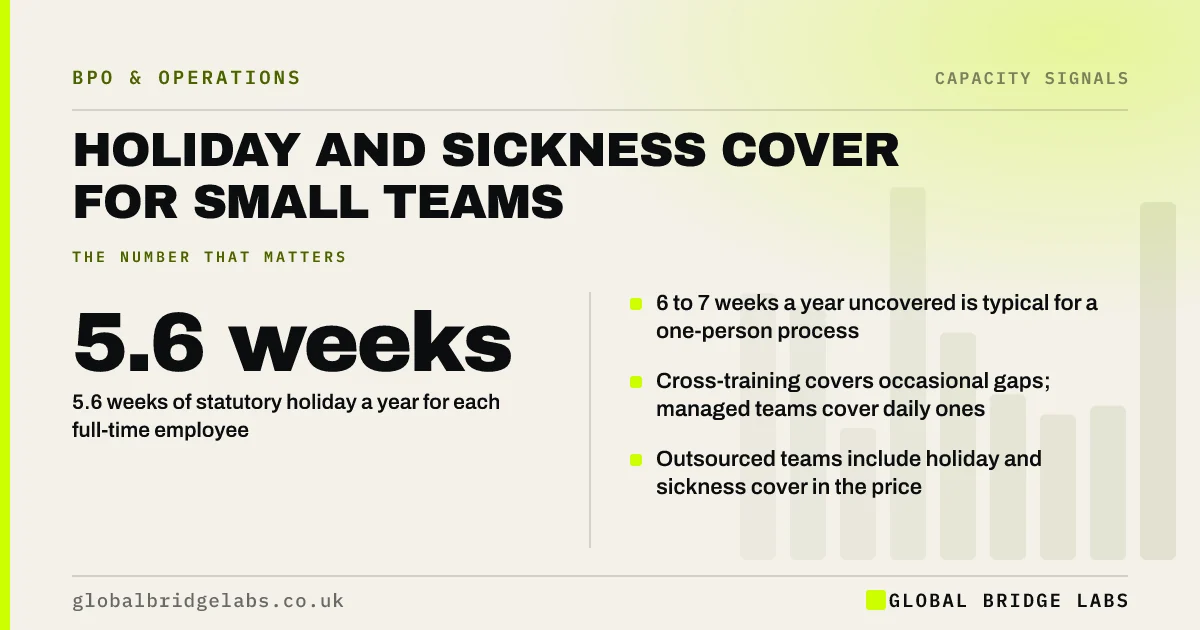
Holiday cover in a small business fails when a process depends on one person. With 5.6 weeks of statutory holiday plus sickness, a single-person process is uncovered for about 6 to 7 weeks a year. Cross-train where you can, and outsource processes that need daily cover, such as phones, inbox and booking.
- 5.6 weeks of statutory holiday a year for each full-time employee.
- 6 to 7 weeks a year uncovered is typical for a one-person process.
- Cross-training covers occasional gaps; managed teams cover daily ones.
- Outsourced teams include holiday and sickness cover in the price.
Gaps every time someone is off? Message us on WhatsApp with the process that breaks.
Chat on WhatsApp →Why is holiday cover so hard for small businesses?
Holiday cover is hard because small businesses run many processes through one person each. When the office manager is on leave, phones, invoicing and supplier orders all stop together. Every full-time employee is entitled to 5.6 weeks of paid holiday a year, so these gaps are predictable, not unlucky.
How much cover does a one-person process need?
Add holiday, sickness and training. 5.6 weeks of statutory holiday is 28 days for a five-day week. Add a few days of sickness and a few of training, and a one-person process is uncovered for roughly 6 to 7 weeks a year, plus lunch breaks and appointments every week.
For a customer-facing process such as the phones, that is more than a month of missed calls a year unless someone else steps in.
What are the options for holiday and sickness cover?
There are four options, and most businesses use more than one. The right mix depends on how often the process needs cover and whether it faces customers.
- Cross-train a colleague: cheap, but pulls them off their own work.
- Temporary agency staff: useful for long absences, slow for short ones.
- Owner covers: common, and the most expensive option in owner time.
- Outsourced team: cover built in, suits daily processes like phones and inbox.
Want to know which mix fits your team? Ask us on WhatsApp.
Chat on WhatsApp →When does outsourcing make sense for cover?
Outsourcing makes sense for processes that need cover every working day, especially customer-facing ones: phones, inbox, live chat, booking and order queries. A managed provider plans its own holidays and sickness, so the process runs through absences. It can also cover only the gaps, as an overflow service, while your employee is in.
What does sickness cost a small business?
Statutory Sick Pay is £123.25 a week or 80% of average weekly earnings, whichever is lower, for up to 28 weeks. The bigger cost is the uncovered work: missed calls, late invoices and customers waiting. For a business where one person runs the phones, a week of sickness can cost more in lost enquiries than in pay.
What are the downsides of outsourced cover?
An outsourced team needs a written process and access to your systems, and it will not know your customers as well as your own person does at first. For processes needing deep customer knowledge, cross-training a colleague may be better. Overflow-only arrangements also need clear rules on when calls or emails switch over.
How do you plan cover before the gaps appear?
Plan cover once a year, not the week someone books leave. Put everyone's expected holidays in one calendar, mark the processes each person runs, and see which weeks leave a process with nobody. Those weeks are where cross-training or outsourced cover needs to be arranged in advance.
Write each one-person process down in enough detail for cover to follow it. The same document supports a colleague, a temp or an outsourced team, and it protects the business if the person leaves.
- One shared calendar of planned leave.
- A list of processes each person runs.
- Weeks with no cover highlighted for each process.
- A written procedure for every one-person process.
What does this look like in practice?
A pattern we see in UK garages and vehicle service centres: one receptionist handles all bookings. Every holiday week, missed calls rise and the technicians answer the phone between jobs. An outsourced booking team that covers lunch, holidays and sickness keeps the diary full and the technicians on the tools.
Cover checklist
Use this to plan cover for each process.
- List every process that depends on one person.
- Mark which ones face customers daily.
- Count the weeks a year each is uncovered.
- Cross-train for occasional, knowledge-heavy processes.
- Outsource daily, customer-facing processes.
- Write down each process so any cover can follow it.
Next step
Tell us which process breaks when someone is off. We will suggest the simplest cover option and whether an outsourced team would pay for itself.
Message us on WhatsApp about your cover gaps, or book a 30-minute consultation.
Chat on WhatsApp →Sources and further reading
- Holiday entitlement · GOV.UK
- Statutory Sick Pay (SSP): employer guide · GOV.UK
- Agency workers: your rights · GOV.UK
Frequently asked questions
How do small businesses cover staff holidays?
Usually by cross-training colleagues, using agency temps for long absences, having the owner step in, or outsourcing processes that need daily cover. Customer-facing processes such as phones, inbox and booking are the ones most often outsourced, because gaps there cost enquiries.
How many weeks of holiday do UK employees get?
Almost all workers are legally entitled to 5.6 weeks of paid holiday a year, which is 28 days for someone working five days a week. Employers can include bank holidays in that total. Part-time workers get a pro-rata amount.
Can I outsource just holiday cover?
Yes. Some providers offer overflow or absence cover, where calls or emails switch to the outsourced team only when your employee is away or busy. It works best when the process is written down and the switch-over rules are clear.
Written by

Global Bridge Labs (GBL) is a UK–Sri Lanka partner for social media, websites and BPO. Everything here comes from client delivery, not theory.