On this page
- 01Key takeaways
- 02What is the GBL Cost-Effectiveness Scorecard?
- 03How do you score each factor?
- 04How do you read the total?
- 05What does a scored example look like?
- 06Does the scorecard replace a full cost comparison?
- 07How is this different from the outsourcing trigger scorecard?
- 08What evidence do you need for each score?
- 09What does this look like in practice?
- 10Scorecard checklist
- 11Next step
- 12Sources and further reading
- 13Frequently asked questions
Key takeaways
The in-house vs outsourcing scorecard, the GBL Cost-Effectiveness Scorecard, rates five factors from 0 to 2: rate, utilisation, cover, quality and flexibility. A total of 8 to 10 favours outsourcing, 5 to 7 favours a hybrid or pilot, and 4 or below favours in-house. It takes about 30 minutes per function.
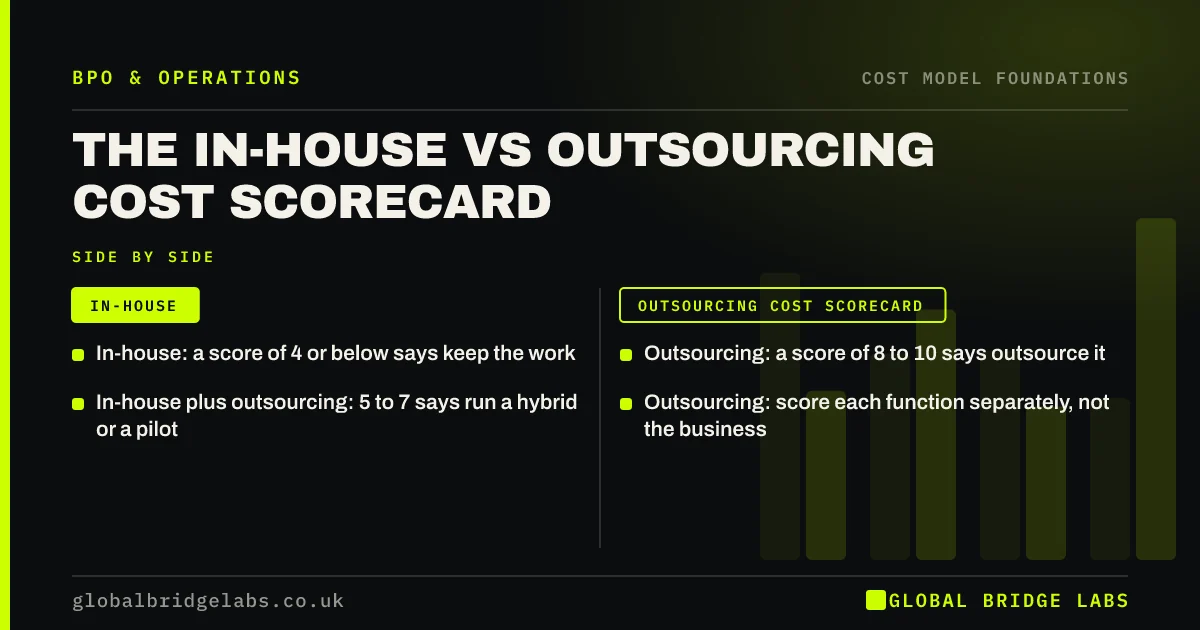
- In-house: a score of 4 or below says keep the work.
- Outsourcing: a score of 8 to 10 says outsource it.
- In-house plus outsourcing: 5 to 7 says run a hybrid or a pilot.
- Outsourcing: score each function separately, not the business.
Want a copy of the scorecard to fill in? Message us on WhatsApp and we will send it.
Chat on WhatsApp →What is the GBL Cost-Effectiveness Scorecard?
The GBL Cost-Effectiveness Scorecard is a five-factor test that compares in-house and outsourced delivery for one function. Each factor scores 0 when it favours in-house, 1 when it is neutral and 2 when it favours outsourcing. It turns a debate about preferences into a comparison of costs and conditions.
How do you score each factor?
Score each factor on evidence, not opinion. Use real hours, real salaries and real quotes where you have them.
- Rate: 0 if the loaded in-house cost per hour is at or below the outsourced rate; 1 if within 20%; 2 if more than 20% higher.
- Utilisation: 0 if in-house people are fully used; 1 if 75% to 90%; 2 if under 75%.
- Cover: 0 if no cover is needed; 1 if holidays only; 2 if extended hours or sickness cover is needed.
- Quality: 0 if the work cannot be documented; 1 if partly; 2 if it can be written down and checked.
- Flexibility: 0 if volume is stable and permanent; 1 if seasonal; 2 if unpredictable or may shrink.
How do you read the total?
Add the five scores for a total out of 10. A score of 8 to 10 means outsourcing is very likely more cost-effective. A score of 5 to 7 means a hybrid model or a 60 to 90-day pilot is the safer route. A score of 4 or below means keep the work in-house for now.
What does a scored example look like?
Customer email for an e-commerce brand: a £28,000 in-house hire costs about £18.45 per worked hour against £12 outsourced, so rate scores 2. The hire is busy 60% of the time in quiet months, utilisation 2. Weekend cover is needed, cover 2. Replies follow templates, quality 2. Volume peaks at Christmas, flexibility 1. Total: 9, outsource.
Key account management for the same brand scores rate 1, utilisation 0, cover 0, quality 0 and flexibility 0. Total: 1, keep in-house.
Want us to score one of your functions with you? Send the details on WhatsApp.
Chat on WhatsApp →Does the scorecard replace a full cost comparison?
No. The scorecard tells you where to look; the cost comparison tells you how much. Use the scorecard to shortlist functions, then build a full in-house vs outsourcing cost comparison for the ones scoring 5 or more.
How is this different from the outsourcing trigger scorecard?
The outsourcing trigger scorecard asks whether it is time to outsource at all, based on hours, cover, volume, speed and cost signals. The Cost-Effectiveness Scorecard asks which model delivers one function more cheaply at the required quality. Use the trigger scorecard first, then this one.
What evidence do you need for each score?
Scores are only as good as the evidence behind them. Gather these before scoring, so the result can stand up in front of a partner, board or bank.
- Rate: salary, hours and at least one outsourced quote.
- Utilisation: two to four weeks of time or workload data.
- Cover: the hours customers expect a response.
- Quality: whether a written process exists, or could.
- Flexibility: monthly volumes for the last 12 months.
What does this look like in practice?
A pattern we see in UK logistics businesses: scoring six back-office functions shows two clear outsourcing candidates (tracking queries and proof-of-delivery admin), two hybrids and two to keep in-house. The business starts with the highest scorer rather than debating the whole back office at once.
Scorecard checklist
Use these steps for each function.
- Collect hours, salaries and at least one outsourced quote.
- Score rate, utilisation, cover, quality and flexibility.
- Add the total out of 10.
- Shortlist functions scoring 5 or more.
- Build a full cost comparison for the shortlist.
- Re-score every 12 months, or when volume changes.
Next step
We will score your functions with you and cost the top candidates in a 30-minute call, and we will say so if in-house scores better.
Message us on WhatsApp for the Cost-Effectiveness Scorecard, or book a 30-minute consultation.
Chat on WhatsApp →Sources and further reading
- Rates and thresholds for employers 2026 to 2027 · HM Revenue & Customs
- Workplace pensions: what you, your employer and the government pay · GOV.UK
- The Sourcing and Consultancy Playbooks · Cabinet Office
Frequently asked questions
What criteria should I use to compare in-house and outsourcing?
Use five: loaded cost per hour against the outsourced rate, how fully in-house staff are used, the need for holiday, sickness or extended-hours cover, whether the work can be documented and checked, and how much volume changes. Score each from 0 to 2 for a total out of 10.
What score means I should outsource?
On the GBL Cost-Effectiveness Scorecard, 8 to 10 favours outsourcing, 5 to 7 favours a hybrid model or a 60 to 90-day pilot, and 4 or below favours keeping the work in-house. Confirm any decision with a full cost comparison before changing how the work is done.
Should I score the whole business at once?
No. Score each function separately. Most SMEs find some functions clearly favour outsourcing, some suit a hybrid and some should stay in-house. Scoring the whole business at once averages those differences away and usually leads to a vague decision that nobody acts on.
How often should the scorecard be repeated?
Every 12 months, and whenever something material changes: a big rise in volume, a key person leaving, a new service line or a change in employment costs. Scores move over time, and a function that suited in-house two years ago may now favour a hybrid, or the reverse.
Written by

Global Bridge Labs (GBL) is a UK–Sri Lanka partner for social media, websites and BPO. Everything here comes from client delivery, not theory.