On this page
- 01Key takeaways
- 02What is the total cost of ownership of an in-house team?
- 03What goes into in-house TCO?
- 04What does a three-year worked example look like?
- 05Why use three years rather than one?
- 06How does in-house TCO compare with outsourcing?
- 07Which TCO costs do businesses miss most?
- 08When is in-house TCO still worth paying?
- 09How does TCO change with salary level?
- 10What does this look like in practice?
- 11TCO checklist
- 12Next step
- 13Sources and further reading
- 14Frequently asked questions
Key takeaways
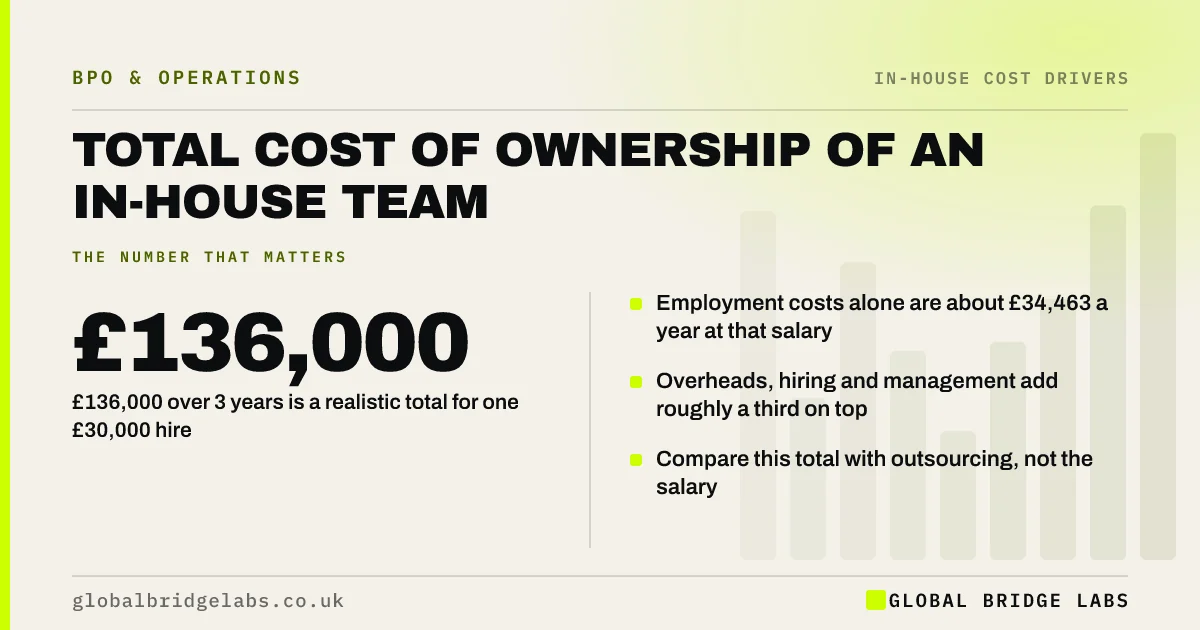
The total cost of ownership of an in-house team is every cost of employing, equipping, hiring, training and managing it over a set period, usually three years. For a £30,000 UK hire, a realistic three-year total is about £136,000, around 1.5 times the salary each year, or £26 per worked hour.
- £136,000 over 3 years is a realistic total for one £30,000 hire.
- Employment costs alone are about £34,463 a year at that salary.
- Overheads, hiring and management add roughly a third on top.
- Compare this total with outsourcing, not the salary.
Want the total cost of ownership worked out for your team? Message us on WhatsApp.
Chat on WhatsApp →What is the total cost of ownership of an in-house team?
Total cost of ownership (TCO) is the full cost of an asset or capability over its life, not just its purchase price. For an in-house team, it covers pay and employer costs, plus overheads, recruitment, training, management time and the cost of cover and replacement. It is the fair number to compare with an outsourced service.
What goes into in-house TCO?
Group the costs into five buckets so nothing is missed. Each is a real cash or time cost the business carries whether or not the work volume is steady.
- Employment: salary, employer National Insurance, pension, holiday pay.
- Overheads: equipment, software, desk space, insurance, IT support.
- Hiring: advertising or agency fees, interview time, checks.
- Training: time to full productivity and trainer time.
- Management: supervision, reviews, cover and replacement.
What does a three-year worked example look like?
Take one £30,000 administrator. Employment costs are about £34,463 a year using 2026/27 rates, or £103,400 over three years. Add overheads of about £12,300 (software £1,200 a year, a laptop £1,200, desk space £2,500 a year), recruitment at 20% of salary, £6,000, about £3,200 of training time, and 2 hours a week of management at £40, about £11,000.
The three-year total is about £136,000, or £45,300 a year. Across 1,740 worked hours a year, that is about £26 per worked hour, against £19.81 for employment costs alone.
Want the same three-year view built for your roles? Send the salaries and hours on WhatsApp.
Chat on WhatsApp →Why use three years rather than one?
One-off costs such as recruitment, equipment and training distort a one-year view, and a single year hides turnover. Three years is long enough to include at least one likely replacement in many small teams, and short enough to be realistic about salary rises and changes in volume.
How does in-house TCO compare with outsourcing?
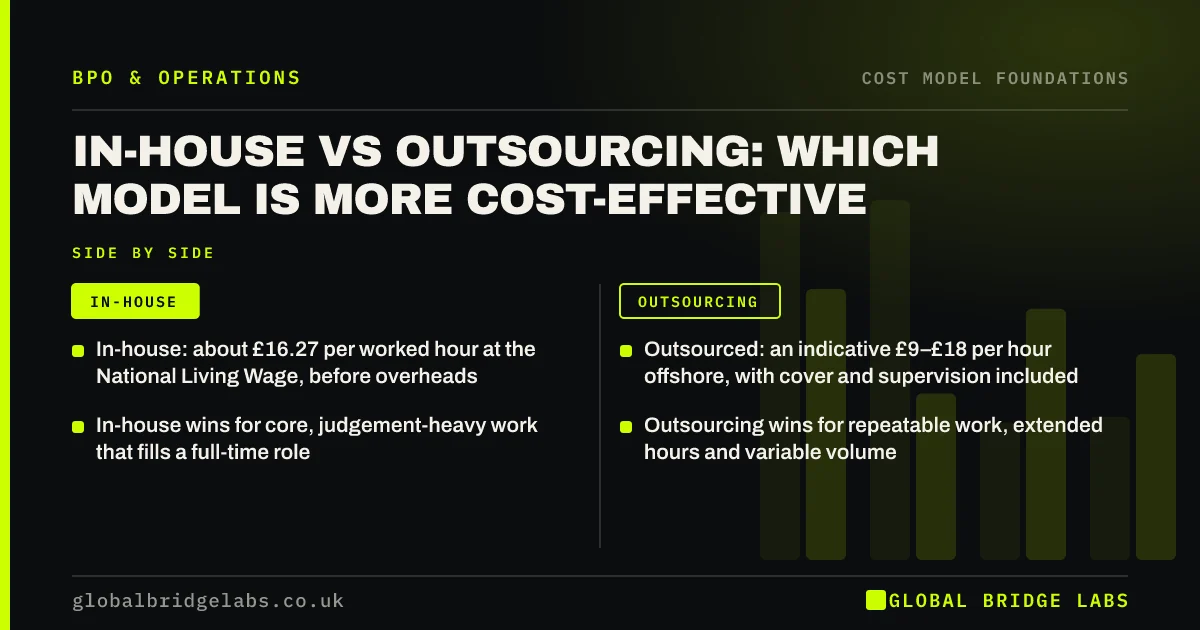
For the same 1,740 hours a year, an outsourced managed team at an indicative £9–£18 per hour costs about £15,700–£31,300 a year, with recruitment, training, supervision and cover included. Add your own management time, about 1 hour a week after setup. Against £45,300 in-house, the gap is usually large for repeatable work.
Which TCO costs do businesses miss most?
The most missed are management time, idle time and replacement. They are rarely on an invoice, so they do not appear in the accounts as staffing costs, but they are real hours taken from someone else's work.
When is in-house TCO still worth paying?
When the team does core work that customers choose you for, is fully used, and builds knowledge that would be hard to write down. In that case the higher TCO buys something a provider cannot. The point of TCO is to see the real price, not to rule out in-house.
How does TCO change with salary level?
Employer costs rise with salary, but overheads and management time stay broadly the same per person. So the ratio of total cost to salary is highest for lower-paid roles and falls slightly for senior ones, while the absolute cost keeps rising. Using the same overheads and management assumptions as the example above:
- £25,000 salary: about £39,100 a year in total, or £22.46 per worked hour.
- £30,000 salary: about £45,300 a year, or £26.04 per worked hour.
- £40,000 salary: about £57,800 a year, or £33.20 per worked hour.
What does this look like in practice?
A pattern we see in UK logistics SMEs: the finance lead budgets a new admin hire at salary plus 15%. Once desk space, software, recruitment, training and supervision are added, the three-year cost is nearly half as much again, which changes the comparison with a managed team.
TCO checklist
Include each of these in your three-year total.
- Salary, employer National Insurance, pension and holiday pay.
- Equipment, software, space, insurance and IT support.
- Recruitment fees and interview time.
- Training time until the hire is fully productive.
- Weekly management time at the manager's loaded rate.
- At least one replacement cycle in three years for small teams.
Next step
Send us one role you are budgeting for. We will build its three-year TCO and compare it with a managed alternative in a 30-minute call.
Message us on WhatsApp for a TCO comparison, or book a 30-minute consultation.
Chat on WhatsApp →Sources and further reading
- Rates and thresholds for employers 2026 to 2027 · HM Revenue & Customs
- Workplace pensions: what you, your employer and the government pay · GOV.UK
- Holiday entitlement · GOV.UK
- Employers' liability insurance · GOV.UK
Frequently asked questions
How do you calculate the total cost of an in-house team?
Add employment costs (salary, employer National Insurance, pension and holiday pay), overheads (equipment, software, space, insurance), hiring and training costs, and management time over three years. Divide by worked hours to get a cost per hour you can compare fairly with an outsourced rate.
How much more than salary does an employee cost?
Employment costs alone add about 15% for a £30,000 salary using 2026/27 rates. Once overheads, recruitment, training and management are included, the total is often around 1.5 times salary a year for a small business, depending on office costs, turnover and how much supervision the role needs.
Is outsourcing always cheaper than in-house TCO?
For repeatable, documentable work, usually. For core work that is fully used and depends on deep context, the in-house TCO may be worth paying, because it buys knowledge, control and speed that a provider working from a written process cannot easily match.
What is the difference between TCO and the true cost of an employee?
The true cost of an employee usually means pay plus statutory employer costs for one year. Total cost of ownership goes further: it adds overheads, recruitment, training, management and replacement over several years. TCO is the better figure for comparing an in-house team with outsourcing.
Written by

Global Bridge Labs (GBL) is a UK–Sri Lanka partner for social media, websites and BPO. Everything here comes from client delivery, not theory.