On this page
- 01Key takeaways
- 02Is outsourced work lower quality than in-house?
- 03Which quality measures should you use?
- 04Why do you need an in-house baseline?
- 05How long before you judge a new team?
- 06How do you keep quality high?
- 07Does quality affect the cost comparison?
- 08What should you do if quality slips?
- 09What does this look like in practice?
- 10Quality comparison checklist
- 11Next step
- 12Sources and further reading
- 13Frequently asked questions
Key takeaways
Outsourcing quality vs in-house can only be compared fairly with the same measures, taken on both sides. Measure accuracy, first contact resolution, response time and customer satisfaction for your in-house team before switching, then hold the provider to the same numbers. Without a baseline, quality debates become opinion.
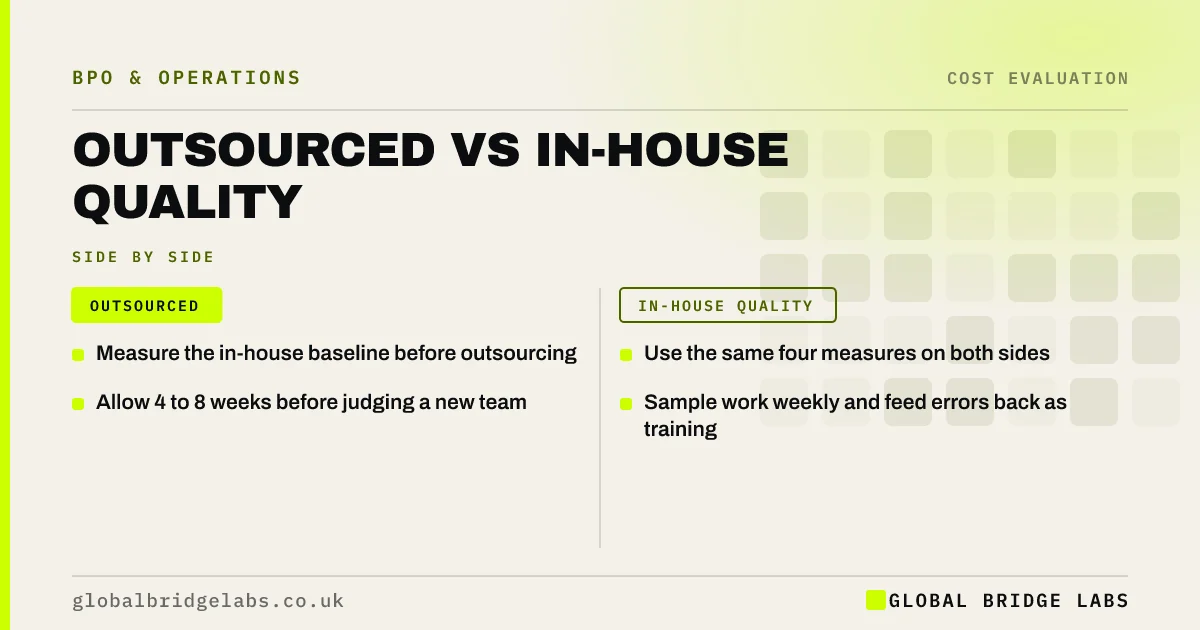
- Measure the in-house baseline before outsourcing.
- Use the same four measures on both sides.
- Allow 4 to 8 weeks before judging a new team.
- Sample work weekly and feed errors back as training.
Want help setting quality measures before you switch? Message us on WhatsApp.
Chat on WhatsApp →Is outsourced work lower quality than in-house?
Not inherently. Quality depends on a written process, training, supervision and measurement. A managed team with quality sampling can be more consistent than a small in-house team without any. Quality drops when a provider is given no process and nobody checks the result, which would also happen in-house.
Which quality measures should you use?
Choose measures that suit the work and use them on both sides.
- Accuracy: share of tasks completed without errors.
- First contact resolution: share of issues solved in one contact.
- Response time: time to first reply against target.
- Customer satisfaction: short survey after contact.
- Complaints and escalations per 1,000 contacts.
Why do you need an in-house baseline?
Because without one, every early mistake by a new team looks like proof that outsourcing does not work, while in-house errors go uncounted. Measure the in-house team for four weeks before switching, using the same definitions you will use for the provider.
How long before you judge a new team?
Allow four to eight weeks for a new team to learn a documented process, longer for complex work. Judge trends, not single days. If quality is not at the baseline by the end of that period, look at the process documentation and training before blaming the model.
Want a quality review plan for a new outsourced team? Ask us on WhatsApp.
Chat on WhatsApp →How do you keep quality high?
Sample a set number of completed tasks or conversations each week, score them against a checklist, and share the results with the provider's team lead. Turn repeated errors into process updates. Review a monthly scorecard with the provider and agree actions.
Does quality affect the cost comparison?
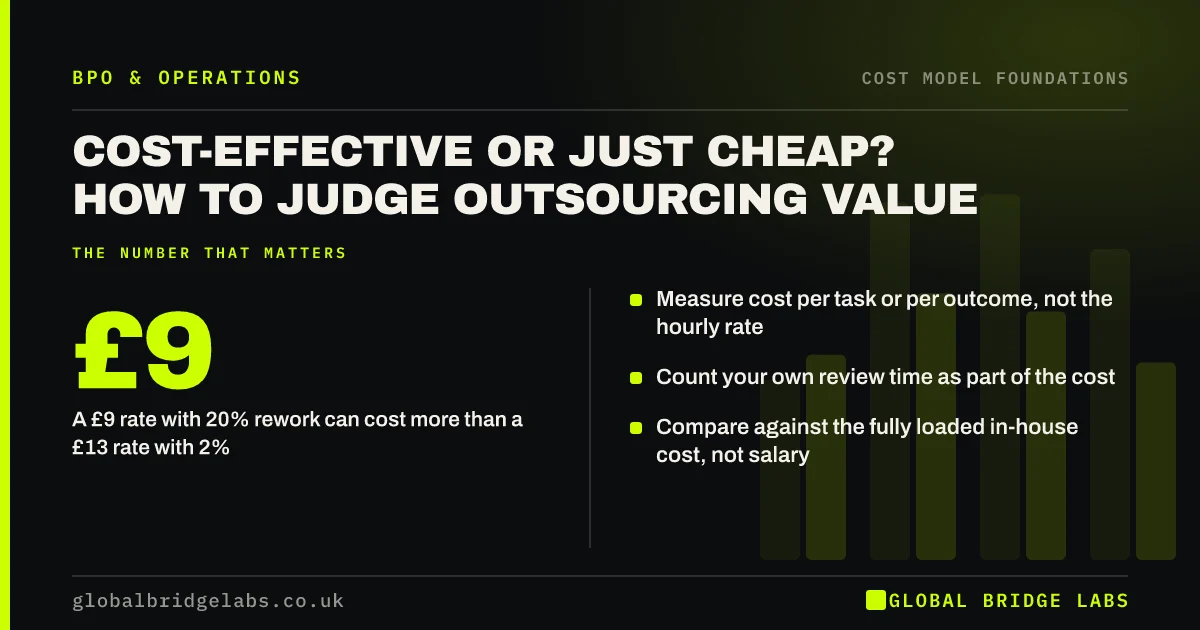
Yes. Errors and repeat contacts are costs. A cheaper team with more rework may cost more in total. Compare cost per task done right first time, not just cost per hour.
What should you do if quality slips?
Find the cause before changing the model. Look at the errors: are they concentrated in one task type, one team member or one period? Most quality problems trace back to an unclear process step, missing examples or a change nobody told the team about. Fix the process, retrain, and re-measure for four weeks.
- Group errors by task type and cause.
- Update the process for the top causes.
- Retrain with real examples.
- Re-measure against the baseline for four weeks.
What does this look like in practice?
A pattern we see in UK e-commerce brands: the owner worries about quality, so the in-house team's accuracy and satisfaction are measured for a month first. The managed team reaches the same accuracy within a few weeks, and weekly sampling keeps it there, which settles the debate with numbers.
Quality comparison checklist
Use these steps.
- Choose three to five quality measures.
- Measure the in-house baseline for four weeks.
- Share the same definitions with the provider.
- Allow four to eight weeks of learning.
- Sample work weekly and review monthly.
Next step
Tell us what quality means for your work. We will help set measures and a baseline before any switch in a 30-minute call.
Message us on WhatsApp to plan a fair quality comparison, or book a 30-minute consultation.
Chat on WhatsApp →Sources and further reading
- UK Customer Satisfaction Index · Institute of Customer Service
- The Sourcing and Consultancy Playbooks · Cabinet Office
Frequently asked questions
Is outsourced customer service worse than in-house?
Not when it is set up with a written process, training, supervision and a scorecard. Measured on the same terms, managed teams can match or beat small in-house teams on consistency. Poor quality usually comes from missing process and measurement rather than from outsourcing itself.
How do you measure outsourcing quality?
Use the same measures as for in-house work: accuracy, first contact resolution, response time, customer satisfaction and complaints per 1,000 contacts. Sample completed work weekly, and review a monthly scorecard with the provider's team lead to agree actions on any gaps.
How long does it take an outsourced team to reach quality?
Typically four to eight weeks for a documented, routine process, and longer for complex work. Judge trends against your in-house baseline rather than individual days, and agree the expected learning curve with the provider before the team starts. Check progress weekly during that period.
Who should check the quality of outsourced work?
Both sides. The provider's team lead should run quality sampling and coaching as part of the service. Someone in your business should also review a small weekly sample and the monthly scorecard, so you see the same picture as the provider and can act early.
Written by

Global Bridge Labs (GBL) is a UK–Sri Lanka partner for social media, websites and BPO. Everything here comes from client delivery, not theory.