On this page
- 01Key takeaways
- 02What is the difference between in-house and outsourcing?
- 03What are the advantages of an in-house team?
- 04What are the disadvantages of an in-house team?
- 05What are the advantages of outsourcing?
- 06What are the disadvantages of outsourcing?
- 07How do the pros and cons compare on cost?
- 08Which work suits which model?
- 09How do the risks compare?
- 10What does this look like in practice?
- 11Pros and cons checklist
- 12Next step
- 13Sources and further reading
- 14Frequently asked questions
Key takeaways
The in-house vs outsourcing pros and cons come down to control against flexibility. In-house gives direct control, deep knowledge and culture, at a higher fixed cost. Outsourcing gives lower cost per hour, built-in cover and easy scaling, but needs documentation and measurement to keep quality. Most SMEs use both.
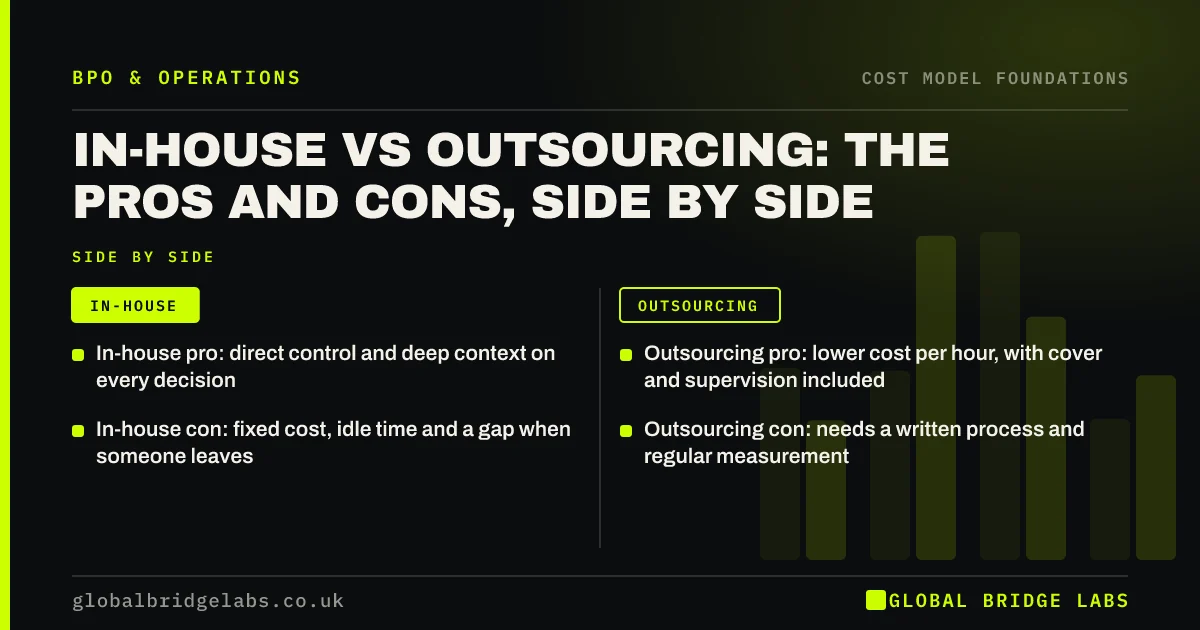
- In-house pro: direct control and deep context on every decision.
- Outsourcing pro: lower cost per hour, with cover and supervision included.
- In-house con: fixed cost, idle time and a gap when someone leaves.
- Outsourcing con: needs a written process and regular measurement.
Weighing up both for one area of the business? Message us on WhatsApp and we will talk it through.
Chat on WhatsApp →What is the difference between in-house and outsourcing?
In-house means your own employees do the work, under your direction, on your payroll. Outsourcing means a provider delivers the work to an agreed standard, using its own staff, supervision and systems, for a fee. The core difference is who employs, manages and replaces the people, and who carries the fixed cost.
What are the advantages of an in-house team?
An in-house team is best at work that needs context, judgement and relationships. People build knowledge of your customers and products over years, can be redeployed quickly, and share your culture. Communication is informal and immediate, which matters for work that changes daily.
- Direct day-to-day control of priorities.
- Deep product, customer and company knowledge.
- Easy to redeploy across tasks as needs change.
- Stronger culture and loyalty over time.
- No provider margin on top of pay.
What are the disadvantages of an in-house team?
The main disadvantages are fixed cost and fragility. You pay for every contracted hour whether or not there is work, carry recruitment and training each time someone leaves, and have no cover for holidays or sickness in a small team. Employer National Insurance at 15% above £5,000 and pension contributions add to every salary.
- Fixed cost that does not fall when volume does.
- Recruitment and training costs every time someone leaves.
- No built-in cover for holidays and sickness.
- Hard to extend hours without overtime or extra hires.
- Knowledge concentrated in one or two people.
What are the advantages of outsourcing?
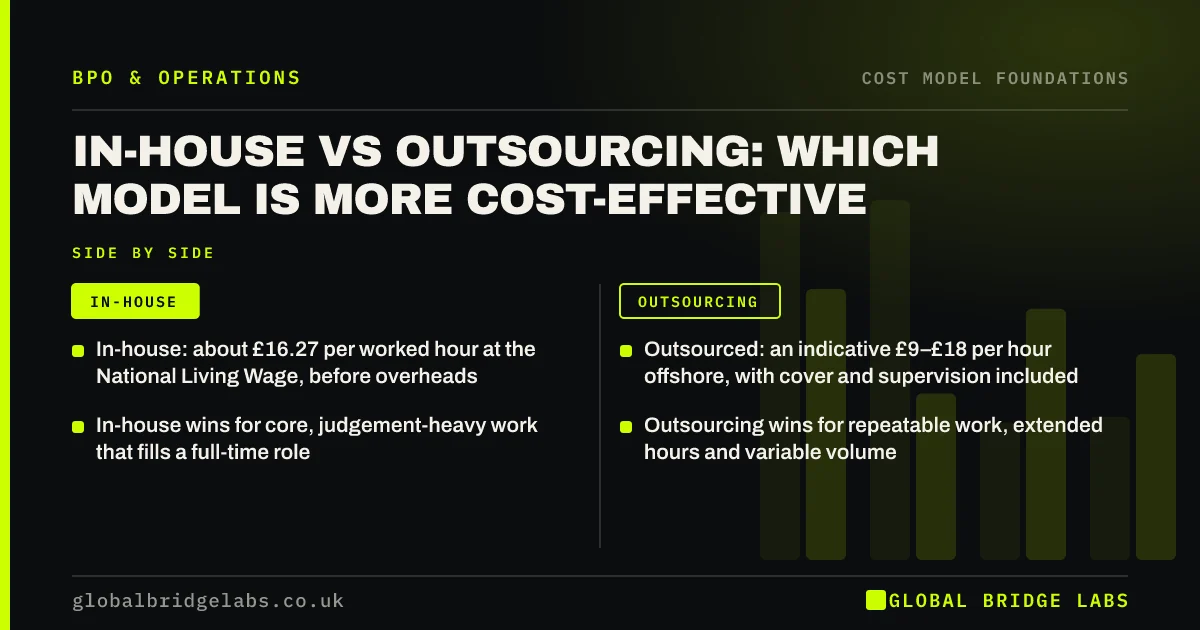
Outsourcing converts a fixed staffing cost into a service you can scale. A managed provider recruits, trains, supervises and covers its team, so you pay for delivered work. Indicative offshore rates of £9–£18 per hour are well below the loaded cost of most UK hires, and extended hours are easier to add.
- Lower cost per hour for repeatable work.
- Holiday, sickness and turnover handled by the provider.
- Scale up or down with volume.
- Extended or UK-hours cover without overtime.
- Access to skills you could not justify full-time.
What are the disadvantages of outsourcing?
Outsourcing needs more up-front structure. The process must be written down, service levels agreed and results measured, or quality drifts. Setup takes your time for the first few weeks, context can be lost at handover, and a UK GDPR processor contract is needed because the provider handles your data.
- Documentation and handover effort at the start.
- Less informal, day-to-day control.
- Quality depends on process and measurement.
- Contract terms, notice periods and exit planning.
- Data protection paperwork, especially offshore.
How do the pros and cons compare on cost?
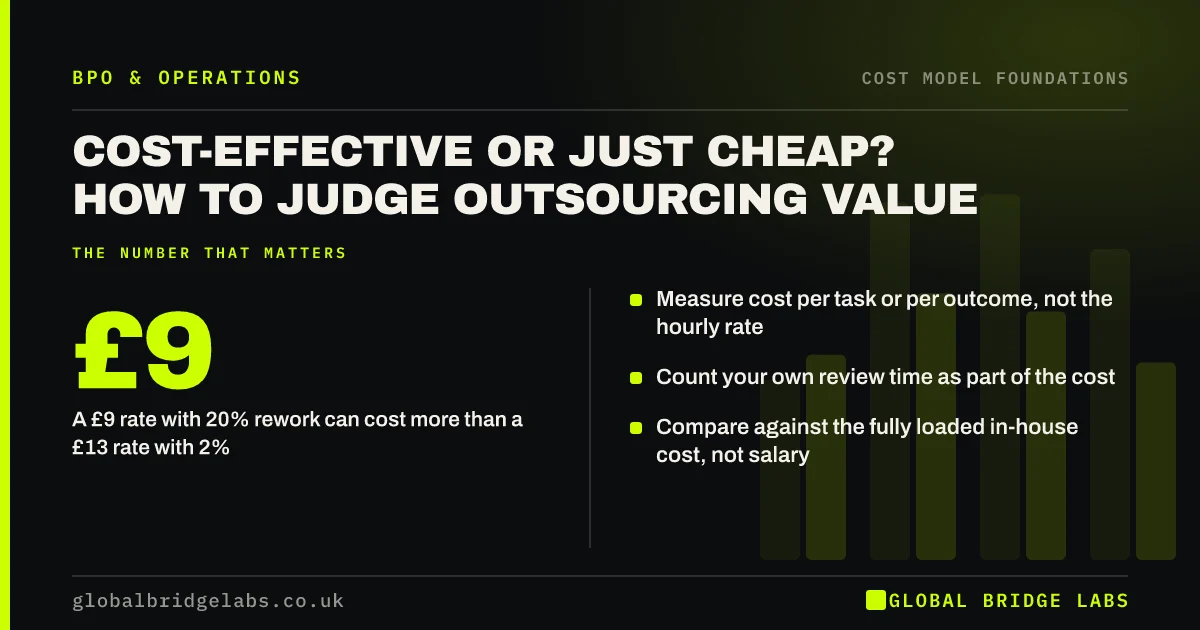
On cost alone, outsourcing usually wins for repeatable work. A £28,000 in-house hire costs about £32,103 a year before overheads, or £18.45 per worked hour, and more per productive hour once idle time is counted. Outsourcing the same hours at £9–£18 per hour, with cover included, typically costs 30% to 50% less.
Want the cost side calculated for your roles? Send us the hours on WhatsApp.
Chat on WhatsApp →Which work suits which model?
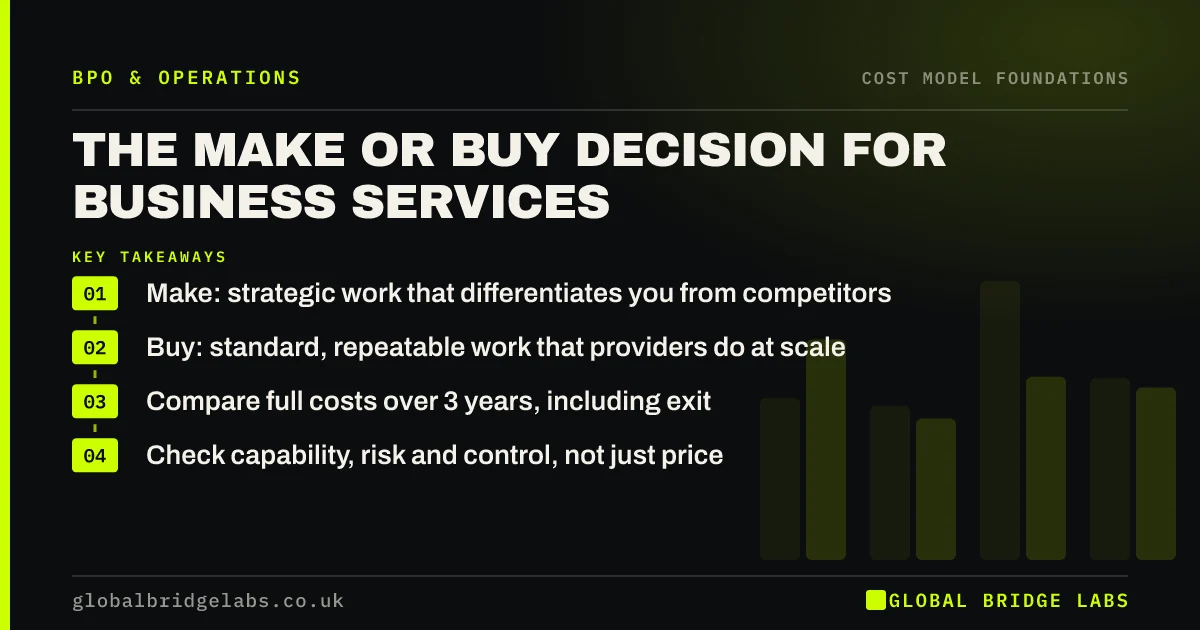
A simple rule: keep in-house what makes you different, and outsource what every business in your sector does the same way. Relationship, strategy and specialist judgement stay in-house. Repeatable volume, cover and admin are strong candidates to outsource.
- Keep in-house: key accounts, pricing, hiring, product decisions.
- Outsource: email and chat support, data entry, booking, invoicing.
- Either: marketing execution, website updates, reporting.
How do the risks compare?
Each model carries a different kind of risk. In-house risk is concentrated in people: one resignation, long sickness or bad hire can stop a process. Outsourcing risk sits in the relationship: quality drift, unclear contracts or a provider that fails. Both are manageable, but they need different controls.
- In-house: key-person dependency; control it with cross-training and documentation.
- In-house: fixed cost when volume falls; control it by sizing for the steady core.
- Outsourcing: quality drift; control it with SLAs and monthly scorecards.
- Outsourcing: provider failure; control it with notice terms and documentation you own.
What does this look like in practice?
A pattern we see in UK e-commerce brands: the founder keeps supplier relationships and product decisions in-house, while customer email, returns admin and order exceptions go to a managed team. The in-house team is smaller but spends its time on growth, and support no longer stops when one person is on holiday.
Pros and cons checklist
Use these questions for each area of work.
- Does this work make us different from competitors?
- Can the process be written down and measured?
- Is the in-house role fully used every week?
- Does the work need cover beyond one person?
- Does volume change through the year?
- What would it cost to exit each option?
Next step
Tell us which areas of work you are weighing up. We will go through the pros and cons for each and cost both options in a 30-minute call.
Message us on WhatsApp to compare in-house and outsourcing, or book a 30-minute consultation.
Chat on WhatsApp →Sources and further reading
- Rates and thresholds for employers 2026 to 2027 · HM Revenue & Customs
- Workplace pensions: what you, your employer and the government pay · GOV.UK
- Contracts and liabilities between controllers and processors · Information Commissioner's Office
Frequently asked questions
What is the main advantage of an in-house team?
Direct control and deep context. In-house staff build knowledge of your customers, products and ways of working over time, can be redeployed quickly when priorities change, and handle work that needs judgement or relationships better than a provider working from a written process. That knowledge is hard to replace.
What is the main advantage of outsourcing?
Lower cost per productive hour with built-in resilience. A managed provider covers recruitment, training, supervision, holidays and sickness, and lets you scale with volume. You pay for delivered work rather than fixed staff capacity, which matters most when demand changes through the week or the year.
Is outsourcing riskier than in-house?
The risks are different rather than larger. In-house risk is key-person dependency and fixed cost when volume falls. Outsourcing risk is quality drift and data protection, which are managed with a written process, agreed service levels, a UK GDPR processor contract and a monthly scorecard reviewed with the provider.
Can I try outsourcing without giving up my in-house team?
Yes. Most businesses start by outsourcing one process, such as email support or data entry, for 60 to 90 days while the in-house team focuses on complex work. Compare cost per task and quality against a baseline, then decide whether to move more, keep a hybrid, or bring the work back.
Written by

Global Bridge Labs (GBL) is a UK–Sri Lanka partner for social media, websites and BPO. Everything here comes from client delivery, not theory.