On this page
- 01Key takeaways
- 02What does it mean to consider outsourcing?
- 03What are the signs a business should outsource?
- 04How do you score whether it is time to outsource?
- 05Which processes can a UK business outsource?
- 06How does outsourcing cost compare with in-house?
- 07How have UK employment costs changed the decision?
- 08When is the right time in a business's life to outsource?
- 09When should a business not outsource?
- 10What should a UK business outsource first?
- 11What are the risks of outsourcing at the wrong time?
- 12How do you start outsourcing safely?
- 13What does this look like in practice?
- 14When to outsource: a checklist
- 15Next step
- 16Sources and further reading
- 17Frequently asked questions
Key takeaways
When should a business outsource? A UK business should consider outsourcing when repeatable work takes more than about 10 hours a week of owner or skilled staff time, needs cover beyond one person, swings in volume, is slowing replies to customers, or costs more per task in-house than a managed team would charge. Start with one documented process, not the whole back office.
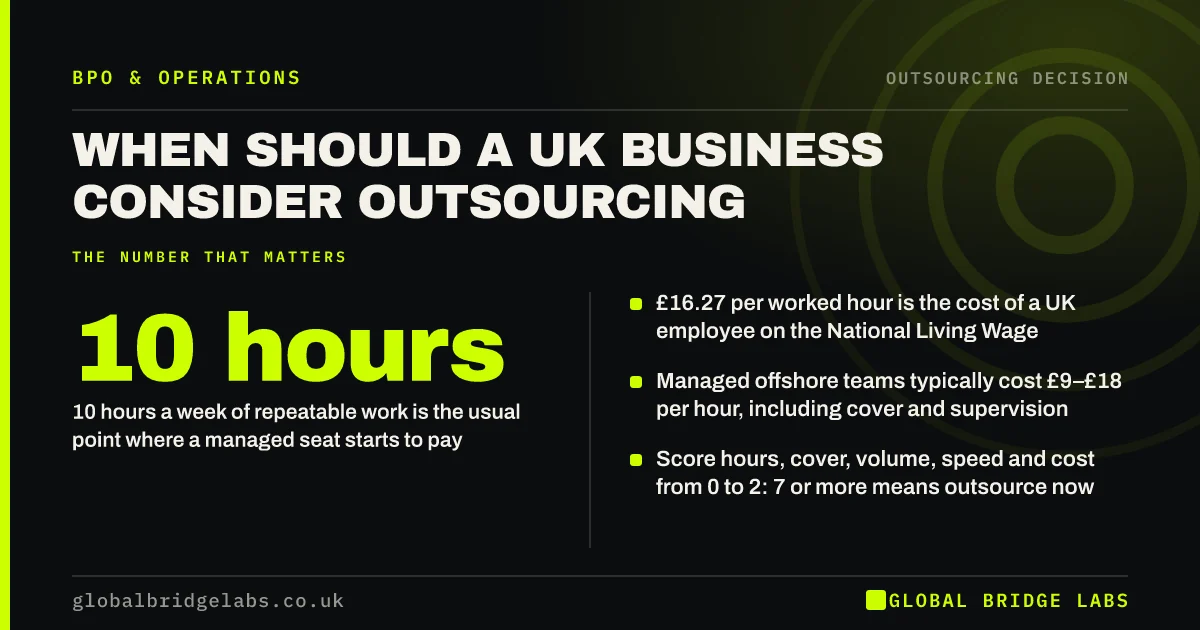
- 10 hours a week of repeatable work is the usual point where a managed seat starts to pay.
- £16.27 per worked hour is the cost of a UK employee on the National Living Wage.
- Managed offshore teams typically cost £9–£18 per hour, including cover and supervision.
- Score hours, cover, volume, speed and cost from 0 to 2: 7 or more means outsource now.
- Wait if the process changes every month or is the reason customers choose you.
Want to know whether your business has reached the point? Message us on WhatsApp with the work you want off your desk.
Chat on WhatsApp →What does it mean to consider outsourcing?
Outsourcing is handing a repeatable business process, such as customer support, inbox handling, data entry or invoicing, to a specialist provider that staffs, runs and reports on it for you. Considering it means testing whether the work, the timing and the numbers point that way, before you advertise for a hire or ask the team to stretch further.
Business process outsourcing (BPO) is not the same as hiring a freelancer. A managed provider takes on cover, training and quality, so the process keeps running when a person is off. That is why the question is about processes, not people.
What are the signs a business should outsource?
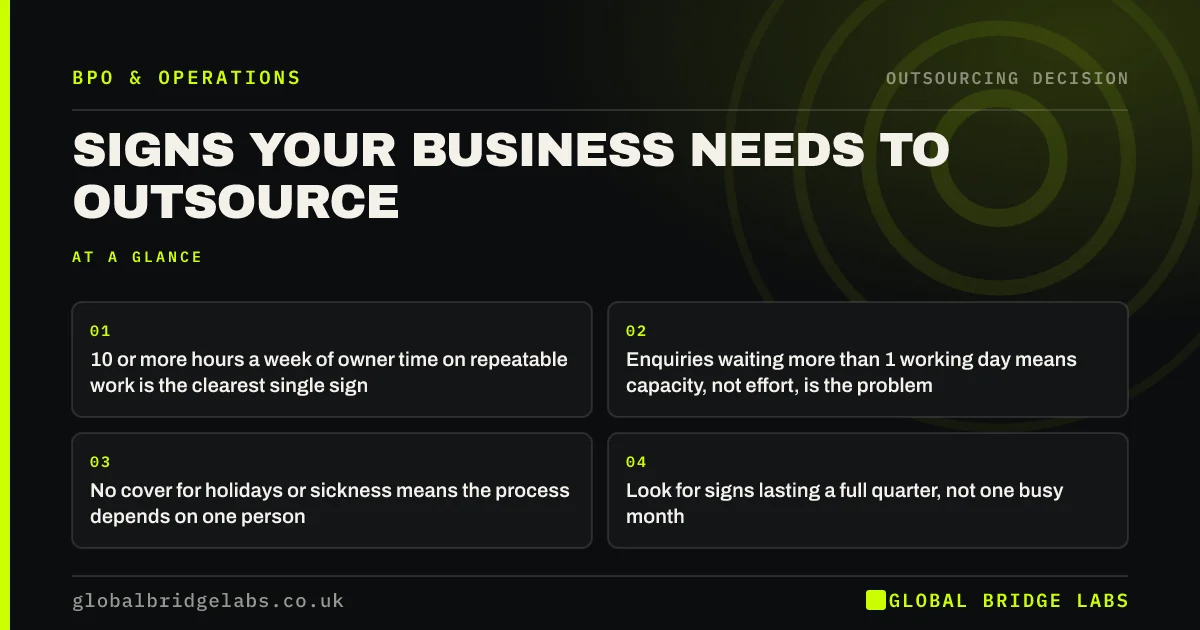
The clearest signs are operational, not emotional. Work is waiting, replies are slow, skilled people are doing admin, and the owner's evenings go on email. When two or more of these have lasted for a full quarter, the business has usually outgrown its current way of working.
- The owner or a senior person spends 10 or more hours a week on repeatable admin.
- Enquiries or customer emails regularly wait more than one working day for a reply.
- Holidays and sickness leave gaps that nobody covers.
- Volume swings by season or week, so the team is either idle or overloaded.
- Recruitment for admin or support roles has failed, or hires keep leaving.
- Errors, missed follow-ups or complaints have risen as the business has grown.
How do you score whether it is time to outsource?
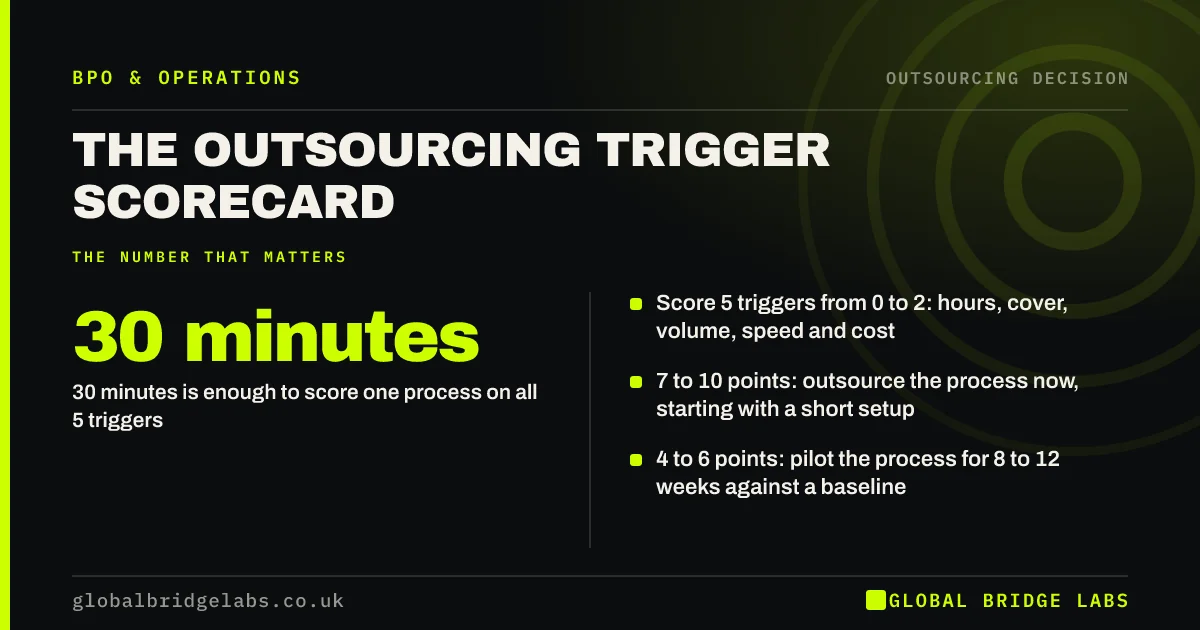
Use the GBL Outsourcing Trigger Scorecard. It rates five triggers from 0 to 2: hours, cover, volume, speed and cost. A total of 0 to 3 means not yet, 4 to 6 means pilot one process, and 7 to 10 means outsource now, starting with the process that scores highest.
The scorecard only works on processes that are stable enough to write down. If the work changes every fortnight, fix that first, because an outside team will amplify whatever it is given.
- Hours: 0 is under 5 hours a week, 1 is 5 to 10 hours, 2 is more than 10 hours.
- Cover: 0 is none needed, 1 is holiday gaps, 2 is daily cover beyond one person's hours.
- Volume: 0 is steady, 1 swings up to 30%, 2 swings more than 30%.
- Speed: 0 is on target, 1 is sometimes late, 2 is routinely late.
- Cost: 0 is cheaper in-house, 1 is similar, 2 is clearly dearer in-house per task.
Which processes can a UK business outsource?
Almost any process that follows written rules and produces a measurable result can be outsourced. For UK SMEs the common candidates fall into two groups: front-office work that faces customers, and back-office work that keeps the business running. Most businesses start with one process from whichever group costs them more time today.
- Front office: enquiry handling, inbox, call answering, live chat, WhatsApp and appointment booking.
- Back office: data entry, CRM updates, order processing, invoicing and credit control.
- Specialist support: document chasing, case administration and compliance record-keeping.
- Keep in-house: pricing, strategy, key relationships and work needing senior judgement.
How does outsourcing cost compare with in-house?
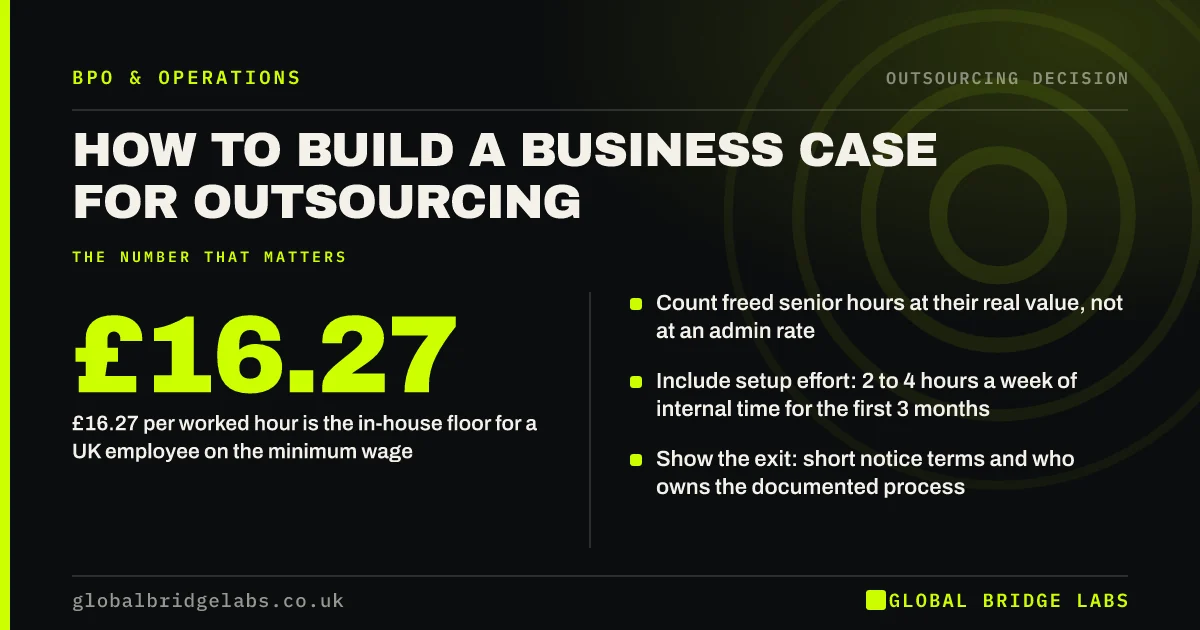
Managed offshore teams typically cost £9–£18 per hour and onshore UK teams £20–£35, as indicative market ranges. A full-time UK employee on the National Living Wage of £12.71 costs about £28,309 a year with employer National Insurance and pension, or about £16.27 per worked hour before recruitment, equipment and management time.
The more useful comparison is cost per task. A process run by a skilled employee on £40,000 a year costs well over £25 per worked hour once on-costs are added, so every hour of admin they do is expensive admin.
- UK hire at the legal minimum: about £16.27 per worked hour before overheads.
- Skilled UK employee on £40,000: roughly £27 per worked hour before overheads.
- Managed offshore seat: about £9–£18 per hour including cover and supervision.
- Managed onshore seat: about £20–£35 per hour.
- BPO cost per hour in the UK
- The true cost of an employee in the UK
- The outsourcing break-even point: when it pays
Want those numbers run for your actual process? Message us on WhatsApp and we will discuss your requirements.
Chat on WhatsApp →How have UK employment costs changed the decision?
Rising employment costs have moved the break-even point. Employer National Insurance rose to 15% on earnings above £5,000 from April 2025, and the National Living Wage rose to £12.71 an hour from April 2026. Together they add thousands of pounds a year to every full-time role, before any pay rise for experienced staff.
Small employers can offset up to £10,500 of employer National Insurance through the Employment Allowance, which softens the effect for the first few hires. Beyond that, each additional admin or support role costs more than it did two years ago, which is why more UK SMEs now test outsourcing before they recruit.
When is the right time in a business's life to outsource?
The right time is usually before the pressure peaks, not during it. Outsourcing while you still have time to write the process down and review early work goes far better than outsourcing in a crisis. Good moments include a quieter quarter, the weeks after a new contract is signed, or the point a resignation lands.
Growth events are strong triggers because they change the volume permanently: a big contract, a new location, a product launch or an investment round with a hiring plan attached.
When should a business not outsource?
Do not outsource work that is the reason customers choose you, work that needs judgement on every case, work that must be done on site, or a process you are still inventing. Also wait if the volume is only a few hours a week, where a part-timer, automation or a simple overflow service is usually cheaper.
Outsourcing to escape a problem you have not understood rarely works. If quality is poor because the process is unclear, a provider will inherit the confusion.
What should a UK business outsource first?
Start with the process that scores highest on the trigger scorecard and is easiest to document. For most UK SMEs that is inbox and enquiry handling, call answering, data entry or invoicing and credit control, because the rules are clear and the results are easy to measure.
One process, run well for 8 to 12 weeks, builds the procedures, reporting and trust you need to add the next one.
What are the risks of outsourcing at the wrong time?
Too early, you pay setup effort for a few hours of work and lock in a process that is still changing. Too late, you hand over a backlog, a burnt-out team and unhappy customers, and the first month goes on firefighting. Both are avoidable with a baseline and a short pilot.
UK GDPR also applies from day one. Any provider handling personal data needs a processor contract, and an offshore team needs a valid transfer safeguard. Build that into the timeline rather than treating it as paperwork at the end.
How do you start outsourcing safely?
Start small, measured and reversible. The businesses that outsource well treat the first process as a test with a baseline, a named owner and short notice terms. Those that struggle hand over several processes at once, with no written procedure and no way to tell whether the result is better.
- Log two weeks of tasks to find the repeatable work and its real hours.
- Score the top processes and pick the highest that is easy to document.
- Write the process down, including the ten most common cases.
- Choose a provider that will start small on 30-day or similar terms.
- Sign a processor contract and set up individual logins with MFA.
- Run an 8 to 12-week pilot with weekly reviews against the baseline.
- Decide to expand, adjust or stop, using the numbers.
What does this look like in practice?
A pattern we see in UK service businesses with 10 to 30 staff: the owner answers enquiries at night, the office manager covers the phones and the invoicing, and nobody covers either of them on holiday. Enquiries wait until the next morning and invoices go out late.
Moving enquiry handling and invoicing to a managed team, with the office manager as the internal owner, is usually the first step. Across our client work, owners have got 31 hours a week back, response time to enquiries has fallen by 71% and back-office cost per task by 42%.
When to outsource: a checklist
Work through these before you decide.
- Log two weeks of tasks and hours for the owner and the busiest people.
- Mark which tasks are repeatable and which need judgement.
- Score each repeatable process on hours, cover, volume, speed and cost.
- Work out your cost per task in-house, including on-costs.
- Check the top process is stable and can be written down.
- Name an internal owner with two to four hours a week for the first three months.
- Pilot one process for 8 to 12 weeks against a baseline.
Next step
If you think you have reached the point where outsourcing makes sense, tell us what is taking your time. We will score it with you in 30 minutes and tell you honestly whether to outsource now, pilot one process or wait.
Message us on WhatsApp for a straight answer on outsourcing, or book a 30-minute consultation.
Chat on WhatsApp →Sources and further reading
- National Minimum Wage and National Living Wage rates · GOV.UK
- Rates and thresholds for employers 2026 to 2027 · HM Revenue & Customs
- Workplace pensions: what you, your employer and the government pay · GOV.UK
- International transfers of personal data · Information Commissioner's Office
- UK Customer Satisfaction Index · Institute of Customer Service
Frequently asked questions
When should a small business start outsourcing?
When repeatable work takes more than about 10 hours a week of owner or skilled staff time, needs cover beyond one person, or is slowing replies to customers. Start with one stable, documented process and pilot it for 8 to 12 weeks before adding more. Below a few hours a week, simpler options usually win.
What are the main reasons UK businesses outsource?
To free owner and skilled staff time, to get cover beyond one person's hours, to reply to customers faster, to handle volume that swings by season, and to lower the cost per task. Recruitment difficulty and rising UK employment costs have made the last two more common reasons since 2025.
Is it cheaper to outsource than to employ someone in the UK?
For repeatable support and admin work it usually is. A National Living Wage employee costs about £16.27 per worked hour before overheads, while managed offshore teams typically cost £9–£18 per hour including cover. For skilled, judgement-heavy work, hiring often gives better value.
How do I know if my business is too small to outsource?
Size matters less than volume. If a process takes only a couple of hours a week, the setup effort usually outweighs the saving. If one process takes 10 or more hours a week, even a two-person business can outsource it well, often through a part-time seat.
Should I outsource or hire when I am overloaded?
Outsource repeatable, measurable work that needs cover or swings in volume; hire for judgement, relationships and on-site work. Many UK SMEs do both: an in-house lead who owns the function, supported by an outsourced team that handles the volume.
Written by

Global Bridge Labs (GBL) is a UK–Sri Lanka partner for social media, websites and BPO. Everything here comes from client delivery, not theory.