On this page
- 01Key takeaways
- 02What knowledge is at risk?
- 03Is knowledge safer in-house anyway?
- 04How do you keep the knowledge?
- 05What should the contract say?
- 06How do you test that you still hold it?
- 07When is some dependence acceptable?
- 08What does this look like in practice?
- 09Knowledge retention checklist
- 10Next step
- 11Sources and further reading
- 12Frequently asked questions
Key takeaways
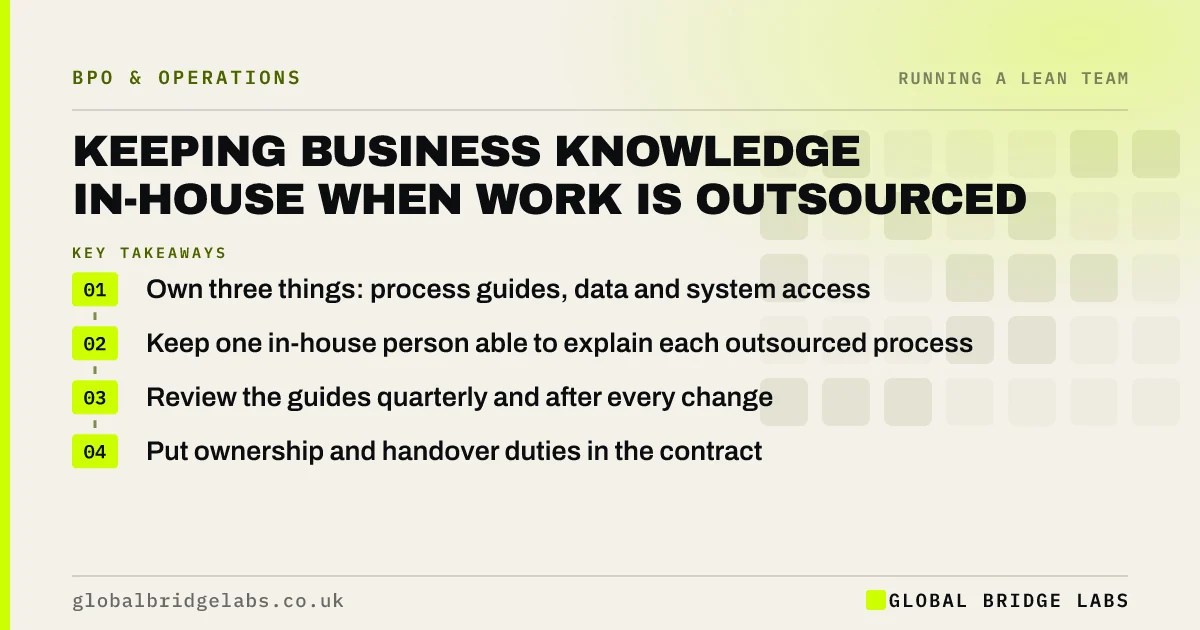
Knowledge retention in outsourcing means making sure your business, not the provider, holds the knowledge of how work is done. Keep three things in your own hands: the written process guides, the data and the system access. With those, you can change provider or bring work back. Without them, you are dependent.
- Own three things: process guides, data and system access.
- Keep one in-house person able to explain each outsourced process.
- Review the guides quarterly and after every change.
- Put ownership and handover duties in the contract.
Not sure who really holds your process knowledge? Message us on WhatsApp.
Chat on WhatsApp →What knowledge is at risk?
The knowledge at risk is the practical kind: how exceptions are handled, why a rule exists, which customers need special treatment, where the awkward data sits. Once a provider has run a process for a year, its people know these things and your own may not. That is the knowledge to capture.
Is knowledge safer in-house anyway?
Not automatically. In many small businesses, process knowledge sits in one employee's head, with nothing written down. When that person leaves, it goes with them. Outsourcing forces documentation, which often leaves the business better protected than before, provided it keeps the documents.
How do you keep the knowledge?
Keep the knowledge by owning the artefacts and staying involved. Store process guides in your own shared drive. Hold administrator rights to every system. Have the provider record changes and new exception rules in the guide as they arise. Keep one in-house person close enough to explain the process to a newcomer.
- Guides stored in your own document system.
- Administrator access held by your business.
- A change log maintained in the guide.
- A named in-house process owner.
- A quarterly walk-through of each process.
What should the contract say?
The contract should say that documentation created for your work belongs to you, that your data is returned or deleted at the end, and that the provider will support a handover for an agreed period. UK GDPR already requires processor contracts to cover return or deletion of personal data when the service ends.
Want the knowledge and exit clauses in a draft contract checked? Message us on WhatsApp.
Chat on WhatsApp →How do you test that you still hold it?
Test it once or twice a year. Ask an in-house person who does not normally do the task to complete five cases using only the written guide. If they can, the knowledge is retained. If they get stuck, the gaps they find are exactly what needs adding to the guide.
When is some dependence acceptable?
Some dependence is acceptable for specialist work you never intend to do yourself, such as payroll processing or statutory accounts. There you rely on the provider's expertise by design. The aim is not to be able to do everything, but to be able to move the work and understand what you are buying.
What does this look like in practice?
A pattern we see when UK firms review an older outsourcing arrangement: the only current process guide is on the provider's system, and logins were created under the provider's email addresses. Nothing has gone wrong, but changing anything would be difficult. Moving the guide and the accounts into the client's name takes a few days and removes the risk.
Knowledge retention checklist
Check these every six months.
- Process guides stored where you control them.
- Guides updated within the last quarter.
- System accounts registered to your business.
- A named in-house owner for each process.
- A guide-only test completed this year.
- Contract terms on documentation, data and handover.
Next step
Tell us which processes are outsourced or about to be. We will help you check where the knowledge sits and what to bring into your own hands.
Message us on WhatsApp for a knowledge retention check, or book a 30-minute consultation.
Chat on WhatsApp →Sources and further reading
- Contracts and liabilities between controllers and processors · Information Commissioner's Office
- How copyright protects your work · GOV.UK
Frequently asked questions
Does outsourcing cause loss of knowledge?
It can if the provider becomes the only place the process is understood. The risk is avoided by owning the written guides, keeping system access in your name, staying involved through a named process owner and testing periodically that someone in-house could follow the documentation.
Who owns process documentation in an outsourcing arrangement?
Ownership depends on the contract, so state it. Documentation created to describe your processes should belong to your business and be stored where you control it. Agree this at the start, along with the provider's duty to keep it current and hand it over at exit.
How do I keep control of data with an outsourced team?
Keep data in systems you administer, grant the provider only the access each task needs, and have a written processor contract covering security, confidentiality and return or deletion at the end. Review access lists when people join or leave the provider's team.
What happens to our knowledge if the provider's staff leave?
If knowledge is in a maintained written guide, a replacement can be trained from it with little disruption. That is why the guide matters more than any individual. Ask providers about staff retention and how they hand over between team members.
Written by

Global Bridge Labs (GBL) is a UK–Sri Lanka partner for social media, websites and BPO. Everything here comes from client delivery, not theory.