On this page
- 01Key takeaways
- 02Why does the relationship need one owner?
- 03Who is the right person?
- 04What does the owner of the relationship do?
- 05How much time does the role take?
- 06Should the business owner do it?
- 07What if nobody has the capacity?
- 08What does this look like in practice?
- 09Relationship owner checklist
- 10Next step
- 11Sources and further reading
- 12Frequently asked questions
Key takeaways
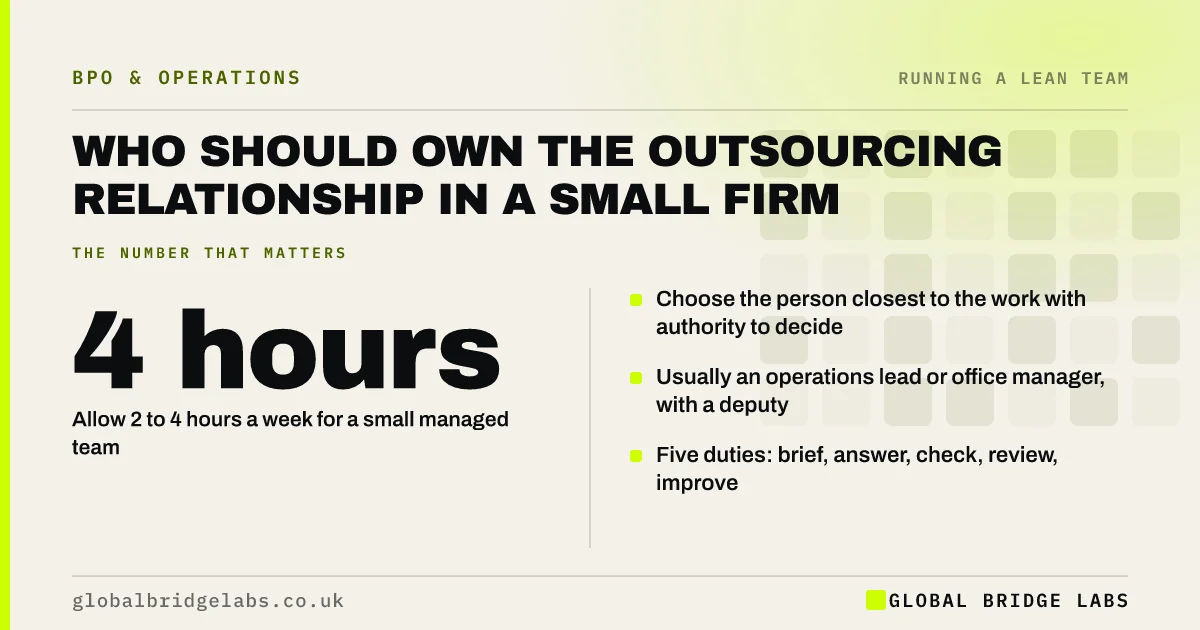
The person who should manage an outsourcing provider in a small business is the one closest to the work who has authority to make decisions about it. That is usually an operations lead or office manager, not the owner. The role takes a few hours a week and has five duties: brief, answer, check, review and improve.
- Choose the person closest to the work with authority to decide.
- Usually an operations lead or office manager, with a deputy.
- Five duties: brief, answer, check, review, improve.
- Allow 2 to 4 hours a week for a small managed team.
Not sure who should own it in your firm? Message us on WhatsApp with your team structure.
Chat on WhatsApp →Why does the relationship need one owner?
The relationship needs one owner because a provider with several points of contact receives conflicting instructions and has nobody to resolve them. Questions go unanswered, changes are not communicated and problems are noticed late. A single owner gives the provider clarity and gives the business someone accountable for the result.
Who is the right person?
The right person understands the process, is available during the working day and can make routine decisions without asking. In firms of 5 to 15 people that is typically the office or operations manager. Below that size it may have to be the owner at first, with a plan to hand it on.
- Knows how the work should be done.
- Available to answer questions the same day.
- Has authority over routine decisions.
- Comfortable giving direct feedback.
What does the owner of the relationship do?
The relationship owner has five recurring duties. None is complicated, but each needs to happen every week.
- Brief: tell the team about changes to products, prices and rules.
- Answer: respond to questions and escalations the same day.
- Check: sample a set number of cases each week.
- Review: run the weekly scorecard meeting.
- Improve: update the guide and remove causes of repeat issues.
How much time does the role take?
For one to three managed seats, plan on 2 to 4 hours a week after the first month, and roughly double that during the first four weeks. Put the time in the person's diary and remove something else to make room. A relationship owner with no allocated time is the commonest cause of a disappointing arrangement.
Want the role and weekly rhythm written up for your team? Message us on WhatsApp.
Chat on WhatsApp →Should the business owner do it?
The business owner should sponsor the arrangement, not run it. If the purpose of outsourcing is to free the owner's time, making the owner the daily contact defeats it. The owner attends a monthly or quarterly review, decides on scope and budget, and leaves the weekly rhythm to the relationship owner.
What if nobody has the capacity?
If nobody has the capacity, start smaller. One process and a part-time seat need less oversight. Ask the provider what its own team leader will handle and what it expects from you. If no one inside can spare two hours a week, the business is not yet ready, and that needs solving first.
What does this look like in practice?
A pattern we see in UK firms where outsourcing has stalled: three managers each send requests to the provider, and the owner steps in when something goes wrong. Naming the office manager as the single contact, with a 30-minute weekly review, usually settles quality within a month.
Relationship owner checklist
Put these in writing on day one.
- One named owner and one deputy.
- Hours allocated in the diary.
- Authority limits for routine decisions.
- A weekly review slot.
- A sample size for quality checks.
- A route for urgent escalations.
- A quarterly review with the business owner.
Next step
Tell us who is involved with your provider today, or who you have in mind. We will outline the role and a weekly rhythm that fits the time they have.
Message us on WhatsApp to define the role, or book a 30-minute consultation.
Chat on WhatsApp →Sources and further reading
- The Sourcing and Consultancy Playbooks · Cabinet Office
- Controllers and processors · Information Commissioner's Office
Frequently asked questions
Who should manage an outsourced team?
An outsourced team should be managed by one named person inside the business who knows the process and can make routine decisions, usually an operations or office manager. The provider's own team leader handles daily supervision. The internal owner briefs, checks, reviews and resolves questions.
Does a small business need a vendor manager?
Not as a job title. A small business needs someone to carry out the vendor management tasks for a few hours a week: briefing the provider, checking quality, reviewing performance and agreeing changes. It is usually part of an existing operations or office management role.
What skills does an outsourcing relationship owner need?
They need to know the process well, communicate clearly in writing, give specific feedback, read a simple scorecard and make routine decisions promptly. Consistency matters more than seniority: a reliable weekly rhythm produces better results than occasional attention from a director.
How often should I meet my outsourcing provider?
Meet weekly for about 30 minutes to review numbers, quality samples and open issues, and hold a longer review each quarter covering scope, cost and improvements. Daily contact for questions happens through messaging. In the first month, a brief daily check-in helps the team settle.
Written by

Global Bridge Labs (GBL) is a UK–Sri Lanka partner for social media, websites and BPO. Everything here comes from client delivery, not theory.