On this page
Key takeaways
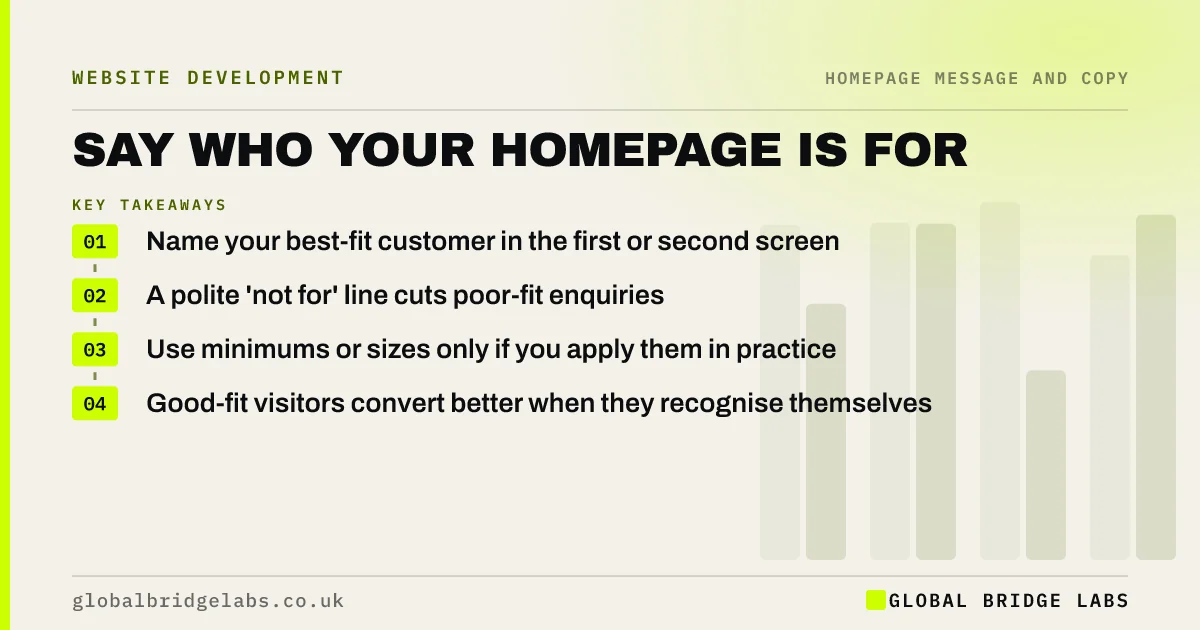
Saying who your homepage is for, in a short line near the top, helps good-fit buyers recognise themselves and lets poor-fit buyers leave without taking up your time. Name the customer type, size or situation you serve best, and, where it matters, say politely who you are not for, such as 'projects from £10,000' or 'businesses with 5 to 50 staff'.
- Name your best-fit customer in the first or second screen.
- A polite 'not for' line cuts poor-fit enquiries.
- Use minimums or sizes only if you apply them in practice.
- Good-fit visitors convert better when they recognise themselves.
Want to define who your homepage is for? Message us on WhatsApp.
Chat on WhatsApp →Why say who your homepage is for?
Saying who your homepage is for helps visitors decide quickly whether they are in the right place. A firm that 'helps businesses' sounds like it serves everyone and nobody; a firm that 'runs payroll for UK firms with 5 to 50 staff' sounds expert to exactly those firms. Recognition is one of the fastest routes to trust.
How do you describe your best-fit customer?
Describe them by something they would recognise in themselves: type ('landlords with 3 to 20 properties'), situation ('moving your accounts from another firm'), size, sector or budget. Avoid internal labels like 'SME segment'. Put the short version in the subheadline and a fuller 'who we work with' block lower down.
Should you say who you are not for?
If poor-fit enquiries waste real time, yes, politely. 'We focus on kitchens and bathrooms from £8,000; for smaller repairs we recommend a local handyman' filters without insulting anyone. A minimum project size or a 'we are not the cheapest' line can raise enquiry quality, though it usually lowers volume.
When is narrowing a mistake?
Narrowing is a mistake when you cannot afford to turn work away, when the excluded group is a big share of your revenue or when you would not actually refuse them. Say only what you mean. A filter you do not apply confuses staff and customers alike.
What does this look like in practice?
A pattern we see in professional services: lots of enquiries from start-ups wanting a one-off form filled, while the firm wants ongoing clients. Adding 'for established businesses that want a monthly adviser' to the hero and a clear minimum lower down usually cuts the volume and improves the conversations.
'Who it is for' checklist
- Describe your best customers in words they would use.
- Name them in the subheadline.
- Add a 'who we work with' block lower down.
- Add a polite 'not for' line only if it saves real time.
- Check your team applies the same filter.
Next step
Look at your ten best customers from last year and write one sentence describing what they have in common. That sentence is your 'who it is for' line.
Message us on WhatsApp to sharpen it, or book a 30-minute consultation.
Chat on WhatsApp →Sources and further reading
- Personas make users memorable for product team members · Nielsen Norman Group
- Know your customers' jobs to be done (Christensen and others, 2016) · Harvard Business Review
Frequently asked questions
Should my website say who we work with?
Yes. Naming your best-fit customers helps them recognise themselves and trust that you understand their situation. Use terms they would use about themselves, such as type, size or situation, in the subheadline and in a short section lower down.
Will saying who we are not for lose customers?
It can lower enquiry volume, which is the point when poor-fit enquiries waste time. Done politely and honestly, it usually improves the quality of enquiries and reassures good-fit buyers that you specialise in work like theirs.
How do I stop getting the wrong enquiries from my website?
State clearly who you serve, where, and any minimum size or budget you apply. Show the type of work you do in your examples. If price is the main filter, consider showing price ranges or 'from' prices.
Written by

Global Bridge Labs (GBL) is a UK–Sri Lanka partner for social media, websites and BPO. Everything here comes from client delivery, not theory.