On this page
Key takeaways
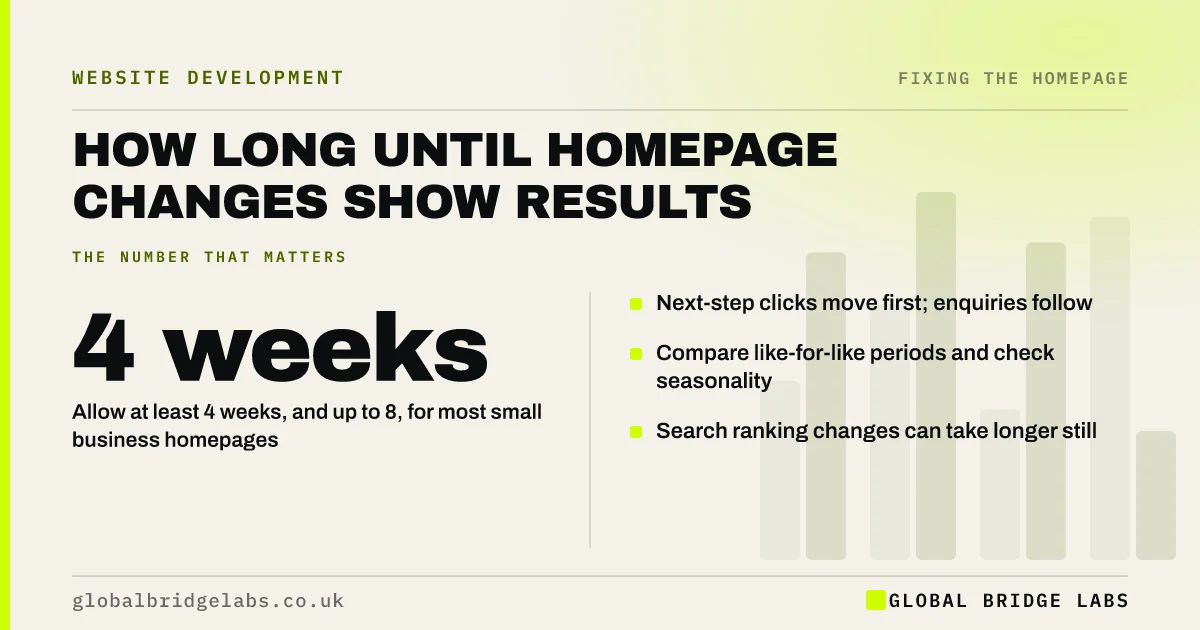
How long website changes take to show results depends on traffic, but for most small business homepages, allow four to eight weeks. Clicks to the next step move first, often within days; enquiries take longer because they are fewer and vary week to week. Compare like-for-like periods and check seasonality before deciding a change worked or failed.
- Allow at least 4 weeks, and up to 8, for most small business homepages.
- Next-step clicks move first; enquiries follow.
- Compare like-for-like periods and check seasonality.
- Search ranking changes can take longer still.
Want help reading your homepage results? Message us on WhatsApp.
Chat on WhatsApp →Why do homepage changes take weeks to show?
Because small business homepages have modest traffic and enquiries vary naturally from week to week. If you get ten enquiries a month, one good or bad week can swing the figure by a third. You need several weeks of data to see a real change through the noise.
What moves first?
Behaviour on the page moves first: clicks on the main button, clicks to service pages and scroll depth can change within days of a clear improvement. Enquiries follow over the next few weeks. Search rankings, if affected, can take longer as Google recrawls and reassesses the page.
How do you compare fairly?
Compare four-week periods before and after, and the same period last year if your business is seasonal. Check homepage sessions too: if traffic fell, enquiries may fall even if the page converts better. Use the change log to make sure nothing else changed.
When can you judge sooner?
You can judge sooner if traffic is high, if the change fixed something broken (a form that did not send) or if the effect is dramatic. You can also check early signals after a week or two, as long as you do not over-read them.
What if nothing changes?
If clicks and enquiries are flat after eight weeks, the change did not address the real problem. Re-score the homepage, check traffic quality and move to the next weakest rung. A flat result is still useful: it tells you where the problem is not.
What does this look like in practice?
A pattern we see: an owner rewrites the headline, sees no new enquiries in the first week and changes it back. With a four-week comparison, button clicks were already up. Patience and a change log turn guesses into evidence. Across our client work, the first measurable result usually arrives within weeks rather than days.
Results timeline checklist
- Record a four-week baseline before changing anything.
- Watch next-step clicks in the first two weeks.
- Judge enquiries after four to eight weeks.
- Compare like-for-like periods and seasons.
- Check traffic volume and the change log.
Next step
Put a reminder in your diary six weeks after your next homepage change, labelled 'compare before and after'.
Message us on WhatsApp to read the results together, or book a 30-minute consultation.
Chat on WhatsApp →Sources and further reading
- About key events · Google Analytics Help
- Performance report (Search results) · Search Console Help
Frequently asked questions
How long does it take to see results from website changes?
For most small business homepages, four to eight weeks for enquiries, because traffic is modest and enquiries vary week to week. On-page behaviour such as button clicks can change within days. Search ranking effects can take longer.
How soon should I check if a homepage change worked?
Look at early signals such as clicks to the next step after a week or two, but judge enquiries after four to eight weeks. Compare with the four weeks before the change and the same period last year if seasonal.
Why have my enquiries not improved after changing my homepage?
The change may not have addressed the real problem, traffic may have fallen, or not enough time has passed. Check traffic, re-score the homepage, check the change log and move to the next weakest part if results stay flat after eight weeks.
Written by

Global Bridge Labs (GBL) is a UK–Sri Lanka partner for social media, websites and BPO. Everything here comes from client delivery, not theory.