On this page
- 01Key takeaways
- 02What is enquiry-to-sale rate?
- 03How do you measure it?
- 04How does the website affect enquiry-to-sale rate?
- 05How does follow-up speed affect it?
- 06What is a typical enquiry-to-sale rate?
- 07When is a high close rate a warning sign?
- 08What does this look like in practice?
- 09Enquiry-to-sale checklist
- 10Next step
- 11Sources and further reading
- 12Frequently asked questions
Key takeaways
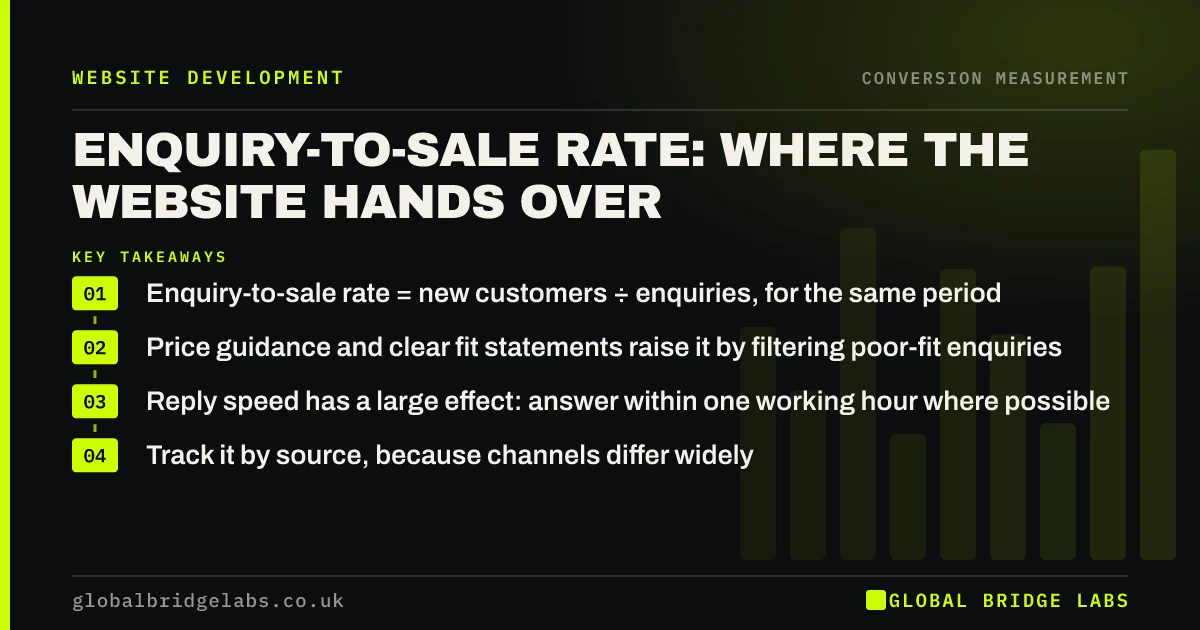
Enquiry-to-sale rate is the share of enquiries that become paying customers. It is where the website hands over to the business, and it is shaped by both. A high-converting website raises it by attracting better-fit buyers and setting clear expectations; slow or inconsistent follow-up lowers it, whatever the website does.
- Enquiry-to-sale rate = new customers ÷ enquiries, for the same period and source.
- Price guidance and clear fit statements raise it by filtering poor-fit enquiries.
- Reply speed has a large effect: answer within one working hour where possible.
- Track it by source, because channels differ widely.
Want your enquiry-to-sale rate measured by channel? Message us on WhatsApp.
Chat on WhatsApp →What is enquiry-to-sale rate?
Enquiry-to-sale rate, sometimes called lead-to-customer rate or close rate, is the percentage of enquiries in a period that become paying customers. It completes the picture that website conversion rate starts: a site might produce many enquiries, but if few become customers, the business is no better off.
How do you measure it?
Record every enquiry with its source and date, then record the outcome: won, lost or still open. A CRM does this well, but a shared spreadsheet works for small teams. Calculate the rate monthly or quarterly, allowing time for longer sales cycles to close.
- Enquiry date, name and source (search, ads, social, referral).
- Service requested and estimated value.
- Outcome: won, lost (with reason) or open.
- Date of first reply.
How does the website affect enquiry-to-sale rate?
The website influences who enquires and what they expect. Pages that give price guidance, areas served and a clear description of who you work with deter poor-fit enquiries. Pages that explain the process and next step mean buyers arrive prepared. Both raise the rate. Vague pages and 'free quote for anyone' offers lower it.
- Poor quality leads from your website: causes and fixes
- When your website and sales process do not match
Want to see which pages send your best-fit enquiries? Ask us on WhatsApp.
Chat on WhatsApp →How does follow-up speed affect it?
Speed of reply is one of the biggest influences on close rate for service businesses. Buyers often enquire with several providers and the first credible reply has an advantage. A thank-you page promising a reply within a set time, and a team that keeps that promise, protects the value the website created.
What is a typical enquiry-to-sale rate?
It varies widely by sector, price and lead source, so compare with your own history rather than an average. As a rough guide from our client work, many UK service SMEs close somewhere between 15% and 40% of website enquiries, with referrals and brand searches closing higher than cold ad traffic.
When is a high close rate a warning sign?
A very high close rate can mean you are underpriced, or that the website is deterring buyers who would have been good customers. If you close almost everything, test whether clearer price guidance or a broader offer would bring more enquiries without much loss in rate.
What does this look like in practice?
A UK landscaping firm's website produced plenty of enquiries, but only about 1 in 10 became a job. Most were for small tidy-ups the firm did not want. Adding 'Projects from £8,000' and examples of typical gardens cut enquiries by a quarter but roughly doubled the close rate, and the owner stopped spending evenings on unwinnable quotes.
Enquiry-to-sale checklist
- Record every enquiry with source and date.
- Record the outcome and loss reason.
- Calculate the rate monthly or quarterly, by source.
- Add price guidance and fit statements to key pages.
- Reply within one working hour where possible.
- Review loss reasons for website fixes.
Next step
Your website's job does not end when the form is sent. The enquiry-to-sale rate shows whether it is attracting the right buyers and whether follow-up protects them. We can help you measure it and improve both sides.
Message us on WhatsApp for an enquiry-to-sale review, or book a 30-minute consultation.
Chat on WhatsApp →Sources and further reading
- About key events · Google Analytics Help
- URL builders: collect campaign data with custom URLs · Google Analytics Help
Frequently asked questions
What is a good lead to customer conversion rate?
It varies by sector, price and lead source. Many UK service SMEs close roughly 15% to 40% of website enquiries in our experience, with referrals and brand searches higher. Compare with your own history and track it by source. Referrals usually close highest.
How do I calculate my enquiry conversion rate?
Divide the number of enquiries that became paying customers by the total number of enquiries in the same period, then multiply by 100. Allow time for longer sales cycles to close before calculating. Calculate it separately for each lead source, because referrals, search and ads often close at very different rates.
Can my website improve my close rate?
Yes. Clear price guidance, service areas and fit statements deter poor-fit enquiries, and explaining the process prepares buyers. Both raise the share of enquiries that become customers. Clear pages also shorten first calls, because buyers arrive knowing the likely price and process, which leaves more time to discuss the job itself.
Does response time affect sales?
Yes. Buyers often contact several providers, and a fast, credible reply gives you an advantage. Set a reply target, such as one working hour, state it on the thank-you page and measure whether it is met. Speed matters most for urgent services.
Written by

Global Bridge Labs (GBL) is a UK–Sri Lanka partner for social media, websites and BPO. Everything here comes from client delivery, not theory.