On this page
- 01Key takeaways
- 02What is the homepage conversion ladder?
- 03What does each rung test?
- 04Why does the order of the rungs matter?
- 05How do you score a homepage on the ladder?
- 06When is the ladder the wrong tool?
- 07What does this look like in practice?
- 08Homepage ladder checklist
- 09Next step
- 10Sources and further reading
- 11Frequently asked questions
Key takeaways
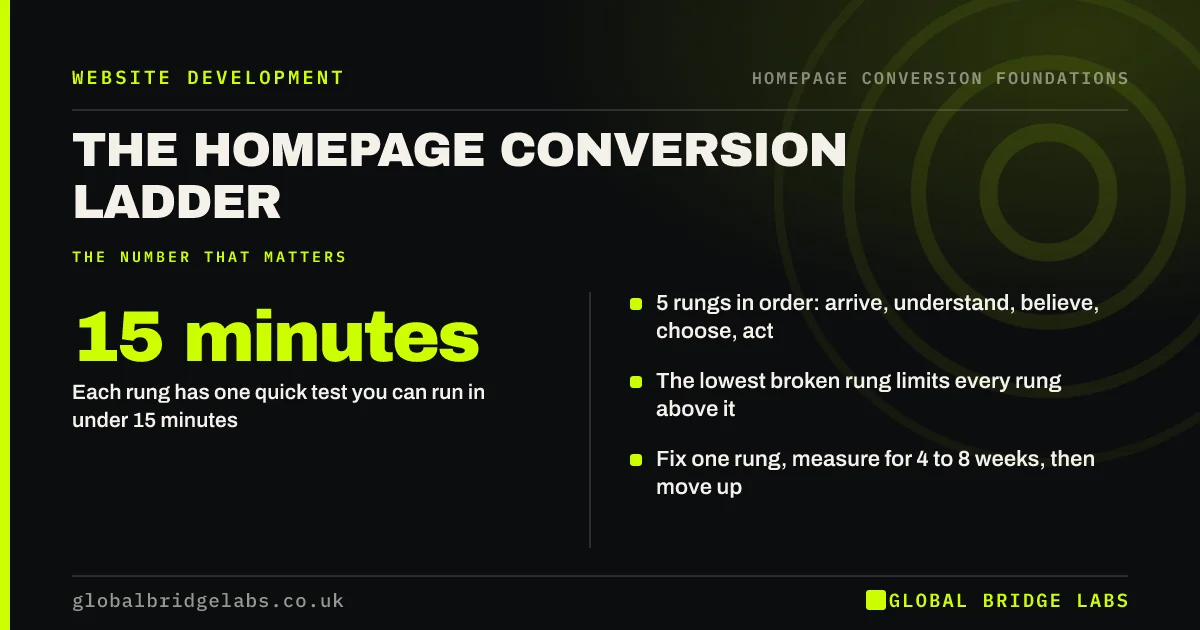
The homepage conversion framework we use is the GBL Homepage Ladder: arrive, understand, believe, choose, act. A visitor must climb each rung in order, so the lowest broken rung caps everything above it. Test the rungs from the bottom up and fix only the first one that fails, then test again.
- 5 rungs in order: arrive, understand, believe, choose, act.
- The lowest broken rung limits every rung above it.
- Each rung has one quick test you can run in under 15 minutes.
- Fix one rung, measure for 4 to 8 weeks, then move up.
Want the ladder run on your homepage? Message us on WhatsApp.
Chat on WhatsApp →What is the homepage conversion ladder?
The homepage conversion ladder is a five-step model of what a visitor must do before they enquire: arrive on a working page, understand what you offer, believe you can deliver, choose a next step and act on it. Global Bridge Labs (GBL) uses it to diagnose homepages because it turns a vague problem into one specific broken step.
What does each rung test?
Each rung has one question and one quick test. If the test fails, that is the rung to fix.
- Arrive: are the right people reaching a page that loads? Test: GA4 sources plus a phone load time.
- Understand: can a stranger say what you do, for whom and where in 20 seconds? Test: show the first screen to someone outside the business.
- Believe: is there specific proof near the top? Test: count reviews, real work and named accreditations in the first two screens.
- Choose: is one action clearly the main one? Test: ask someone which button they would press.
- Act: does the route work end to end? Test: enquire yourself on a phone and time the reply.
Why does the order of the rungs matter?
Order matters because each rung only has an audience if the rung below works. Better proof does nothing for visitors who left because they could not tell what you do, and a better form does nothing if nobody reaches it. Businesses that redesign everything at once usually fix rung four and five beautifully while rung two stays broken.
Working bottom up also keeps changes small. You change one thing, so you can tell whether it worked.
How do you score a homepage on the ladder?
Score each rung 0, 1 or 2: 0 means the test fails, 1 means it partly works, 2 means it clearly works. A total of 8 to 10 means the homepage is sound and the problem is probably elsewhere; 5 to 7 means one or two rungs need work; 4 or below means start with the message before anything else. These bands are GBL working rules of thumb, not an industry standard.
When is the ladder the wrong tool?
The ladder assumes the homepage is a front door. If most visitors land on inner pages from ads or articles, apply the same five rungs to those pages instead. It also assumes there is demand: if almost nobody visits, the problem is visibility, and no ladder will create enquiries from traffic you do not have.
What does this look like in practice?
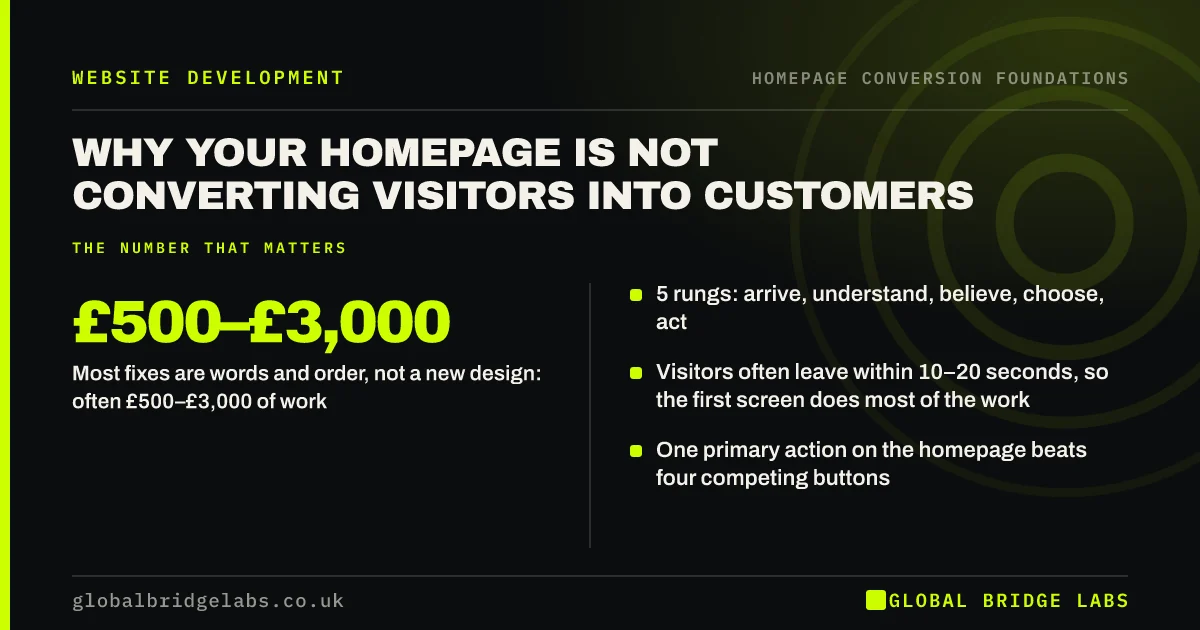
A pattern we see often: an owner is sure the problem is the design, but the ladder test shows visitors understand the page and trust it; they simply cannot find a button that says what happens next. Changing one hero button and the words beside it is a two-hour job, against a redesign quoted at several thousand pounds.
Homepage ladder checklist
- Arrive: check sources in GA4 and time a phone load.
- Understand: run the 20-second stranger test on the first screen.
- Believe: count specific proof in the first two screens.
- Choose: ask which button a stranger would press.
- Act: enquire yourself and time the reply.
- Score each rung 0 to 2 and fix the lowest first.
Next step
Write the five rung names on a page, run the five tests this week and score each one. Fix only the first rung that scores 0 or 1.
Message us on WhatsApp for the ladder score sheet, or book a 30-minute consultation.
Chat on WhatsApp →Sources and further reading
- How long do users stay on web pages? · Nielsen Norman Group
- About key events · Google Analytics Help
- Why you only need to test with 5 users · Nielsen Norman Group
Frequently asked questions
What is a homepage conversion framework?
It is a structured way to check why a homepage does or does not turn visitors into enquiries. The GBL Homepage Ladder uses five steps in order: arrive, understand, believe, choose and act. You test each step and fix the first one that fails before moving on.
Which rung of the ladder fails most often?
Understand fails most often on small business homepages, because the first screen carries a slogan, a welcome line or a stock photo instead of a clear statement of what the business does, for whom and where. It is also the cheapest rung to fix, usually with words alone.
Can I use the ladder on pages other than the homepage?
Yes. Any page that receives first-time visitors, such as a service page reached from Google or a landing page reached from an advert, has to pass the same five rungs. Start with the pages that receive the most entrances in GA4.
Written by

Global Bridge Labs (GBL) is a UK–Sri Lanka partner for social media, websites and BPO. Everything here comes from client delivery, not theory.