On this page
- 01Key takeaways
- 02Why does the journey after the enquiry matter?
- 03What should the confirmation page say?
- 04What should the first automated email do?
- 05How fast should you reply to a website enquiry?
- 06How should the first call continue the website journey?
- 07When can the post-enquiry journey be simple?
- 08What does this look like in practice?
- 09Post-enquiry checklist
- 10Next step
- 11Sources and further reading
- 12Frequently asked questions
Key takeaways
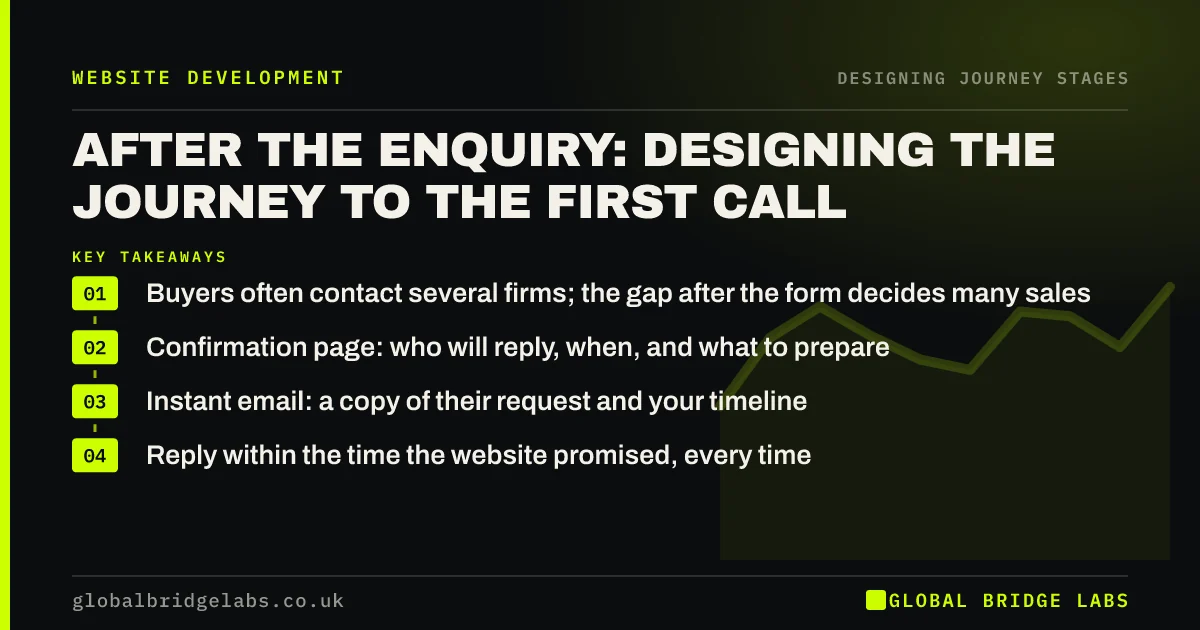
The customer journey does not end when the form is sent. Between the enquiry and the first conversation, buyers are often still talking to competitors. Design that gap: a confirmation page that says what happens next, an instant confirmation email, a reply within a stated time, and a first call that picks up where the website left off. Many lost buyers are lost here, not on the site.
- Buyers often contact several firms; the gap after the form decides many sales.
- Confirmation page: who will reply, when, and what to prepare.
- Instant email: a copy of their request and your timeline.
- Reply within the time the website promised, every time.
Want your post-enquiry journey tested? Submit a test enquiry and tell us on WhatsApp.
Chat on WhatsApp →Why does the journey after the enquiry matter?
The journey after the enquiry matters because the buyer has not yet committed. Many enquire with two or three firms at once, and the first useful reply often wins. A website that turns visitors into enquiries but hands them to a slow or vague follow-up wastes the work of every page before it.
What should the confirmation page say?
The confirmation page should confirm the request was received, say who will reply and by when, explain the next steps, and offer something useful while they wait, such as a price guide or what to prepare. It is also the right place to give a phone number for urgent cases. 'Thanks, we will be in touch' leaves buyers uncertain.
- Confirmation: 'We have your request'.
- Timing: 'We reply within two working hours, Monday to Friday'.
- Next steps: call, survey, quote, with typical timescales.
- Preparation: photos, measurements or documents to have ready.
- Urgent option: a phone number.
What should the first automated email do?
The first automated email should arrive within a minute, repeat the buyer's request so they can check it, restate the reply time and next steps, and come from a named person or monitored address they can reply to. Check it lands in inboxes rather than spam, and that it reads well on a phone.
How fast should you reply to a website enquiry?
Reply as fast as you can do it well, and never later than the website promises. For urgent services, minutes matter. For considered purchases, a same-day personal reply is a sound target during business hours. The most important rule is consistency: a promise of two hours that is met beats a promise of 15 minutes that is often broken.
How should the first call continue the website journey?
The first call should continue where the website left off. The person calling should see what the buyer asked, which page they came from and what they selected, so the buyer does not have to repeat themselves. It should follow the steps the website described, so the experience matches the promise.
Want your form to send the page and answers to whoever calls back? Message us on WhatsApp.
Chat on WhatsApp →When can the post-enquiry journey be simple?
It can be simple when one person handles every enquiry and replies quickly, such as a sole trader who answers within the hour. Even then, a clear confirmation page and an automated email help, because they reassure the buyer during the wait and reduce chasing calls.
What does this look like in practice?
A pattern we see when we submit test enquiries: the confirmation page says 'Thank you', no email arrives, and the reply comes two days later from a different name than the website shows. By then the buyer has spoken to someone else.
A specific confirmation page, an instant email and an agreed reply window are cheap and change the outcome of enquiries already won by the website. Across our client work we have seen a 2.4x enquiry rate from conversion changes of this kind. Global Bridge Labs (GBL) tests the journey after the form on every project.
Post-enquiry checklist
- Submit a test enquiry from your phone.
- Rewrite the confirmation page with timing and next steps.
- Send an instant confirmation email with their request.
- Set a reply time you can always meet, and publish it.
- Pass the source page and answers to whoever replies.
- Check the first call matches the website's promise.
Next step
Enquiries lost after the form are invisible in website analytics. We will test your journey from submit to first call and show where buyers wait.
Message us on WhatsApp to test your post-enquiry journey, or book a 30-minute consultation.
Chat on WhatsApp →Sources and further reading
- Structuring forms · GOV.UK Service Manual
- Service blueprints: definition · Nielsen Norman Group
- About key events · Google Analytics Help
Frequently asked questions
What should happen after someone submits a contact form?
They should see a confirmation page saying who will reply, when and what happens next; receive an instant email repeating their request; and get a personal reply within the time the website promised. The first call should pick up from the details they gave.
How quickly should I respond to website enquiries?
As quickly as you can do it well, and always within the time your website states. For urgent services that means minutes; for considered purchases, a same-day personal reply in business hours is a sound target. Keeping a realistic promise matters more than a fast one that is often missed.
What should an enquiry confirmation email include?
A copy of the buyer's request, your reply time, the next steps, a named contact or monitored reply address, and a phone number for urgent cases. Send it within a minute and check it lands in inboxes rather than spam.
Written by

Global Bridge Labs (GBL) is a UK–Sri Lanka partner for social media, websites and BPO. Everything here comes from client delivery, not theory.