On this page
- 01Key takeaways
- 02What are the main signs a business needs to outsource?
- 03How do you tell a capacity problem from a bad month?
- 04Which signs point to fixing the process first?
- 05How many signs do you need before acting?
- 06What do these signs cost if you ignore them?
- 07When are these signs not a reason to outsource?
- 08Which signs show up first in different businesses?
- 09What does this look like in practice?
- 10Signs checklist
- 11Next step
- 12Sources and further reading
- 13Frequently asked questions
Key takeaways
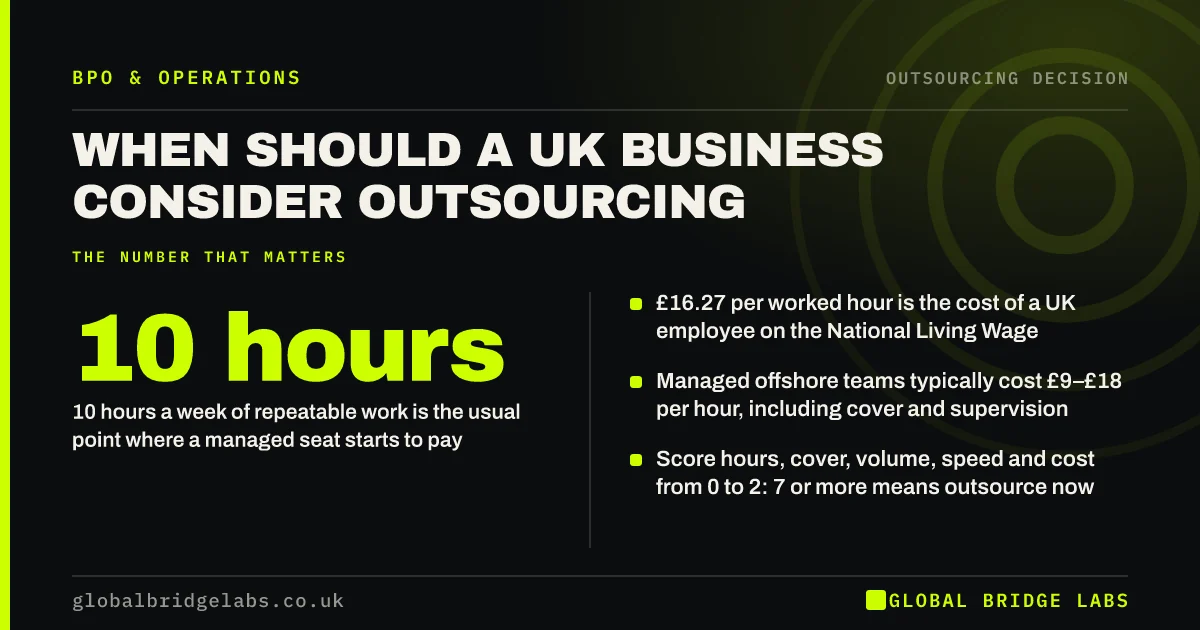
The signs you need to outsource are sustained, not occasional: repeatable work eating 10 or more hours a week of senior time, replies slipping past one working day, no cover for holidays, and recruitment that keeps failing. If two or more have lasted a full quarter, the business has outgrown its current capacity.
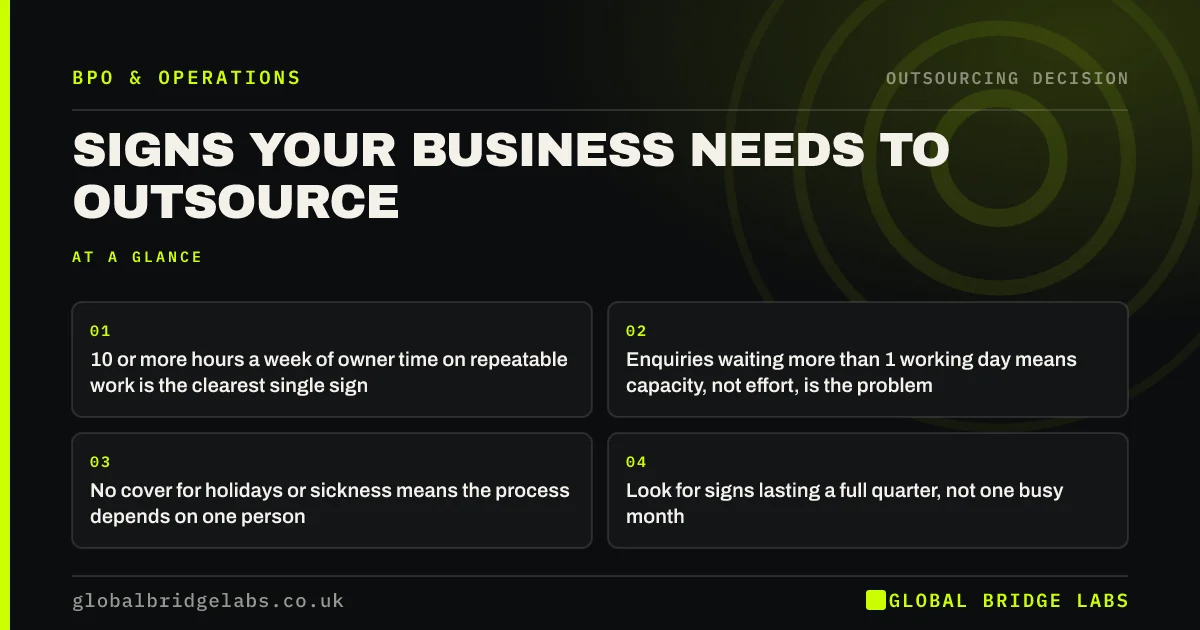
- 10 or more hours a week of owner time on repeatable work is the clearest single sign.
- Enquiries waiting more than 1 working day means capacity, not effort, is the problem.
- No cover for holidays or sickness means the process depends on one person.
- Look for signs lasting a full quarter, not one busy month.
Recognise three or more of these? Message us on WhatsApp and we will tell you which one to fix first.
Chat on WhatsApp →What are the main signs a business needs to outsource?
The main signs a business needs to outsource are that repeatable work is taking senior time, customers are waiting, and nobody can cover when a key person is away. These are capacity signals. They show that the way the work is organised, not the effort of the team, has become the limit on growth.
- The owner works evenings and weekends on email, quotes and invoices.
- Skilled or fee-earning staff spend hours a week on admin.
- Enquiries and customer emails regularly wait until the next day.
- A holiday or sick day leaves the phones or inbox uncovered.
- Work piles up in busy weeks and the team is idle in quiet ones.
- Job adverts for admin or support roles attract few suitable applicants.
- Errors and missed follow-ups have increased as volume has grown.
- Overtime has become normal rather than occasional.
How do you tell a capacity problem from a bad month?
Measure it over time. A bad month is a spike that clears; a capacity problem is a pattern that repeats. Track three numbers for 12 weeks: hours spent on repeatable work, time to first reply, and work carried over to the next week. If all three trend the wrong way, it is capacity.
Write the numbers down weekly. Owners consistently underestimate time spent on admin by several hours, which is why a short time log is more reliable than memory.
Which signs point to fixing the process first?
Some signs look like capacity but are really process problems. If work is slow because nobody agrees how to do it, because information arrives incomplete, or because approvals sit with one person, outsourcing will not fix it. Fix the process first, then decide.
- The same task is done three different ways by three people.
- Work waits on the owner's approval rather than on capacity.
- Customers send incomplete information and staff chase it every time.
- A tool is broken or missing, such as no shared inbox or no booking system.
How many signs do you need before acting?
Two sustained signs are enough to investigate, and three are usually enough to act. One sign on its own, such as a single slow month, can often be handled with a temporary fix. Several signs together mean the problem will not clear on its own and is costing you customers or margin.
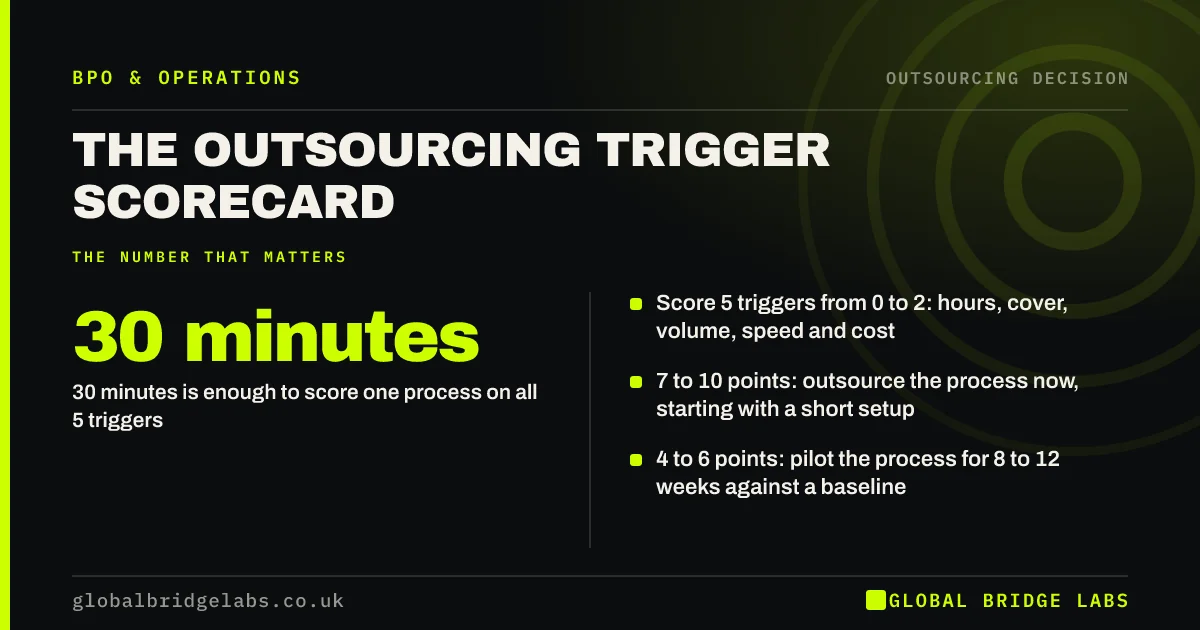
Score the signs on the GBL Outsourcing Trigger Scorecard to turn a feeling into a number you can share with a partner or the team.
Want a quick score for your business? Send us your top three signs on WhatsApp.
Chat on WhatsApp →What do these signs cost if you ignore them?
They cost owner time, lost enquiries and staff. An owner who spends 12 hours a week on admin loses about 540 hours a year once holidays are taken out. Slow replies send buyers to competitors, and overloaded teams leave, which restarts recruitment at the worst possible moment.
The Institute of Customer Service's UK Customer Satisfaction Index was 78.3 out of 100 in July 2026, and prompt, first-time resolution consistently separates the highest-scoring organisations from the rest.
When are these signs not a reason to outsource?
When the overloaded work is the core of what you sell, needs judgement on every case, or must be done in person. A busy senior engineer is a reason to hire another engineer, not to outsource engineering. Outsource the repeatable work around them instead.
Which signs show up first in different businesses?
The first sign depends on how customers reach you. Businesses that live on the phone see missed calls first; online businesses see email backlogs; professional firms see fee earners doing admin. Knowing your likely first sign helps you spot it a quarter earlier.
- Trades and construction: missed calls while on site, quotes sent days late.
- E-commerce: order status emails piling up, weekend backlogs after peaks.
- Professional services: fee earners chasing documents at charge-out rates.
- Clinics: phones unanswered during appointments, booking gaps.
- Logistics: delivery queries and proof-of-delivery chasing crowding out planning.
- Hospitality: booking enquiries unanswered during service.
What does this look like in practice?
A pattern we see in UK trades firms: the owner quotes during the day, returns calls from the van, and does invoices on Sunday. Three signs are present at once: owner hours, slow replies and no cover. Moving call handling and invoicing to a managed team usually clears two of the three within the first month.
Signs checklist
Tick each sign that has lasted at least a full quarter.
- Owner spends 10 or more hours a week on repeatable work.
- Customer replies regularly take more than one working day.
- No cover for holidays or sickness on phones, inbox or invoicing.
- Volume swings of more than 30% between busy and quiet weeks.
- Admin or support recruitment has failed or hires have left.
- Errors or complaints have risen with volume.
- Overtime is routine.
Next step
Send us the signs you ticked. We will tell you which process to look at first and whether outsourcing, hiring or a process fix is the right answer. 30 minutes, no pitch.
Message us on WhatsApp with your ticked signs, or book a 30-minute consultation.
Chat on WhatsApp →Sources and further reading
- UK Customer Satisfaction Index · Institute of Customer Service
- National Minimum Wage and National Living Wage rates · GOV.UK
- Rates and thresholds for employers 2026 to 2027 · HM Revenue & Customs
Frequently asked questions
How do I know if my business needs to outsource?
Look for sustained capacity signals: repeatable work taking 10 or more hours a week of senior time, customer replies slipping past one working day, no holiday cover, and failed recruitment. If two or more have lasted a full quarter, outsourcing one process is worth testing.
Is being busy a sign I should outsource?
Not on its own. Busy is fine if the work is the right work. It becomes a sign when senior people are busy with repeatable tasks, customers are waiting, or the workload swings so much that you are overloaded one week and idle the next.
What should I do before outsourcing?
Log two weeks of tasks, pick the repeatable process that takes most time, check it is stable, and write it down. Measure a baseline for reply time or cost per task so you can tell whether outsourcing has worked.
Can outsourcing fix a messy process?
Rarely. A provider will run the process you give it. If the process is unclear, the provider inherits the confusion. Document and simplify first, then outsource. A good provider will help you write it down during setup.
Written by

Global Bridge Labs (GBL) is a UK–Sri Lanka partner for social media, websites and BPO. Everything here comes from client delivery, not theory.