On this page
- 01Key takeaways
- 02What is the difference between a virtual assistant and BPO?
- 03How do a VA and BPO compare?
- 04What do VAs and BPO cost?
- 05When is a virtual assistant the better choice?
- 06When is BPO the better choice?
- 07What about data protection?
- 08Can you use both?
- 09What does this look like in practice?
- 10Checklist: VA or BPO?
- 11Next step
- 12Sources and further reading
- 13Frequently asked questions
Key takeaways
Virtual assistant vs BPO is a choice between one flexible person and a managed process. A freelance virtual assistant (VA) suits varied, low-volume tasks for one person. A BPO provider suits repeatable work that needs cover, service levels, quality checks and continuity when someone leaves.
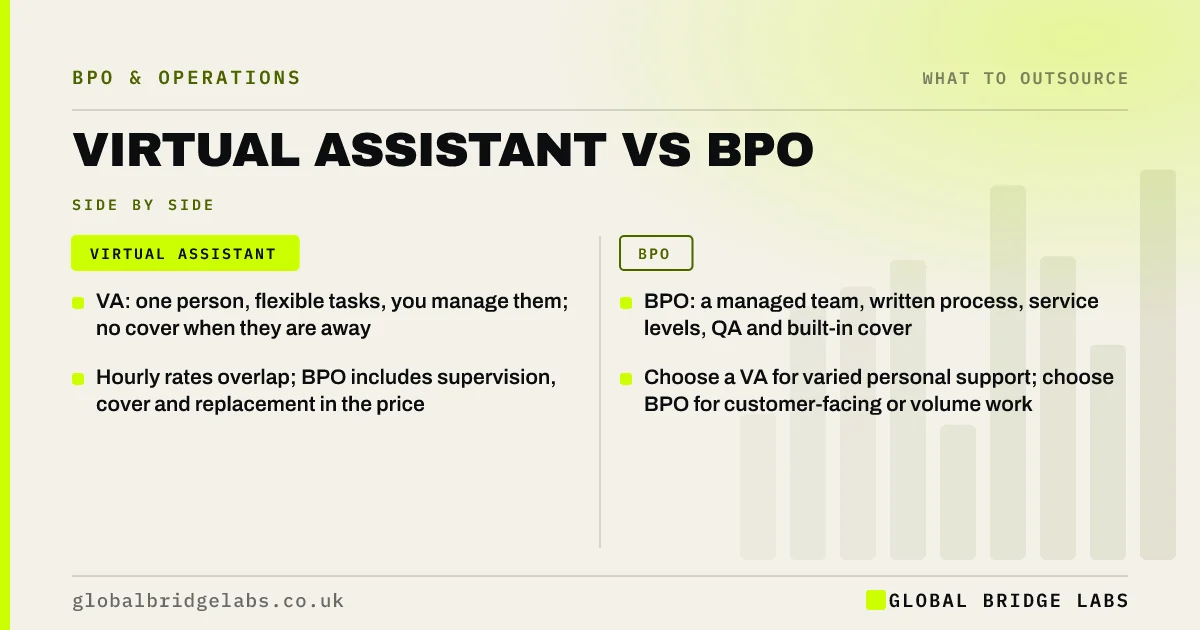
- VA: one person, flexible tasks, you manage them; no cover when they are away.
- BPO: a managed team, written process, service levels, QA and built-in cover.
- Hourly rates overlap; BPO includes supervision, cover and replacement in the price.
- Choose a VA for varied personal support; choose BPO for customer-facing or volume work.
- Either way, UK GDPR needs a contract whenever personal data is handled.
Not sure whether you need a VA or a team? Message us on WhatsApp with the tasks and we will tell you honestly.
Chat on WhatsApp →What is the difference between a virtual assistant and BPO?
A virtual assistant is an individual, usually self-employed, who provides remote support on tasks you set. Business process outsourcing (BPO) is a service in which a provider runs a defined process with a managed team, to agreed service levels, handling recruitment, supervision, quality and cover.
The core difference is who owns the outcome. With a VA, you manage the person and the process lives with them. With BPO, the provider manages the people and the process is written down and measured.
How do a VA and BPO compare?
The comparison below assumes ongoing support rather than a one-off project.
- Management: VA managed by you; BPO managed by the provider's team lead.
- Cover: VA has none when sick or on holiday; BPO includes trained cover.
- Quality: VA self-checked; BPO sampled and scored against a procedure.
- Continuity: VA leaving takes the knowledge; BPO replaces people without a gap.
- Scope: VA handles varied tasks; BPO handles defined processes at volume.
- Contracts: VA terms vary; BPO usually offers service levels and processor contracts.
What do VAs and BPO cost?
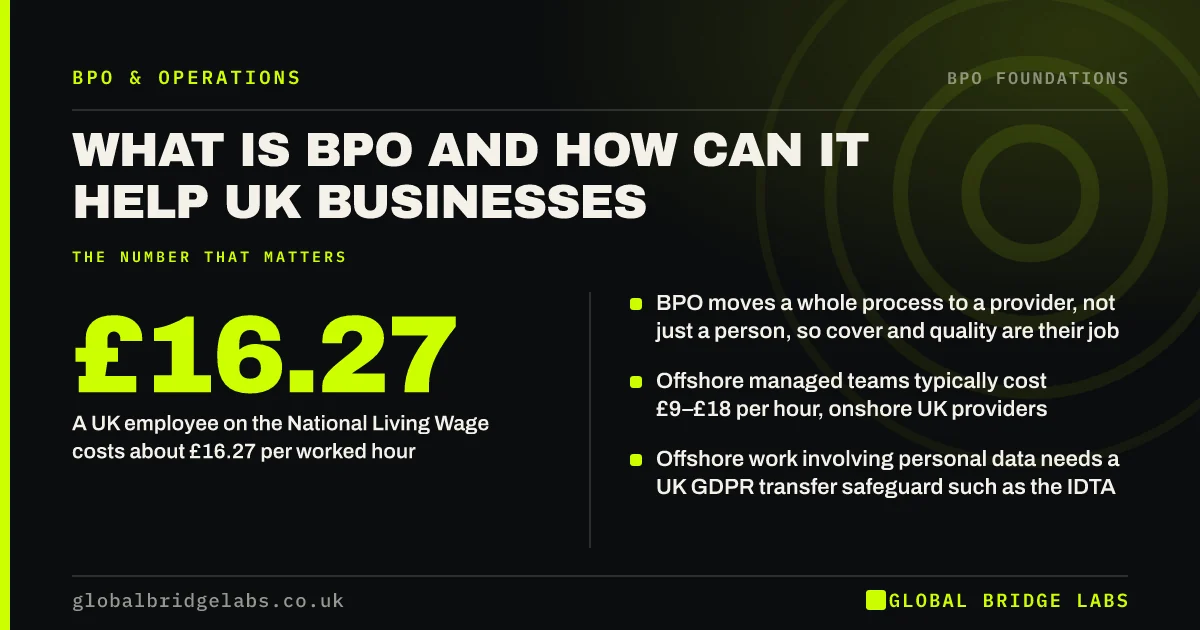
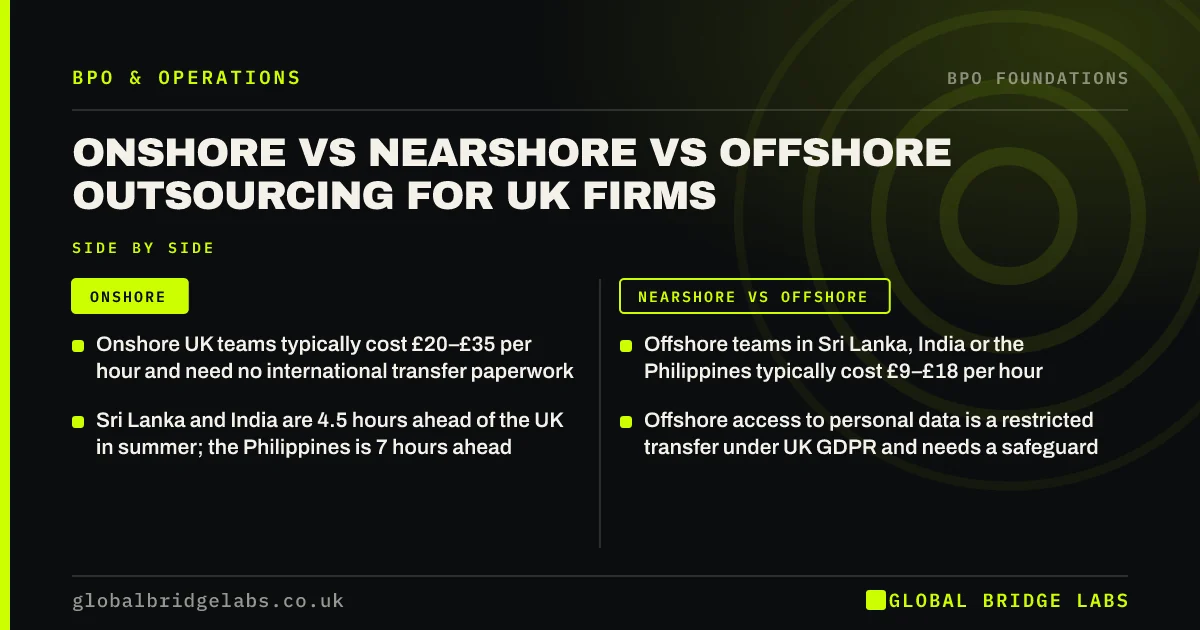
Rates overlap widely. UK-based freelance VAs commonly charge more per hour than offshore VAs, and managed offshore BPO typically costs around £9–£18 per hour, with onshore UK providers around £20–£35, as indicative market ranges. The difference is what is included: a BPO rate covers supervision, quality checks, cover and replacement.
Hidden costs sit on the VA side: your time managing them, gaps when they are unavailable, and starting again when they move on. For customer-facing work, a single gap can cost more than months of rate difference.
Want a VA and a managed team costed side by side for your tasks? Send us the list on WhatsApp and we will discuss your requirements.
Chat on WhatsApp →When is a virtual assistant the better choice?
A VA is the better choice for varied, low-volume support for one person: diary management, travel booking, research, document formatting and ad hoc admin. VAs are flexible, quick to start and good value when the work changes week to week and does not need cover.
When is BPO the better choice?
BPO is the better choice when the work is customer-facing, time-sensitive or high-volume, when it needs cover across full trading hours, or when mistakes are costly. Call answering, customer support, bookings, order processing and credit control all fall here.
It is also the better choice when you have already lost a VA and had to start again. That experience is usually a sign the work has become a process that needs to outlast any one person.
What about data protection?
Both routes involve personal data, so UK GDPR applies either way. A VA handling your customers' data is a processor and needs a written contract covering the points the ICO lists. If the VA or team is outside the UK, remote access is a restricted transfer that needs a safeguard such as the International Data Transfer Agreement.
In practice, managed providers are more likely to have these documents, access controls and security training in place. With a freelancer, you will usually need to supply them.
Can you use both?
Yes. A common pattern is a VA supporting the owner personally, and a BPO team running customer-facing and volume processes for the business. The VA handles judgement-heavy, varied tasks; the team handles repeatable work with cover and service levels.
What does this look like in practice?
A pattern we see often: a business hires a VA for "admin", and over a year the VA ends up answering customer calls, WhatsApp and bookings. When the VA leaves, the business discovers that nobody else knows how any of it works. Documenting those processes and moving them to a managed team, while keeping a VA for the owner's own diary, fixes the dependency.
Checklist: VA or BPO?
Answer these for the work you want to hand over.
- Is the work varied or a repeatable process?
- Is it for one person or for customers?
- Does it need cover across full trading hours?
- What happens if the person is away for two weeks?
- Who will check the quality of the work?
- Who will supply the data protection contract?
Next step
Send us the tasks you want to hand over and we will tell you which suit a VA, which suit a managed team, and what each would cost. 30 minutes, no pitch.
Message us on WhatsApp with your task list, or book a 30-minute consultation.
Chat on WhatsApp →Sources and further reading
- Contracts and liabilities between controllers and processors · Information Commissioner's Office
- International transfers of personal data · Information Commissioner's Office
- Controllers and processors · Information Commissioner's Office
Frequently asked questions
Is a virtual assistant cheaper than BPO?
Sometimes per hour, but not always overall. A freelance VA's rate excludes supervision, quality checks and cover, which a BPO rate includes. For varied, low-volume personal support a VA is usually better value; for customer-facing or high-volume work, gaps in cover often make BPO cheaper in practice.
What happens if my virtual assistant leaves?
Unless their work is documented, the knowledge leaves with them and you start again. That is the main risk of relying on one person. Write down every recurring task as they do it. A BPO provider handles this by design, with written procedures and trained cover.
Can a virtual assistant answer customer calls?
Yes, but a single VA cannot answer two calls at once, cover their own breaks or work when ill. For occasional calls that is fine. For a business line where missed calls mean lost work, a managed team with cover and service levels is more reliable.
Do I need a contract with a virtual assistant?
Yes. Beyond commercial terms, if the VA handles personal data you need a controller-processor contract under UK GDPR, covering instructions, confidentiality, security, sub-processors, audit and data return. If the VA is outside the UK, a transfer safeguard is also required.
Written by

Global Bridge Labs (GBL) is a UK–Sri Lanka partner for social media, websites and BPO. Everything here comes from client delivery, not theory.