On this page
- 01Key takeaways
- 02What are the signs you waited too long to outsource?
- 03How do you outsource in a hurry without making things worse?
- 04What should you do with the existing backlog?
- 05What should stay in-house during catch-up?
- 06How do you tell customers during catch-up?
- 07What are the risks of outsourcing in a crisis?
- 08How do you stop it happening again?
- 09How do you choose a provider in a hurry?
- 10What does this look like in practice?
- 11Catch-up checklist
- 12Next step
- 13Sources and further reading
- 14Frequently asked questions
Key takeaways
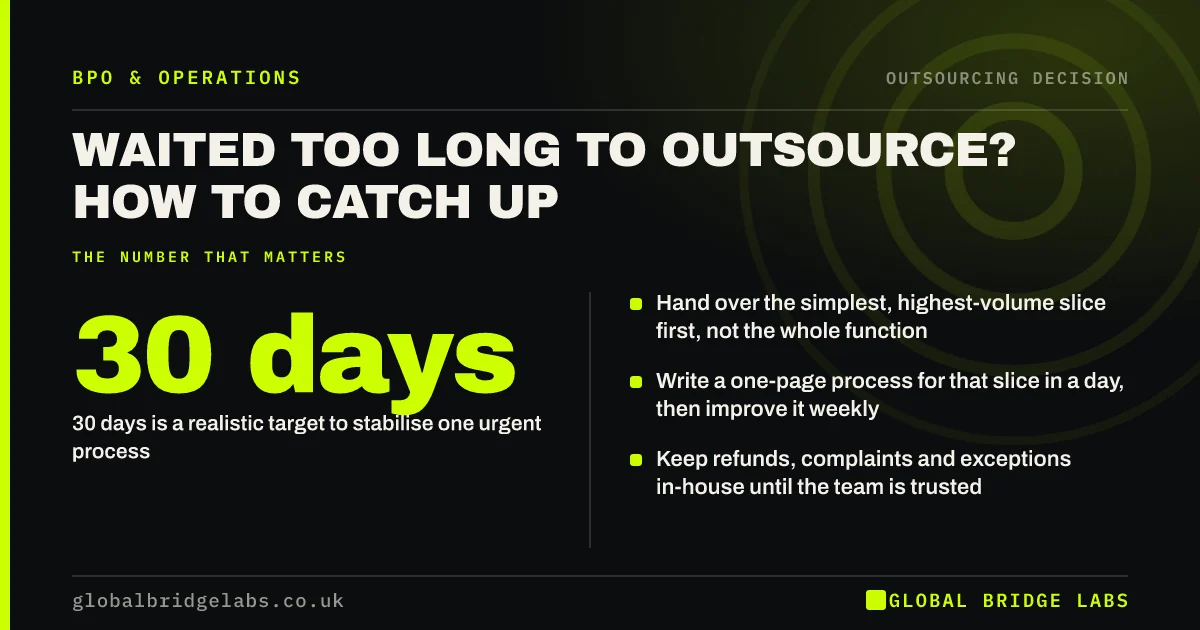
If you waited too long to outsource, do not hand over everything at once. Triage the backlog, outsource the simplest high-volume slice first with a one-page process, keep judgement calls in-house, and aim to stabilise within 30 days. Then add the next process from a position of control.
- 30 days is a realistic target to stabilise one urgent process.
- Hand over the simplest, highest-volume slice first, not the whole function.
- Write a one-page process for that slice in a day, then improve it weekly.
- Keep refunds, complaints and exceptions in-house until the team is trusted.
Already overloaded? Message us on WhatsApp and tell us what is on fire.
Chat on WhatsApp →What are the signs you waited too long to outsource?
You waited too long when the backlog grows every week, customers chase you before you reply, staff are working routine overtime or leaving, and the owner is doing admin late at night. At that point, outsourcing is still the right move, but it has to be done differently from a planned handover.
How do you outsource in a hurry without making things worse?
Narrow the scope. Pick one slice of work that is high volume, low judgement and easy to check, such as first replies to enquiries, order status emails or data entry. Write a one-page process for it, hand it over, and review the first 50 items personally. Speed comes from a small scope, not a big one.
- Day 1: list the backlog by type and pick the simplest high-volume slice.
- Day 2: write a one-page process with the ten most common cases.
- Days 3 to 10: supervised work with daily checks.
- Days 10 to 30: weekly reviews, then decide on the next slice.
Want help picking the first slice? Send us your backlog types on WhatsApp.
Chat on WhatsApp →What should you do with the existing backlog?
Separate the backlog from the flow. New work goes to the outsourced team from day one so the backlog stops growing. The backlog itself is triaged: urgent items handled in-house, simple items batched for the team, and stale items closed with a polite update. Clearing old work and handling new work at the same time is how teams fall further behind.
What should stay in-house during catch-up?
Keep complaints, refunds, exceptions and anything involving money or legal risk in-house until the outsourced team has a track record. These cases need judgement and carry the most risk if handled wrongly. As the team proves accuracy, move clear-cut categories across one at a time.
How do you tell customers during catch-up?
Tell them honestly and briefly. A short message acknowledging delays and giving a realistic reply time reduces chasers, which frees capacity. Update your auto-reply, voicemail and website with the current response time, and stick to it.
What are the risks of outsourcing in a crisis?
The main risks are poor early quality, data protection shortcuts and choosing the first provider who answers. Do not skip the processor contract or give shared logins to save a day. Check that the provider can start with a small scope on short terms, so a rushed choice is not a long commitment.
How do you stop it happening again?
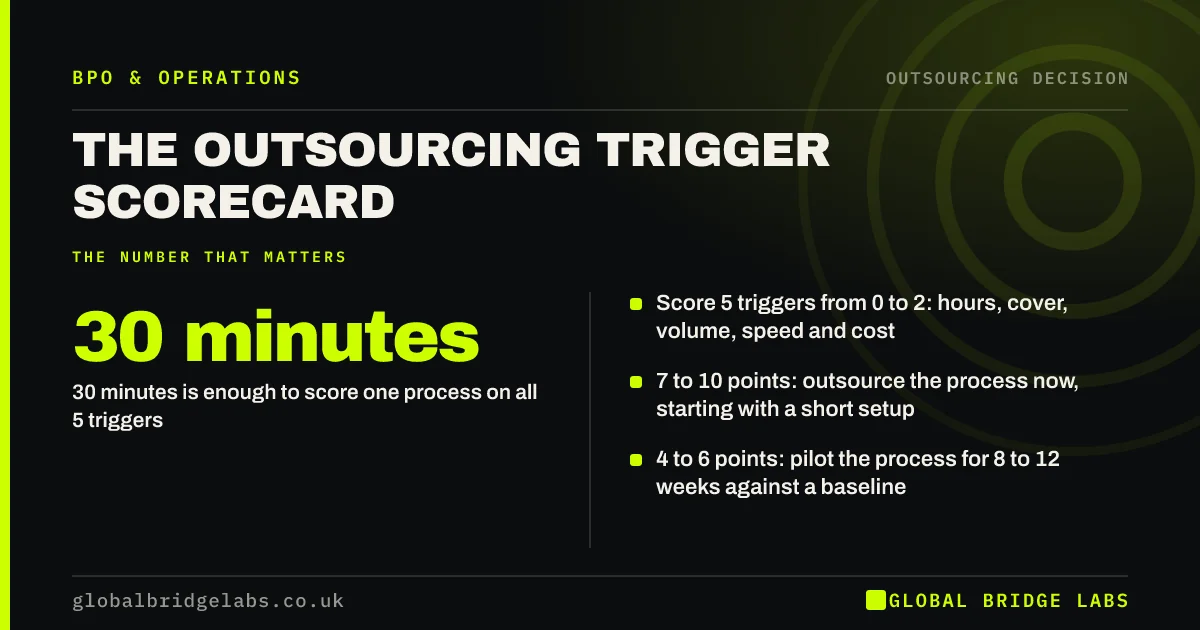
Put a quarterly check in the diary. Score each repeatable process on hours, cover, volume, speed and cost, and act when a score passes 4 rather than when the team is at breaking point. Growing businesses cross outsourcing thresholds regularly; the aim is to see each one coming a quarter early.
Keep the documentation alive too. Every process you wrote in a hurry during catch-up should be improved from the team's questions, so the next handover starts from a proper procedure rather than a crisis.
How do you choose a provider in a hurry?
Prioritise short terms, a small starting scope and evidence the provider can start within two weeks. Ask who will actually do the work, how they handle data protection, and what happens if the first month goes badly. A provider that insists on a long minimum term before you have seen any work is the wrong choice under pressure.
- Can you start one process within two weeks?
- Will you work on 30-day or similar notice terms?
- Who is the named team lead and how do we reach them?
- Will you sign a processor contract before any data is shared?
What does this look like in practice?
A pattern we see in UK e-commerce brands after a strong launch: 600 unanswered emails, most of them asking where an order is. Handing over order status replies first, with a one-page process and read-only access to the order system, usually removes most of the new volume within the first fortnight while the team clears the rest.
Catch-up checklist
Work through these in order.
- List the backlog by type and volume.
- Pick one simple, high-volume slice to hand over.
- Write a one-page process with the most common cases.
- Sign the processor contract and set up individual logins.
- Route new work to the team; triage the backlog separately.
- Review the first 50 items personally.
- Add the next slice only once the first is stable.
Next step
If you are behind now, tell us what the backlog looks like. We will suggest the first slice to hand over and what a 30-day plan could look like.
Message us on WhatsApp with your backlog, or book a 30-minute consultation.
Chat on WhatsApp →Sources and further reading
- Contracts and liabilities between controllers and processors · Information Commissioner's Office
- UK Customer Satisfaction Index · Institute of Customer Service
- Maximum weekly working hours · GOV.UK
Frequently asked questions
Can I outsource if I am already overwhelmed?
Yes, but narrow the scope. Hand over one simple, high-volume slice of work first, with a one-page process and personal checks on the first 50 items. Keep complaints and exceptions in-house until the team is trusted. Aim to stabilise that slice within 30 days.
How quickly can outsourcing reduce a backlog?
Routing new work to an outsourced team stops the backlog growing from day one. Clearing the existing backlog depends on its size and complexity, but simple, high-volume categories often clear within two to four weeks once a trained team is working through them.
Should I skip documentation to outsource faster?
No, but keep it short. A one-page process covering the ten most common cases is enough to start. Improve it weekly from the questions the team asks. Skipping documentation entirely means every answer lives in your head, and the backlog comes back.
Written by

Global Bridge Labs (GBL) is a UK–Sri Lanka partner for social media, websites and BPO. Everything here comes from client delivery, not theory.